



Moldeo de plástico automotriz: Interior, Exterior, y Guía de Piezas Estructurales
Automotive plastic molding is used to produce interior, exterior, and structural vehicle components with different tooling, Material, and durability requirements. Interior parts focus on cosmetic finish quality, exterior parts need UV and impact resistance, and structural components require reinforced materials, Tolerancias más estrictas, and stronger mold engineering for long-term performance.
Modern vehicles depend on molded plastic parts far beyond simple trim pieces. Paneles, bumpers, battery housings, Cuadros, and under-hood assemblies all rely on different tooling strategies and material choices. That’s why automotive suppliers don’t treat every mold the same way. A cosmetic dashboard panel and a structural EV battery housing may use similar molding processes, but their engineering priorities are completely different.
What is automotive plastic molding?
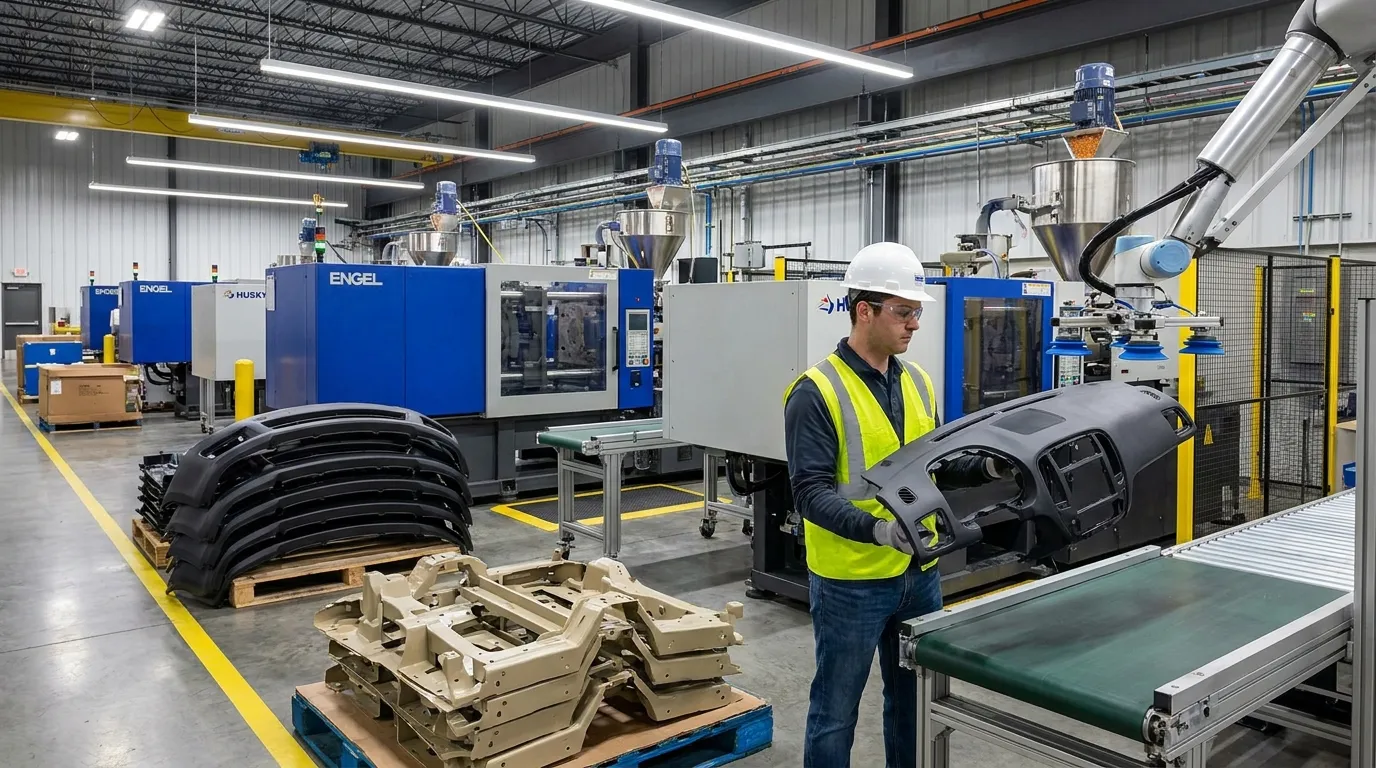
Automotive plastic molding uses injection molds to mass-produce precise vehicle components with repeatable quality. It is widely used for dashboards, bumpers, Alojamientos, Acabados, and structural support parts because it supports complex geometries, lightweighting, and scalable production.
Automotive injection molding works by forcing molten plastic into a precision mold cavity under pressure. Tras el enfriamiento, the part ejects with consistent dimensions and repeatable geometry. This process supports high-volume production with tight tolerances, which is essential for vehicle manufacturing.
Car manufacturers use molded plastics because they reduce weight and support complex part designs that would be difficult or expensive with metal. Según el EE. UU.. Environmental Protection Agency, plastics are widely used across transportation applications because they balance durability, Flexibilidad, and manufacturing efficiency.
Interior trim pieces, exterior panels, Clips, Alojamientos, and structural supports all use different tooling strategies. Companies sourcing Soluciones de moldeo automotriz often focus on repeatability, Calidad de la superficie, and production scalability before anything else.
Which automotive parts are commonly injection molded?
Automotive injection molding is commonly used for dashboards, por paneles, bumper covers, Parrillas, battery housings, Clips, Cuadros, and engine-compartment components. Different part categories require different materials, mold tolerances, cooling strategies, and surface finishes.
Automotive parts usually fall into three main categories: interior, exterior, and structural components. Each category places different demands on mold engineering, Selección de resina, and production control.
| Categoría de Piezas | Partes comunes | Prioridad principal | Materiales típicos | Complejidad de las herramientas |
|---|---|---|---|---|
| Interior | Paneles, consoles, por paneles | Calidad cosmética | ABS, PP blends | Medio |
| Exterior | Bumpers, Parrillas, Carcasas de espejos | Resistencia a los rayos UV y al impacto | PP, Mezclas para PC | De media a alta |
| Estructura | Battery housings, Cuadros, supports | Resistencia y estabilidad dimensional | Nailon relleno de vidrio | Alto |
Interior parts focus heavily on appearance. Exterior components must survive heat, Humedad, road debris, and sunlight. Structural parts handle mechanical loads and often require reinforced materials.
Muchos fabricantes que producen Componentes automotrices moldeados separate tooling strategies based on these application groups early in the DFM process. That helps reduce costly redesigns later in production.
How do interior automotive parts affect mold design?
Interior automotive molds prioritize cosmetic consistency, texture accuracy, y estabilidad dimensional. Dashboard panels, trim pieces, and console components require tight surface-quality control because visible defects immediately affect perceived vehicle quality.
Interior parts may not handle structural loads, but they often create the highest cosmetic expectations. A small weld line or sink mark on a dashboard panel can become immediately visible to vehicle buyers. That changes how tooling engineers design gates, Sistemas de refrigeración, and surface textures.
Dashboard molds, por ejemplo, often require highly controlled cooling to reduce warpage across large flat surfaces. Interior trim pieces also need consistent texture replication. Uneven gloss levels or inconsistent grain patterns can make production parts look mismatched inside the vehicle cabin.
Defectos estéticos comunes en interiores de automóviles
- Marcas de hundimiento cerca de las nervillas o puntos de montaje
- Líneas de soldadura visibles alrededor de las aberturas
- Deformación en componentes de acabado largo
- Inconsistencia de brillo entre superficies texturizadas
- Destellos alrededor de las funciones de ajuste rápido
Cosmetic automotive parts are usually harder to perfect than many structural parts. Structural components can tolerate minor visual variation, but interior trim cannot. That’s why mold polishing, Ventilación, and cooling balance become major priorities during tooling development.
A textured dashboard mold and a painted bumper mold illustrate this difference clearly. The dashboard tool focuses on texture consistency and low distortion, while the bumper mold focuses more on impact resistance and dimensional stability during assembly.
Para lectores que desean fundamentos más profundos de la herramienta, esto Conceptos básicos del diseño de moldes de inyección resource explains broader mold engineering concepts in more detail.
What changes for exterior automotive plastic parts?
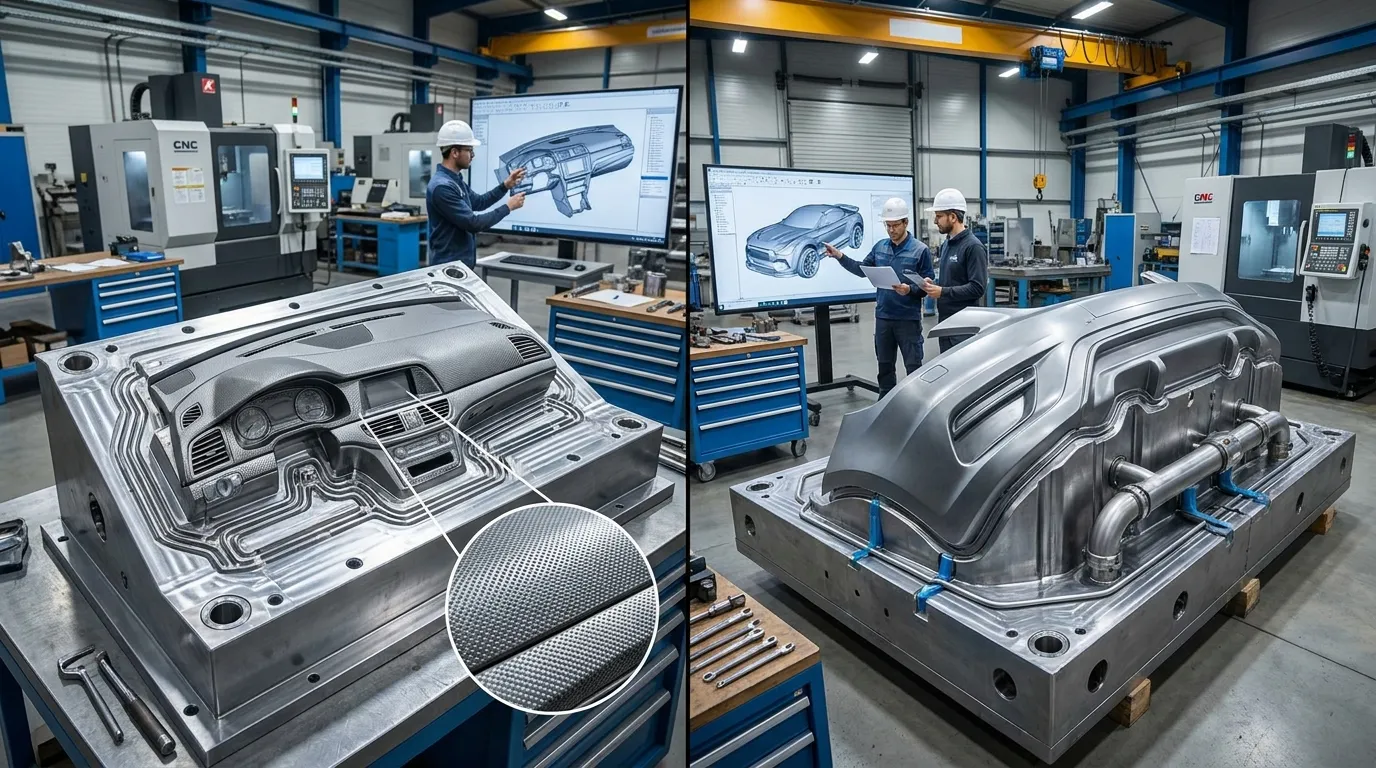
Exterior automotive parts require molds that support durable finishes, impact-resistant materials, and stable dimensions under heat and UV exposure. Bumpers, Parrillas, and mirror housings often require larger tooling systems and stricter process consistency.
Exterior automotive parts deal with far harsher environments than interior components. Heat, Humedad, sunlight, road debris, and temperature swings all affect material selection and tooling requirements. Molds for these parts must support stable processing over long production runs.
Large exterior components also create cooling challenges. A bumper cover, por ejemplo, requires balanced cooling across a wide mold surface to reduce distortion. Poor cooling balance can create uneven shrinkage and assembly problems during vehicle production.
Por qué los moldes de parachoques difieren de los del salpicadero
| Prioridad en el moho del parachoques | Prioridad de moho en el salpicadero |
|---|---|
| Resistencia al impacto | Consistencia de texturas superficiales |
| Durabilidad UV | Precisión del grano cosmético |
| Adhesión de pintura | Variación de bajo brillo |
| Estabilidad dimensional en grandes partes | Líneas de ajuste visibles y ajustadas |
Exterior molds also require attention to paintability and surface durability. Some exterior parts use textured finishes, while others require Class A surfaces that support high-quality painting.
Lower tooling quotes are not always cheaper long term. Exterior molds with weak cooling systems or lower-grade steel may struggle with large-part consistency after extended production cycles. That often leads to higher maintenance costs and slower production later.
Búsqueda de equipos Proceso de moldeo por inyección automotriz support often evaluate tooling durability alongside upfront cost for this reason.
How do mold requirements change for structural automotive parts?
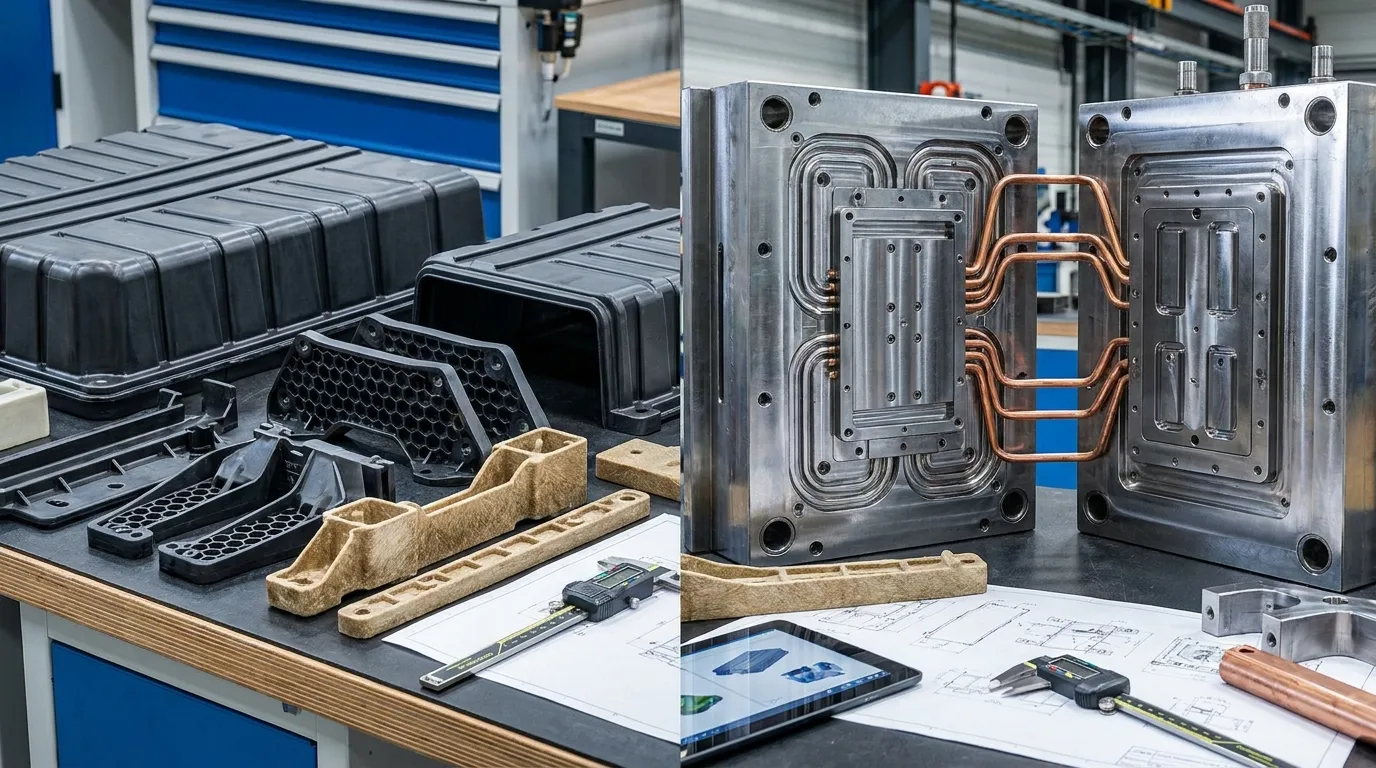
Structural automotive plastic parts require stronger materials, tighter engineering validation, and more durable tooling than cosmetic components. Battery housings, Cuadros, and under-hood supports must maintain strength, Estabilidad dimensional, and long-term performance under stress.
Structural parts create different engineering priorities because they carry loads or support critical assemblies. These parts often use reinforced engineering plastics that increase mold wear and processing complexity.
Glass-filled nylon is a common example. It improves stiffness and heat resistance, but the abrasive glass fibers wear mold surfaces faster than standard polypropylene. Buyers focused only on part strength sometimes underestimate how quickly reinforced materials can increase tooling maintenance requirements.
Materiales comunes para componentes estructurales automotrices
| Requisitos estructurales | Material común | Impacto en las herramientas |
|---|---|---|
| Resistencia al calor | Nailon relleno de vidrio | Mayor desgaste por molde |
| Estabilidad dimensional | Mezclas para PC | Control de refrigeración estricto |
| Resistencia al impacto | Reinforced PP | Requisitos de compuertas más grandes |
| Aislamiento eléctrico | Ingeniería de termoplásticos | Control de tolerancia de precisión |
EV battery housings are a good example of structural complexity. These components require dimensional stability across large surfaces because small variations can affect sealing performance or assembly alignment.
Snap-fit console clips and large structural battery supports also show very different tooling demands. The clip mold may focus on tiny tolerance control and fast cycles, while the battery housing mold may prioritize cooling efficiency and long-term dimensional stability across a much larger cavity.
Muchos equipos de ingeniería utilizan un Guía completa de componentes del molde when evaluating tooling durability, Sistemas de refrigeración, and cavity design for reinforced materials.
Which plastics are commonly used for automotive parts?
Automotive manufacturers choose plastics based on heat resistance, impact strength, UV exposure, Resistencia química, y requisitos cosméticos. Polipropileno, ABS, Nailon, and reinforced engineering plastics are commonly selected for different automotive applications.
Material selection changes based on where the part sits in the vehicle and what conditions it must survive. Interior trim parts may prioritize appearance and low cost, while under-hood parts require heat resistance and structural strength.
| Material | Uso automovilístico común | Beneficio principal |
|---|---|---|
| Polipropileno (PP) | Bumpers, Acabados, panels | Ligero y rentable |
| ABS | Paneles, interior trim | Buen acabado cosmético |
| Mezclas de policarbonato | Carcasas exteriores | Resistencia al impacto |
| Nailon (PA) | Soportes estructurales | Resistencia y resistencia al calor |
| Nailon relleno de vidrio | Soportes bajo el capó | Alta rigidez |
Según Plastics Europe, engineering plastics help reduce vehicle weight while supporting durability and manufacturing efficiency.
Glass-filled materials are not always the safest choice. They work well for high-strength applications, but they also accelerate mold wear significantly. For some medium-load parts, reinforced polypropylene may provide a better balance between tooling life and mechanical performance.
What production problems commonly affect automotive molded parts?
Automotive molded parts often fail because of cooling imbalance, Variación de contracción, poor venting, or inconsistent process control. Even small dimensional shifts can create assembly issues when parts must align with surrounding vehicle components.
Warpage is especially common in large parts like door panels and bumper covers. Uneven cooling rates across the mold cavity can cause twisting or dimensional distortion after ejection. Sink marks also appear frequently around ribs and thicker wall sections.
Por qué las tolerancias automotrices aumentan el riesgo de defectos
- Deformación en componentes largos
- Marcas de hundimiento cerca de las costillas estructurales
- Flash alrededor de las zonas de cierre
- Líneas de soldadura alrededor de aberturas
- Contracción inconsistente entre cavidades
Automotive tolerances increase risk because molded parts often interact with metal fasteners, electronic assemblies, or visible body gaps. Small dimensional changes can affect fit, Apariencia, or assembly speed.
A supplier choosing lower-cost cooling layouts may reduce upfront tooling expenses, but poor cooling balance often creates higher rejection rates later. Según Este estudio de clasificación de defectos, production defects remain a major focus area for automated quality inspection systems.
Lectores que evalúan problemas recurrentes de calidad en Defectos en el moldeo automotriz often focus on cooling consistency, resin control, and cavity balance first.
How should buyers evaluate an automotive molding supplier?
Buyers should evaluate automotive molding suppliers based on tooling engineering capability, automotive quality systems, material expertise, production scalability, and communication transparency. The lowest tooling quote is not always the safest long-term manufacturing decision.
Automotive tooling projects involve more than part pricing. Buyers should evaluate whether the supplier understands production consistency, Mantenimiento de moho, reinforced materials, and automotive dimensional requirements before approving tooling.
Lead time transparency also matters. Según Aprios Insights, tooling complexity can significantly affect production timelines. Structural molds with large cavities or reinforced materials usually require more engineering validation and testing.
Lista de verificación para la decisión de moho automotriz
| Área de evaluación | Qué deberían comprobar los compradores |
|---|---|
| Experiencia en automoción | Programas anteriores de producción automovilística |
| Especialización en materiales | Experiencia con plásticos de ingeniería reforzados |
| Calidad de las herramientas | Steel selection, Diseño de refrigeración, maintenance planning |
| Escalabilidad en producción | Capacidad para apoyar el crecimiento del volumen |
| Comunicación | Retroalimentación del DFM y claridad de la línea temporal |
| Sistemas de calidad | Proceso de inspección y controles dimensionales |
Nearshoring and mold transfer flexibility are becoming more important for automotive sourcing teams. Informe de tendencias manufactureras de Fictiv highlights growing pressure around supply chain resilience and tooling adaptability.
Empresas con más amplio Experiencia en fabricación de precisión often bring stronger process discipline to automotive programs, especially for high-tolerance components.
Acertando en el siguiente paso
Automotive plastic molding works best when tooling strategy matches the part’s real application requirements. Cosmetic interior panels, exterior body parts, and structural supports all demand different engineering priorities, material choices, and production controls.
If you’re sourcing automotive molds, focus on long-term production stability instead of only upfront tooling cost. Balance de refrigeración, material compatibility, dimensional control, and mold durability usually affect total manufacturing cost far more than the initial quote. A supplier that understands those tradeoffs can help prevent expensive quality and maintenance problems later.
Preguntas frecuentes
What plastics are used in automotive injection molding?
Automotive injection molding commonly uses polypropylene, ABS, Nailon, polycarbonate blends, and glass-filled engineering plastics. La selección del material depende de la exposición al calor, Requisitos cosméticos, structural load, Resistencia UV, y durabilidad a largo plazo.
What automotive parts are injection molded?
Many dashboards, bumpers, Parrillas, por paneles, battery housings, Clips, Cuadros, and interior trim components are injection molded. The process supports high-volume production with consistent dimensions and repeatable quality.
What is the best plastic for automotive exterior parts?
Exterior automotive parts often use polypropylene blends, ABS blends, or reinforced engineering plastics because they resist UV exposure, Calor, Humedad, and impact damage. The best material depends on the part’s mechanical and cosmetic requirements.
How durable are automotive plastic parts?
Automotive plastic parts can last for years when the correct resin, tooling design, and processing controls are used. Structural and under-hood components typically require reinforced materials and stricter validation testing.
How long do automotive injection molds last?
Automotive injection molds can last hundreds of thousands or even millions of cycles depending on steel quality, Abrasividad del material, and maintenance practices. Structural and glass-filled applications usually create faster mold wear.
Why is plastic used in modern vehicles?
Plastics help reduce vehicle weight, support complex geometries, improve fuel efficiency, and lower manufacturing costs compared with many metal alternatives. They also allow faster high-volume production.
Compartir:



Escrito por Sunshine
Al sol, Somos un fabricante y proveedor profesional de componentes de moldes de precisión, ofreciendo una amplia gama de productos para aplicaciones de estampado y moldes de inyección. Nuestro enfoque principal es el punzonamiento de troqueles, Pasadores y fundas eyector, y postes guía y casquillos. Con mecanizado CNC avanzado, Control de calidad estricto, y una fuerte capacidad de producción, Garantizamos la fiabilidad, Piezas de alta precisión, junto con componentes estándar en stock para un suministro global rápido y eficiente.
NOTICIAS
CONSIGUE EL SERVICIO
Con piezas de calidad para todos los presupuestos y personal amable formado para que tu visita sea informativa y sin complicaciones.
