



Moldeo por inyección de piezas para automóviles: Materiales, Tolerancias, y QC
Injection molding automotive parts requires balancing material strength, dimensional tolerances, cosmetic appearance, and inspection consistency. Automotive manufacturers commonly use PP, ABS, nylon, and PC/ABS blends based on heat exposure, Resistencia al impacto, and surface requirements. Reliable production depends on stable tooling, controlled molding conditions, Inspección dimensional, and quality-control systems that reduce warpage, assembly-fit issues, and cosmetic defects.
Automotive plastic components do more than reduce vehicle weight. They also affect assembly accuracy, cabin appearance, Durabilidad, y rendimiento a largo plazo. A dashboard trim panel and an under-hood bracket may use the same molding process, but they need very different materials, Tolerancias, and inspection methods. Understanding those differences helps buyers avoid costly production problems before tooling starts.
What automotive parts are commonly made with injection molding?
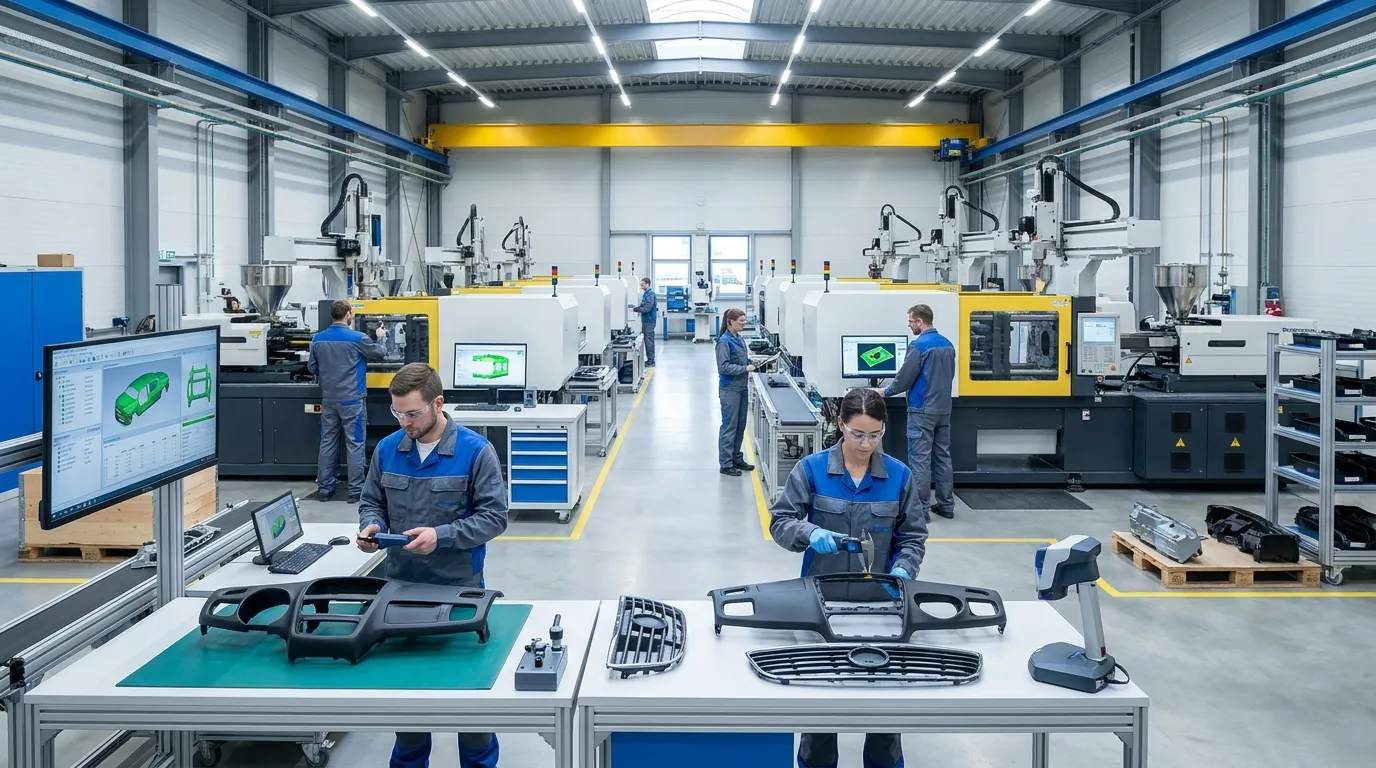
Automotive injection molding is widely used for dashboards, Parrillas, Carcasas de lámparas, trims, Clips, and under-hood components because it supports repeatable high-volume production with tight dimensional control and strong surface consistency.
Automotive manufacturers use injection molding for both visible and functional parts. Interior components often include dashboards, center-console trims, air vent bezels, and door panels. Exterior applications include bumper trims, mirror housings, and front grilles. Under-hood parts may include clips, reservoirs, and electrical housings.
Many of these components require complex geometry and repeatable dimensions. Según Resumen del moldeo automovilístico de Fictiv, injection molding is widely used because it supports high production volumes with consistent part quality.
| Tipo de pieza | Ejemplos comunes | Prioridad principal |
|---|---|---|
| Estética interior | Dashboard trim, bezels | Acabado superficial |
| Aspecto exterior | Grilles, mirror covers | Resistencia UV |
| Partes funcionales | Clips, Alojamientos | Ajuste dimensional |
| Partes bajo el capó | Reservoirs, brackets | Resistencia al calor |
Visible parts usually have stricter cosmetic standards than hidden structural parts. A small weld line on an internal clip may pass inspection, but the same defect on a dashboard trim piece can trigger rejection.
Para empresas que evalúan Soluciones de moldeo automotriz, it’s important to separate cosmetic and functional requirements early. The molding process may be similar, but quality expectations are not.
Which materials are best for automotive injection molded parts?
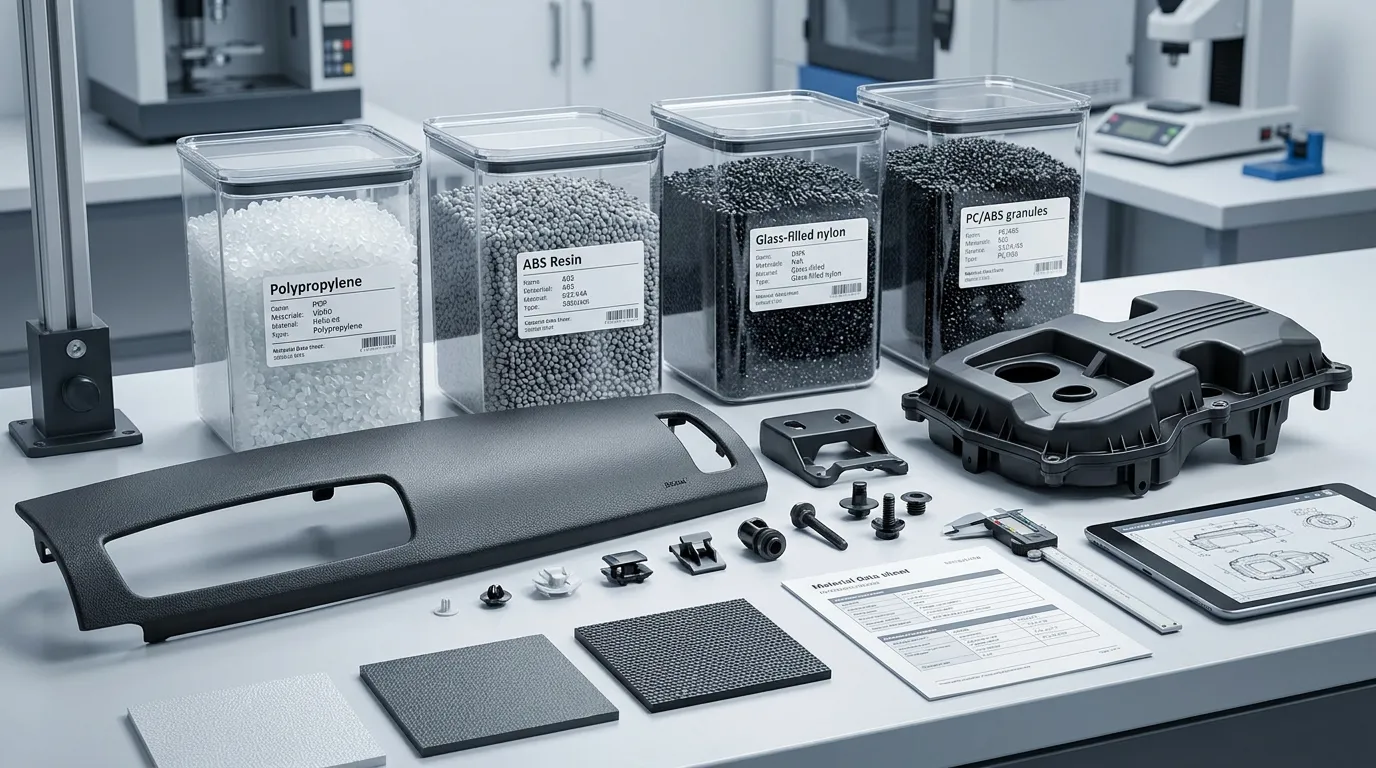
Material selection depends on heat exposure, impact requirements, UV stability, and cosmetic expectations. PP is common for lightweight interior parts, while reinforced nylon and PC/ABS blends are often used where higher strength or appearance quality is required.
Automotive plastics are selected based on operating conditions, not material popularity. A resin that works well for an interior trim piece may fail quickly near engine heat or direct sunlight. Material choice also affects shrinkage, Acabado superficial, and tolerance stability.
Materiales de calidad interior
Polipropileno (PP) is widely used for interior trim because it is lightweight, cost-effective, and easy to process. ABS is also common for interior parts that require better surface appearance and rigidity. For premium visible surfaces, many manufacturers prefer PC/ABS blends because they combine appearance quality with better heat resistance.
ABS is not automatically the best choice for visible automotive parts. It works well in stable interior environments, but PC/ABS blends are often safer when heat exposure and cosmetic stability matter together.
Materiales bajo el capó
Under-hood applications usually require higher heat resistance and structural strength. Nailon, also called polyamide (PA), is common for brackets, Alojamientos, and clips exposed to elevated temperatures. Glass-filled nylon adds stiffness and dimensional stability but may increase mold wear.
La relación más amplia entre el tooling y el comportamiento de la resina se aborda aquí Guía completa de moldes de inyección de plástico.
| Material | Resistencia al calor | Calidad cosmética | Aplicaciones comunes |
|---|---|---|---|
| PP | Moderado | Bien | Interior trims |
| ABS | Moderado | Muy bien | Dash panels, bezels |
| PC/ABS | Alto | Excelente | Piezas visibles premium |
| PA (Nailon) | Alto | Moderado | Componentes bajo el capó |
| Nailon relleno de vidrio | Muy alto | Inferior | Soportes estructurales |
Material selection should also account for long-term dimensional stability. A grille exposed to sun and seasonal temperature swings needs different resin behavior than an interior switch bezel.
What tolerances are realistic for automotive injection molded parts?
Automotive injection molded tolerances vary by material, Grosor de la pared, y geometría. Tight cosmetic and assembly-critical parts often require stricter process control, stable tooling, and validated inspection methods to maintain consistency across production runs.
Automotive tolerances depend on several variables working together. Contracción de resina, Balance de refrigeración, Construcción de moldes, and part geometry all affect final dimensions. Thin-wall parts with uneven geometry usually create more variation than simple, uniform components.
Tight tolerances are meaningless if the supplier cannot maintain stable processing conditions during production. Tool quality alone does not guarantee consistency. Process monitoring and dimensional inspection are just as important as mold precision.
Factores que afectan a la estabilidad de la tolerancia
Parts with uneven wall thickness tend to cool at different rates, which increases warpage risk. Materials such as glass-filled nylon may hold dimensions more consistently but require tighter process control. Cooling layout also plays a major role in maintaining stable geometry.
A lamp housing is a good example. Even small dimensional changes can create assembly gaps or alignment problems. In many automotive applications, fitment consistency matters more than achieving the smallest possible tolerance number.
| Factor | Impacto en la tolerancia |
|---|---|
| Contracción de resina | Cambios en las dimensiones finales |
| Balance de refrigeración | Afecta a la distorsión |
| Calidad del molde | Influye en la repetibilidad |
| Grosor de la pared | Impacto del riesgo de distorsión |
| Variación del proceso | Causas de la deriva dimensional |
For readers who want deeper tooling fundamentals, esto Resumen de los componentes del molde explains how mold structure influences production stability.
How do automotive suppliers control cosmetic quality and surface finish?
Cosmetic automotive parts require tighter process monitoring because visible defects can lead to rejection even when dimensions are technically acceptable. Surface consistency, Brillo, texture, and color stability are major inspection priorities.
Visible automotive parts often fail because of appearance variation before they fail dimensional inspection. Surface quality affects customer perception immediately, especially on dashboards, trim panels, and exterior grille assemblies.
Common cosmetic defects include sink marks, flow lines, weld lines, silver streaks, and gloss inconsistency. Suppliers reduce these risks by controlling mold temperature, injection speed, cooling uniformity, and material drying conditions.
Defectos de apariencia comunes
| Defecto | Typical Cause | Impacto común |
|---|---|---|
| Marcas de hundimiento | Grosor desigual de la pared | Depresiones superficiales |
| Líneas de flujo | Frente de flujo inconsistente | Rayas visibles |
| Líneas de soldadura | Puntos de encuentro del flujo de materiales | Apariencia débil |
| Variación de brillo | Refrigeración desigual | Desajuste de color |
| Curvatura | Desequilibrio de contracción | Mal ajuste |
Texture consistency becomes especially important in multi-cavity production. A dashboard trim program with four cavities may produce visible variation if cooling or pressure differs between cavities.
Empresas que gestionan Producción de moldes automotrices usually inspect cosmetic parts under controlled lighting conditions to identify defects before shipment.
What quality control methods are used for automotive injection molding?
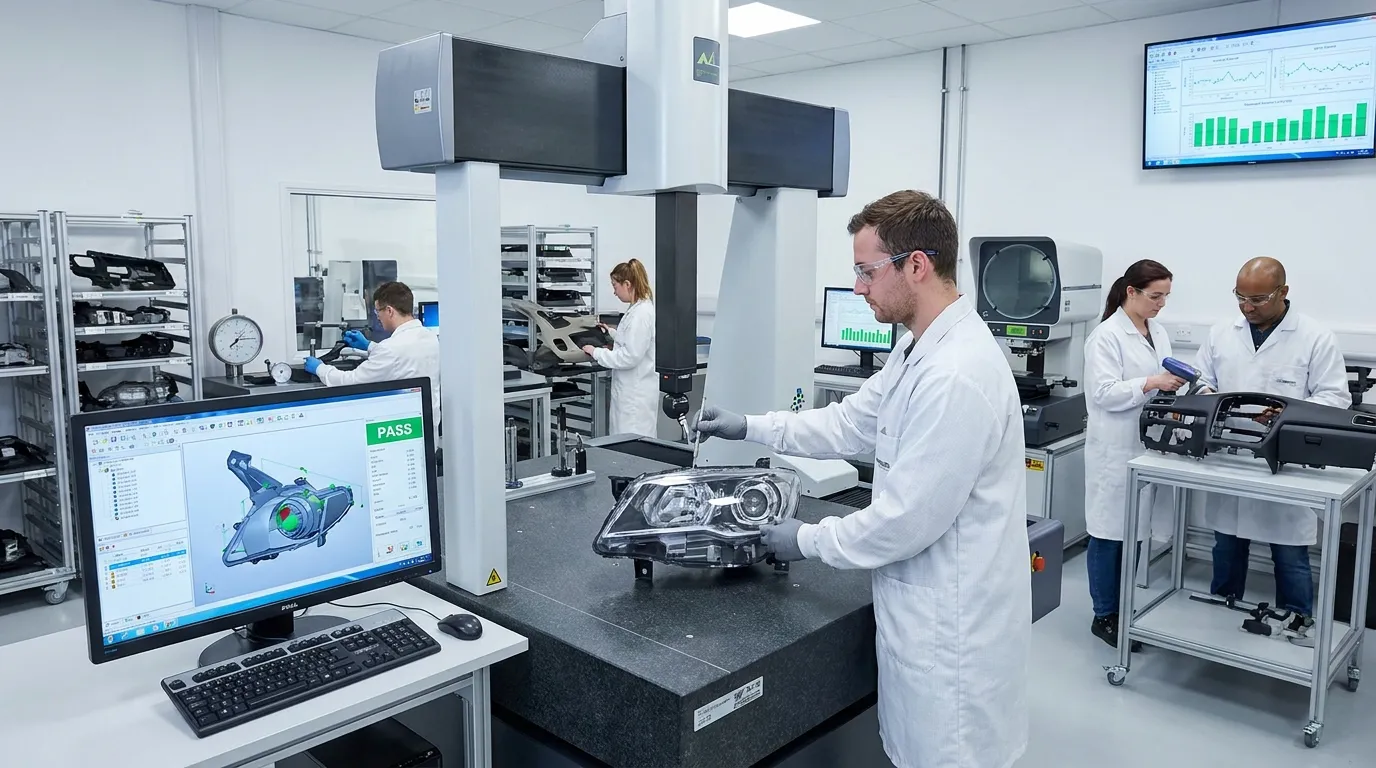
Automotive injection molding quality control combines dimensional inspection, process monitoring, and visual verification to reduce variation and prevent assembly issues during mass production.
Automotive suppliers use multiple inspection stages instead of relying on final checks alone. Quality control often starts with incoming material verification, then continues through sampling, inline monitoring, e inspección final.
Inspección en línea vs inspección final
Inline inspection checks parts during production to identify variation before large batches are affected. Operators may monitor dimensions, appearance, gate quality, and flash levels at regular intervals.
Final inspection focuses on dimensional verification and cosmetic review before shipment. Many suppliers also use statistical process control (SPC) to track process drift over time.
Equipos de medición comunes
| Método de inspección | Propósito |
|---|---|
| Pinzas y manómetros | Comprobaciones dimensionales básicas |
| Coordinate measuring machines (CMM) | Medición de geometría compleja |
| Sistemas de visión | Inspección estética |
| Medidores de go/no-go | Verificación de ensamblaje |
| Software SPC | Monitorización de procesos |
First article inspection is especially important for assembly-critical components. A lamp housing or snap-fit trim piece may pass individual measurements but still fail vehicle assembly if geometry shifts slightly across production runs.
La disciplina de inspección utilizada en Flujos de trabajo de moldeo de precisión is also valuable in automotive production where repeatability matters.
Flujo de Inspección de Control de Calidad Automotriz
- Verificación de materiales entrantes
- Montaje y muestreo del molde
- Primera inspección del artículo
- Comprobaciones dimensionales en línea
- Inspección cosmética de superficies
- Validación de la dimensión final
- Envasado y aprobación de envío
What causes warpage and dimensional inconsistency in automotive parts?
Warpage usually comes from uneven cooling, Grosor de pared inconsistente, Contracción de resina, or unstable processing conditions. Even small distortion can create assembly gaps, Problemas de alineación, or stress during installation.
Cooling layout is one of the biggest contributors to dimensional consistency. Research published on Arxiv highlighted how cooling-channel design affects shrinkage and part stability in injection molding applications.
A production run for an exterior grille is a common example. If one side cools faster than the other, the part may twist slightly after ejection. The distortion may appear minor during inspection but still cause visible fitment issues during vehicle assembly.
| Problema | Causa probable | Resultado |
|---|---|---|
| Torcimiento | Refrigeración desigual | Mala alineación |
| Arco | Desequilibrio de espesor de pared | Huecos de montaje |
| Variación de encogimiento | Inconsistencia de la resina | Variación de tamaño |
| Defectos en el sumidero | Secciones gruesas | Rechazo cosmético |
Poor cooling design creates long-term production risks. That’s one reason automotive programs often spend extra time validating tooling before full production begins.
How should buyers evaluate an automotive injection molding supplier?
Automotive suppliers should be evaluated on tooling quality, process stability, Capacidad de inspección, and production consistency rather than price alone. Poor process control often creates expensive downstream assembly and warranty issues.
A supplier with low pricing but weak process control can create far higher costs later through rejects, assembly delays, or warranty claims. Buyers should focus on production capability, inspection discipline, and communication during tooling validation.
Ask suppliers how they handle dimensional drift, cosmetic inspection, and corrective actions. Their answers usually reveal more than a simple capability list. Experienced automotive molders should also explain how they document sampling, process settings, and inspection records.
Lista de verificación de valoración de compradores
- Revisar los procedimientos de inspección del primer artículo
- Pregunta por la monitorización de calidad en línea
- Verifica experiencia con conjuntos de automoción
- Comproba la capacidad de inspección cosmética
- Confirma los procedimientos de mantenimiento del moho
- Revisa los plazos de entrega y muestreo
Programs with appearance-sensitive parts need extra supplier scrutiny. A dashboard trim supplier may require stronger cosmetic inspection capability than a supplier producing hidden structural clips.
Fabricantes con experiencia en Fabricación centrada en la inspección often apply tighter documentation and traceability practices that benefit automotive production as well.
Acertando en el siguiente paso
Choosing the right partner for injection molding automotive parts goes beyond tooling cost or machine capacity. Material behavior, Control de refrigeración, Estabilidad dimensional, and cosmetic inspection all affect long-term production performance.
Before approving a supplier, review how they handle validation, inspection, and process monitoring during full production runs. Ask for examples tied to parts similar to yours, especially if appearance or assembly fit is critical.
If your project involves complex geometry, visible surfaces, or tight fitment requirements, investing in stronger QC capability early usually prevents far larger production issues later.
Preguntas frecuentes
What plastics are most common in automotive injection molding?
PP, ABS, nylon, and PC/ABS are among the most common automotive molding materials. Manufacturers select them based on heat resistance, impact performance, Estabilidad dimensional, and cosmetic requirements for each specific component.
What automotive parts are usually injection molded?
Dashboards, Parrillas, Carcasas de lámparas, trim panels, Clips, and interior bezels are commonly injection molded. The process supports high-volume production with repeatable dimensions and consistent surface quality.
What tolerances can automotive injection molding achieve?
Automotive molding tolerances depend on resin shrinkage, Calidad del molde, Balance de refrigeración, and part geometry. Tight-tolerance parts usually require validated tooling, stable processing conditions, and repeatable inspection methods.
How are automotive plastic parts inspected?
Automotive plastic parts are inspected using dimensional gauges, coordinate measuring machines, visual inspection systems, and inline quality checks. Many suppliers also use SPC tracking to monitor process variation during production.
What causes warpage in injection molded automotive parts?
Warpage is commonly caused by uneven cooling, Grosor de pared inconsistente, material shrinkage, or unstable molding conditions. Distortion can create fitment problems even when individual dimensions appear acceptable.
How long does automotive injection molding production take?
Production timelines vary based on tooling complexity, sampling requirements, y volumen de producción. Tool validation and first article approval often add significant time before full-scale manufacturing begins.
Compartir:



Escrito por Sunshine
Al sol, Somos un fabricante y proveedor profesional de componentes de moldes de precisión, ofreciendo una amplia gama de productos para aplicaciones de estampado y moldes de inyección. Nuestro enfoque principal es el punzonamiento de troqueles, Pasadores y fundas eyector, y postes guía y casquillos. Con mecanizado CNC avanzado, Control de calidad estricto, y una fuerte capacidad de producción, Garantizamos la fiabilidad, Piezas de alta precisión, junto con componentes estándar en stock para un suministro global rápido y eficiente.
NOTICIAS
CONSIGUE EL SERVICIO
Con piezas de calidad para todos los presupuestos y personal amable formado para que tu visita sea informativa y sin complicaciones.
