



Directrices para moldeo por inyección: Diseño, Herramientas, y Mejores Prácticas de Producción
Injection molding guidelines should be reviewed before tooling starts, not after steel is cut. The most important best practices include maintaining uniform wall thickness, adding proper draft angles, designing ribs and bosses carefully, setting realistic tolerances, and running a full DFM review early. Teams that validate manufacturability before tooling approval reduce revision costs, shorten lead times, y mejorar la consistencia en la producción.
Injection molding problems usually start long before production begins. A part may look fine in CAD, then fail during sampling because of sink marks, poor ejection, unstable tolerances, or expensive tooling revisions. This guide focuses on the practical rules buyers and engineers should check before approving tooling, especially when schedules, production scale, and supplier coordination all matter.
What are the most important injection molding guidelines before tooling starts?
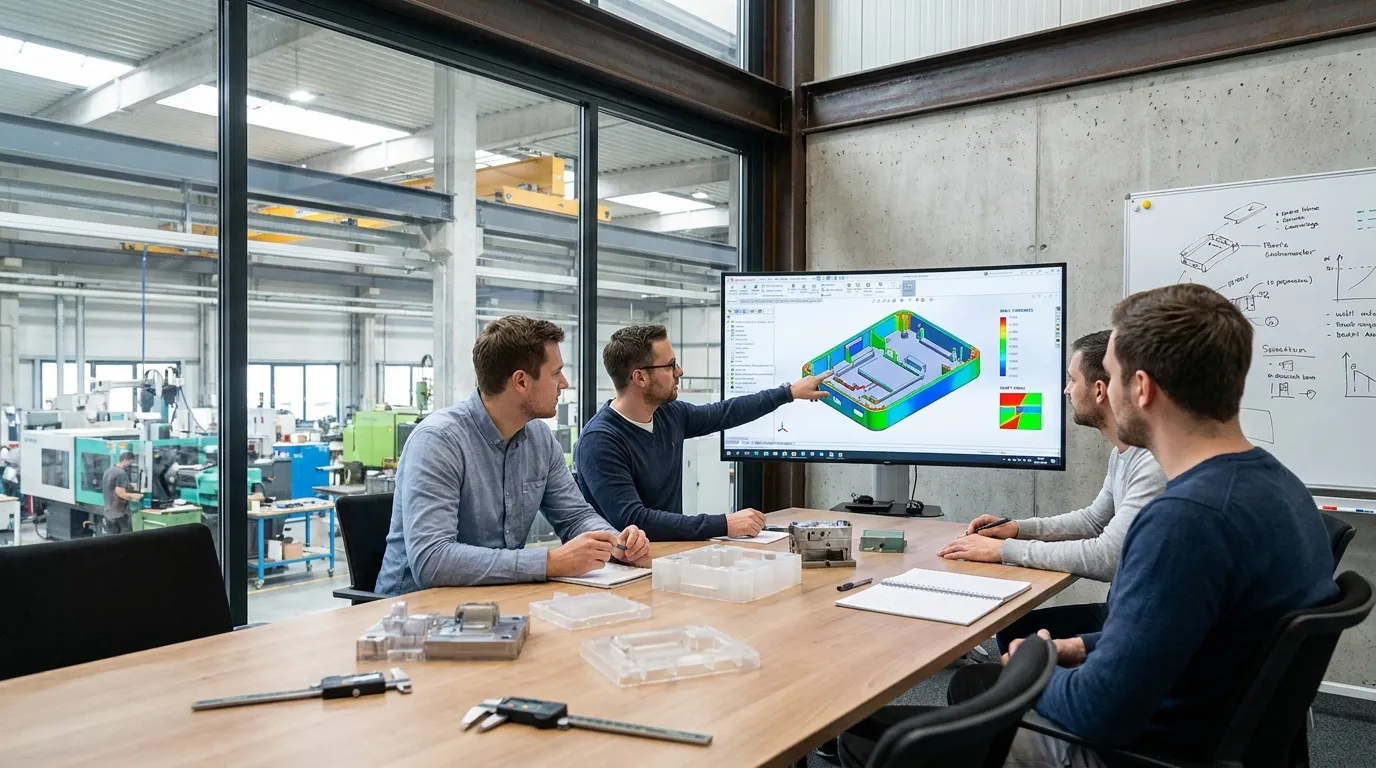
Injection molding guidelines should focus on moldability before steel cutting begins. Espesor uniforme de pared, Ángulos de tiro propios, Tolerancias realistas, and early DFM review reduce tooling revisions, shorten lead times, y mejorar la consistencia en la producción.
The most expensive injection molding mistakes usually happen during the design approval stage. Once tool steel is cut, even small geometry changes can delay production and increase cost. That’s why early manufacturability review matters more than rushing into tooling.
Start by reviewing wall thickness consistency, Ángulos de tiro, Contracción del material, Colocación de puertas, and assembly features. A good supplier should also provide a full Proceso de revisión del DFM Antes de la aprobación de la herramienta.
The cheapest tooling quote is not always the lowest production cost. Suppliers that skip detailed DFM analysis often create more expensive revisions later, especially when defects appear during T1 sampling.
For teams that need broader background on tooling systems and mold terminology, esto Guía completa de moldes de inyección provides a full overview.
Lista de verificación para la aprobación previa a la maquinaria
| Área de revisión | Qué confirmar |
|---|---|
| Grosor de la pared | Secciones consistentes a lo largo de la pieza |
| Ángulos de tiro | Suficiente tiraje para una expulsión limpia |
| Selección de materiales | La resina se ajusta a las necesidades de resistencia y contracción |
| Colocación de puertas | Empaste equilibrado y control estético |
| Tolerancias | Solo las dimensiones críticas son estrictas |
| Diseño de nervaduras y cabezas | No hay funciones de soporte sobredimensionadas |
| Análisis de DFM | El proveedor revisó los riesgos de moldeabilidad |
| Plan de muestreo | T1 y calendario de revisión acordados |
How do wall thickness and draft angles affect moldability?
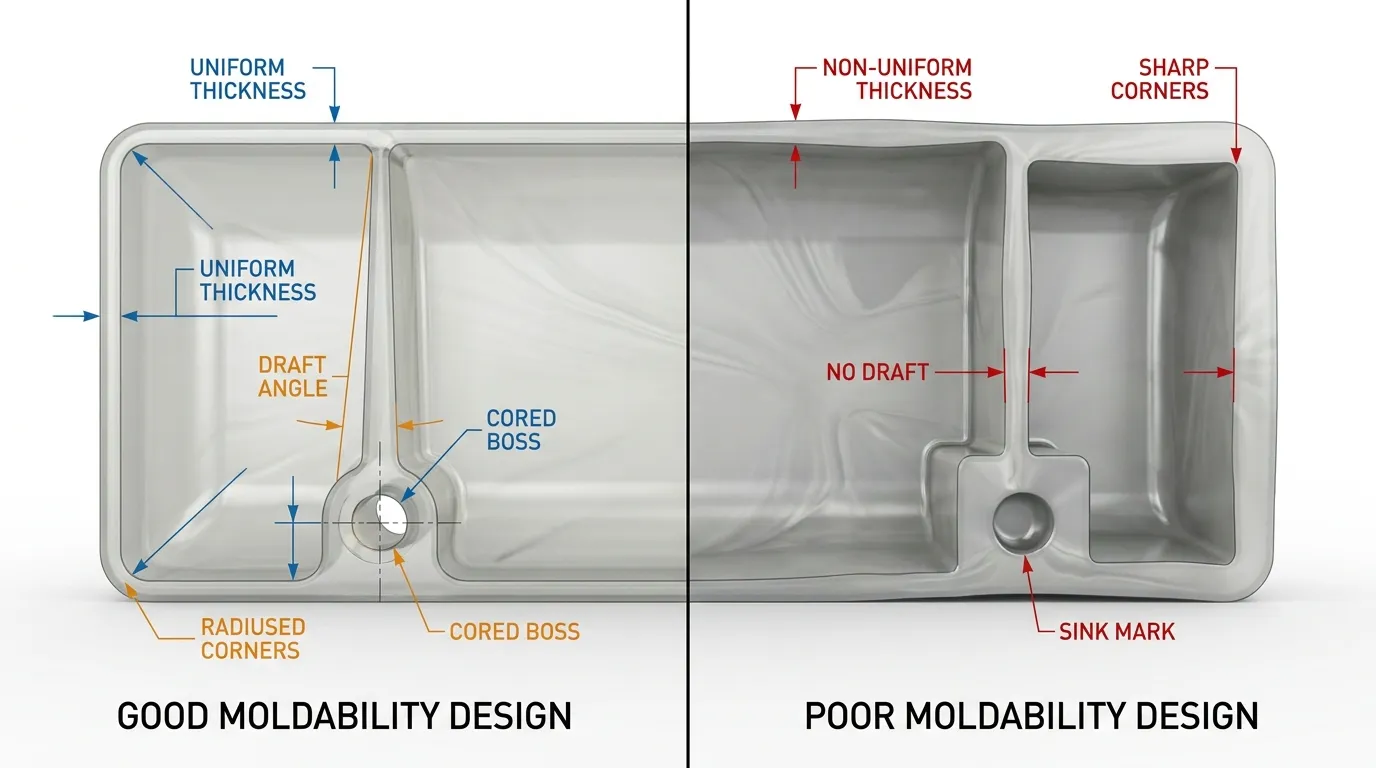
Wall thickness and draft angle directly affect filling, Refrigeración, y eyección. Consistent wall sections reduce warpage, while sufficient draft angles help parts release cleanly and reduce cosmetic damage during production.
Wall thickness controls how plastic flows and cools inside the mold. Thick sections cool more slowly, which can create sink marks, voids, o contracción desigual. Thin sections may fail to fill properly if the material freezes too quickly.
Una carcasa de electrónica de consumo es un ejemplo común. One side may look clean after molding, while another develops visible sink marks because internal ribs created thick cooling zones behind the cosmetic surface.
Según el Guía de moldeo por inyección de bujes y la Guía de diseño de moldeo por inyección ficticia, maintaining uniform wall thickness helps reduce warpage and improves production stability.
Rangos recomendados de grosor de pared
| Tipo de pieza | Directrices generales |
|---|---|
| Piezas pequeñas para consumidores | Thin, uniform walls |
| Carcasas estructurales | Grosor moderado con soporte de nervadura |
| Paneles cosméticos grandes | Espesor equilibrado para reducir la deformación |
| Piezas industriales de alta resistencia | Reinforcement through geometry, not excessive wall thickness |
Directrices para ángulos de borrador para piezas texturizadas y no texturizadas
Draft angles help parts eject cleanly from the mold. Most molded parts need at least 1 to 2 degrees of draft per side. Textured surfaces often require more because the texture increases friction during ejection.
An automotive trim supplier may increase draft angles after testing textured surfaces. Without extra draft, cosmetic drag marks can appear during ejection, especially on deep features or glossy parts.
If you're refining geometry for manufacturability, Esta guía sobre Geometría de piezas plásticas covers additional design considerations.
What are the best practices for ribs, Jefes, and corners?
Ribs and bosses should strengthen parts without creating thick sections that cool unevenly. Gradual transitions, reinforced bosses, and proper rib thickness help prevent sink marks and stress concentration.
Ribs are often better than thick walls when additional stiffness is needed. Thick plastic sections cool unevenly and create visible defects. Properly sized ribs strengthen the part while maintaining more consistent cooling behavior.
Bosses also need careful support. Unsupported bosses may crack during assembly or distort during molding. A startup hardware company may delay tooling approval after a DFM review identifies unsupported screw bosses near a thin wall section.
Lista de verificación de diseño de costillas y cabezas
- Mantén el grosor de las costillas menor que la pared contigua
- Añadir filetes en las bases de las costillas para reducir la concentración de tensión
- Refuerza a los jefes altos con costillas de soporte
- Evita esquinas pronunciadas que interrumpan el flujo de materiales
- Utiliza transiciones de radio gradual entre secciones de pared
Corners matter more than many teams expect. Sharp internal corners increase stress and interrupt flow. Rounded transitions help material move more evenly through the cavity and reduce cracking risk later.
For more detailed feature planning, this resource on Diseño de características del molde explains how mold structures interact with part geometry.
How should material selection influence part design?
Material selection affects shrinkage, Tolerancias, Comportamiento de refrigeración, and mold design requirements. Teams should match resin properties to both product performance and manufacturability goals before tooling approval.
Material choice affects much more than strength. Different resins shrink differently during cooling, respond differently to heat, and require different processing conditions. Those variables directly influence tooling design and production consistency.
A material with higher shrinkage may require additional compensation during mold design. Another resin may need tighter process control to maintain cosmetic quality or dimensional stability.
Tabla de Decisión de Selección de Materiales
| Prioridad de diseño | Consideración Material |
|---|---|
| Acabado cosmético | Calidad superficial y comportamiento del flujo |
| Resistencia al calor | Estabilidad térmica durante el uso |
| Resistencia estructural | Resistencia al impacto y rigidez |
| Tolerancias estrictas | Comportamiento predecible de contracción |
| Uso al aire libre | Resistencia a los rayos UV y ambiental |
Tight tolerances should not be treated as default engineering practice. Many injection molded parts perform well with standard production tolerances and lower tooling complexity. Over-specifying precision often increases cost without improving functional performance.
Esta guía sobre Consideraciones sobre el procesamiento de materiales explains how resin behavior affects production conditions and mold setup.
What tolerance guidelines prevent unnecessary tooling cost?
Tight tolerances increase tooling complexity, Requisitos de inspección, and process variability. Most injection molded parts should use standard production tolerances unless the application requires critical precision features.
Every tolerance should have a reason behind it. Tight dimensions increase machining precision, Complejidad del molde, process monitoring, y requisitos de inspección. They may also reduce production yield during high-volume manufacturing.
Many buyers unknowingly create unnecessary tooling costs by applying precision tolerances across an entire part instead of limiting them to functional areas.
Tabla comparativa de tolerancias
| Estrategia de tolerancia | Impacto en la producción |
|---|---|
| Tolerancia estándar de producción | Menor coste de herramientas y muestreo más rápido |
| Tolerancia estética estricta | Más pulido e inspección |
| Tolerancia de ensamblaje ajustada | Se requiere mayor precisión de herramientas |
| Tolerancia estricta en toda la parte | Mayor variabilidad de producción |
A connector housing may only need critical tolerances around mating features. The outer housing surfaces often do not require the same precision. Restricting tight tolerances to functional areas helps maintain reasonable tooling cost and production efficiency.
If your team is balancing cost against manufacturability, this article on Planificación de tolerancias de fabricación provides additional DFM guidance.
What should a proper injection molding DFM review include?
A proper DFM review checks whether the part can fill, fresco, eject, and maintain tolerances consistently during production. It should identify geometry risks before mold steel is cut.
A strong DFM review is one of the best ways to prevent tooling revisions. It helps suppliers identify molding risks before machining begins, when changes are still manageable and affordable.
Según el Protolabs diseña un kit de herramientas de moldeabilidad, DFM analysis should evaluate geometry, Comportamiento material, Colocación de puertas, Eficiencia de refrigeración, and ejection performance.
Áreas Principales de Revisión del DFM
- Colocación de compuertas y flujo de materiales
- Consistencia de enfriamiento a lo largo de la cavidad
- Validación del ángulo de eyección y tiro
- Marca de hundimiento y riesgo de deformación
- Revisión de la geometría de costillas y bosses
- Colocación de la línea de separación
- Viabilidad de tolerancia
A common production delay happens when teams approve tooling before reviewing gate placement carefully. A later gate relocation may require re-machining steel and extending the sampling timeline by several weeks.
Speed-focused tooling schedules can also create unstable production launches if revision planning is compressed too aggressively. Fast timelines work best when designs are already mature and fully reviewed.
Preguntas que los compradores deberían hacer durante la aprobación del DFM
- Which areas are highest risk for sink or warpage?
- Are any features difficult to eject?
- Which dimensions are difficult to maintain consistently?
- Will cosmetic surfaces require additional draft?
- What revisions become expensive after steel cutting?
For a deeper review workflow, Esta guía sobre Análisis DFM por moldeo por inyección expands on manufacturability evaluation methods.
Which supplier questions prevent production delays?
Buyers should evaluate how suppliers handle DFM feedback, Revisiones de muestreo, Mantenimiento de moho, y aumento de la producción. These operational details often affect timelines more than quoted tooling cost alone.
A supplier may offer competitive tooling pricing but still struggle during production ramp-up. Questions about workflow, Comunicación, and revision handling often reveal more about long-term reliability than the initial quote.
Ask suppliers how they manage T1 sampling, Correcciones de herramientas, preventive maintenance, and process validation. Mold maintenance planning matters because worn tooling can affect consistency over long production runs.
Lista de verificación de evaluación de proveedores
| Pregunta | Por qué importa |
|---|---|
| How are DFM revisions handled? | Evita confusiones de aprobación |
| What is the T1 sampling timeline? | Establece expectativas realistas de calendario |
| What press sizes are available? | Confirma la compatibilidad en producción |
| How are tooling repairs managed? | Reduce el riesgo de inactividad |
| What quality checks are standard? | Mejora la consistencia |
A supplier with a slightly longer lead time may still be the safer option if their DFM communication is stronger and their sampling process is more organized.
Esta visión general de Etapas del flujo de trabajo de producción helps buyers understand how supplier coordination affects production readiness.
What production and sourcing risks should teams plan for?
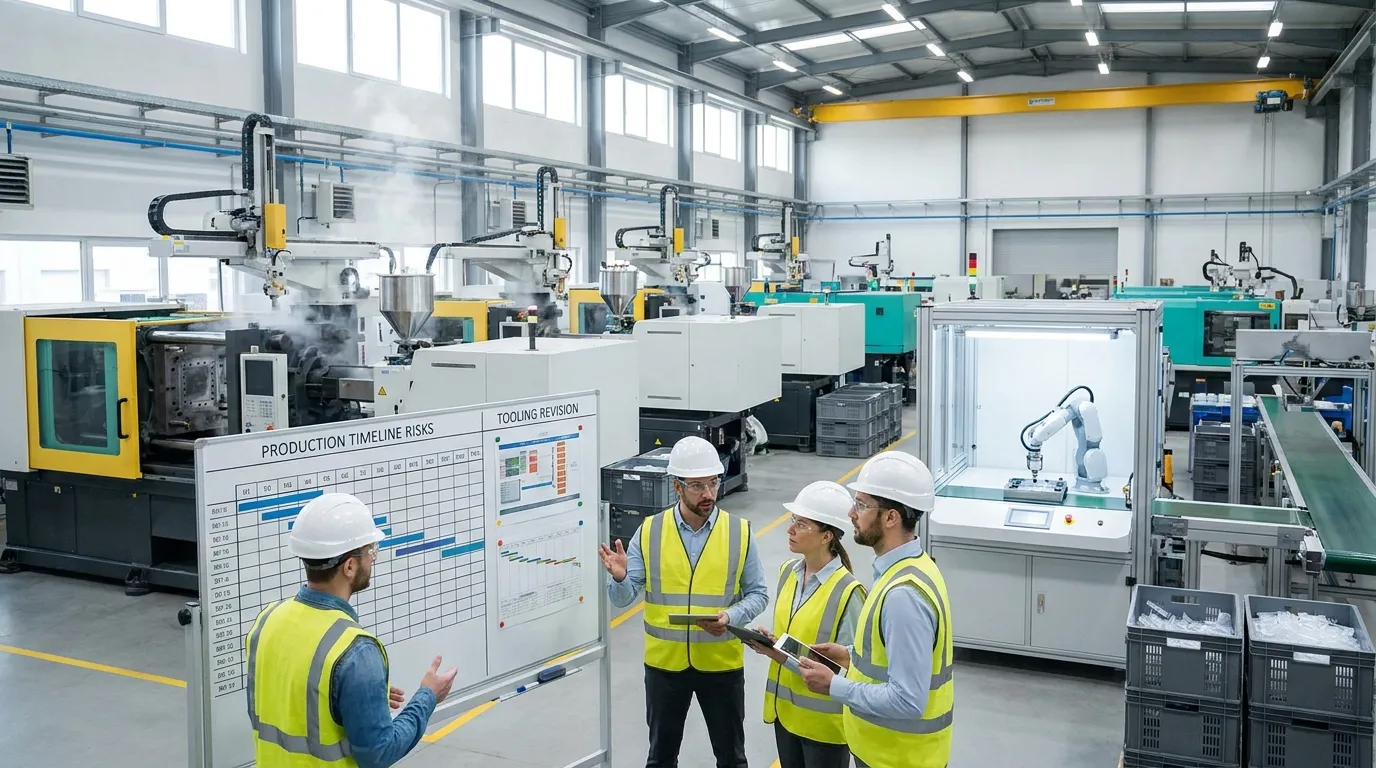
Injection molding timelines often slip because of tooling revisions, Aprobaciones tardías, Inspecciones aduaneras, or unstable production ramp-up after sampling. Early planning reduces both cost risk and launch delays.
Most project delays happen after teams assume tooling is already “finished.” In reality, Muestreo, Revisiones, naviero, and production transfer can still create schedule instability long after steel cutting begins.
A post-steel design revision is one of the most expensive timeline disruptions. Even changing gate placement or adjusting a cosmetic feature may require reworking mold steel and restarting validation.
Por qué los cambios de diseño posteriores al acero generan retrasos costosos
A medical enclosure project may pass initial CAD approval, then fail cosmetic review after T1 sampling. The revised gate location improves surface quality but adds several weeks to the tooling schedule because the cavity needs machining updates.
Those delays become more serious when overseas tooling shipments, Paso de aduanas, or tariff-related inspections are involved. Informes del sector Aprios y actualizaciones de envío comentadas por Moldura BAP show how lead times can extend when production transfer and logistics planning are weak.
Tabla de riesgo de retraso en moldeo por inyección
| Fuente de riesgo | Typical Cause | Impacto en la línea temporal | Paso de prevención |
|---|---|---|---|
| Revisión de herramientas | Cambio de geometría tardío | Retraso de varias semanas | Finalizar el DFM antes |
| Inspección aduanera | Papeleo incompleto | Retraso en el envío | Verificar la documentación |
| Plan de muestreo pobre | Proceso de aprobación poco claro | Ciclos de muestreo repetidos | Define las expectativas T1 |
| Cambio material | Problema de disponibilidad de resina | Revalidación requerida | Selección temprana del material de la esclusa |
| Transferencia de producción | Configuración inconsistente del proceso | Inestabilidad de arranque | Estandarizar los controles de proceso |
An overseas tooling shipment may also face customs delays if sample declarations or commercial documentation are incomplete. Those risks are often ignored during early sourcing discussions, even though they directly affect launch schedules.
For teams managing supplier timelines, this guide to the Cronología de la maquinaria a la producción explains how production stages connect from tooling approval through manufacturing ramp-up.
Acertando en el siguiente paso
Good injection molding guidelines are less about memorizing technical rules and more about making better production decisions before tooling starts. Teams that validate wall thickness, Borrador, Tolerancias, Materiales, and DFM feedback early usually avoid the most expensive revisions later.
Antes de aprobar las herramientas, Revisa la pieza tanto desde una perspectiva de ingeniería como de producción. Ask suppliers difficult questions, challenge unnecessary tolerances, and confirm how revisions will be handled if sampling uncovers problems. Small decisions during design review often determine whether production stays stable or becomes expensive to fix later.
Preguntas frecuentes
What is the ideal wall thickness for injection molding?
The ideal wall thickness depends on the resin and part geometry, but consistency matters more than absolute thickness. Uniform walls reduce warpage, Marcas de hundimiento, and cooling imbalance during production.
How much draft angle is recommended for injection molded parts?
Most injection molded parts need at least 1 to 2 degrees of draft per side for smooth ejection. Textured surfaces and deeper features usually require additional draft to prevent drag marks and cosmetic damage.
Por qué es importante el DFM en el moldeo por inyección?
DFM helps manufacturers identify filling, Refrigeración, Eyección, and tolerance risks before tooling begins. Early DFM review reduces revision costs and prevents avoidable production delays during sampling and ramp-up.
¿Cuánto tiempo tarda en construir un molde de inyección??
Production mold lead times commonly range from several weeks to several months depending on geometry, Cavidades, finish requirements, y revisiones de herramientas. Design changes after steel cutting usually extend schedules further.
Qué causa marcas de hundimiento en el moldeo por inyección?
Sink marks usually occur when thick sections cool unevenly or ribs and bosses are oversized. Consistent wall thickness and gradual transitions help reduce the risk during molding.
What questions should buyers ask an injection molding supplier?
Buyers should ask about DFM review process, sampling workflow, press capability, Manejo de revisiones, and mold maintenance planning. These factors strongly influence production stability and lead time reliability.
Compartir:



Escrito por Sunshine
Al sol, Somos un fabricante y proveedor profesional de componentes de moldes de precisión, ofreciendo una amplia gama de productos para aplicaciones de estampado y moldes de inyección. Nuestro enfoque principal es el punzonamiento de troqueles, Pasadores y fundas eyector, y postes guía y casquillos. Con mecanizado CNC avanzado, Control de calidad estricto, y una fuerte capacidad de producción, Garantizamos la fiabilidad, Piezas de alta precisión, junto con componentes estándar en stock para un suministro global rápido y eficiente.
NOTICIAS
CONSIGUE EL SERVICIO
Con piezas de calidad para todos los presupuestos y personal amable formado para que tu visita sea informativa y sin complicaciones.
