



Mold Limit Pin Material Selection for Impact and Wear
Mold limit pin material selection should start with the pin’s actual loading conditions, not with the highest available hardness. A material that resists surface wear may still chip under repeated impact, while a tough material may deform if its finished hardness is too low.
Los pines límite pertenecen a la categoría más amplia de Piezas estándar de molde (Inferido), but their material requirements depend on a narrow set of factors: Gravedad del impacto, Desgaste de contacto, Temperatura de funcionamiento, Exposición a la corrosión, Geometría de pasadores, and the condition of the mating plate.
For controlled service, a medium-carbon steel such as S45C may be suitable when its heat-treated condition matches the application. Repeated severe impact may justify a shock-resistant tool steel. High temperatures or corrosive conditions can require a different material family. There is no single best material for every mold limit pin.
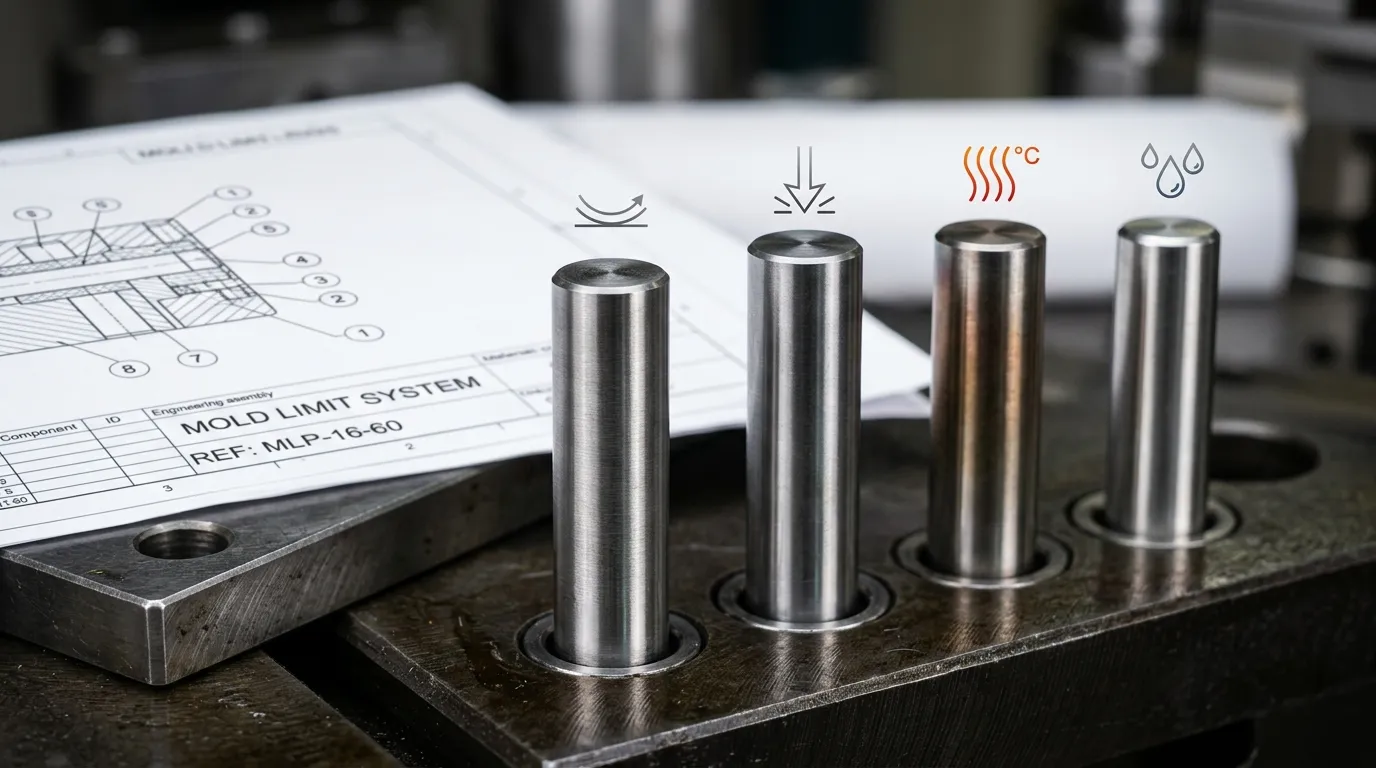
Choose the Material by Service Condition, Not Hardness Alone
The first step is to identify the condition most likely to damage the pin. A pin exposed to abrupt stopping loads needs a different property balance from one experiencing gradual contact wear.
Matriz rápida de selección de materiales
| Situación de servicio | Riesgo principal | Propiedades a priorizar | Categoría de material a evaluar | Principal punto de limitación o verificación |
|---|---|---|---|---|
| Impacto controlado y desgaste moderado | Hendidura o desgaste gradual | Dureza adecuada con una tenacidad razonable | Acero de carbono medio como el S45C | Confirm the finished hardness, Apoyo, Área de contacto, and expected cycle demand |
| Impacto abrupto repetido | Astillado, Grietas, or impact fracture | Tenacidad y resistencia a golpes | Acero para herramientas tipo S7 resistente a impactos | Una mayor dureza por sí sola puede reducir la tolerancia al impacto |
| Desgaste de alto contacto con impactos limitados | Pérdida dimensional en la cara de contacto | Resistencia al desgaste y resistencia a la compresión | Acero orientado al desgaste | Verifica que la tenacidad sea suficiente para el nivel real de impacto |
| Temperatura de funcionamiento elevada | Softening, Fatiga térmica, o cambio dimensional | Resistencia en caliente y estabilidad térmica | Acero tipo H13 para herramientas de trabajo en caliente | Normalmente no es necesario para un servicio a temperatura normal |
| Ambiente húmedo o corrosivo | Rust, Pitting, or surface deterioration | Resistencia a la corrosión | Acero inoxidable para moldes o herramientas | Confirma que su dureza y tenacidad también soportan la carga |
| Condiciones de fallo mixtas o poco claras | Daños repetidos e inexplicables | Revisión de propiedades equilibradas y causas raíz | Revisión de ingeniería específica de la aplicación | Do not change material before checking alignment, Geometría, y superficies de acoplamiento |
This matrix narrows the options, but it does not replace a drawing and application review. Diámetro, Longitud sin soporte, contact-face geometry, Carga lateral, and heat treatment can change how the same steel performs.
Confirma que el componente es un pasador límite antes de seleccionar su material
The term “mold limit pin” is not used consistently across every supplier, catalog, or drawing. It may also appear as a Pasador de parada de moho, Pasador de límite de placa eyector-, o, in some assemblies, a Disco de parada.
A typical stop or limit pin restricts the movement of an ejector plate or another mold mechanism. Some stop-pin designs are installed between an ejector plate and a rear clamping plate to control the plate’s resting position and prevent uncontrolled metal-to-metal contact. Other drawings may use a limit pin in a slider mechanism.
The drawing should confirm the function before any material is selected.
| Componente | Función principal | Preocupación típica de materiales |
| Pasador límite o de parada | Restringe el mecanismo o el recorrido de la placa eyector | Impact, Desgaste de contacto, Deformación, and fracture |
| Pasador guía | Alinea mitades de molde móviles y estacionarias | Desgaste deslizante, Rectitud, Ajuste, y lubricación |
| Pasador eyector | Empuja la pieza moldeada desde la cavidad | Desgaste deslizante, Flexión, Temperatura, y acabado superficial |
| Pasador de retorno | Retorna o posiciona el sistema de eyección | Repeated movement, Alineación, and compressive loading |
| Clavo de varilla | Localiza dos componentes con precisión | Shear strength, Ajuste, and positional accuracy |
Guide pins and bushings belong to a different alignment system. Their fit, Autorización, and lubrication requirements are covered separately in the guide to Pasadores y casquillos de molde.
Balance Hardness, Dureza, Resistencia al impacto, and Wear Resistance
Four properties control most limit-pin material decisions.
Dureza helps the contact face resist indentation and some forms of wear. If the surface is too soft for the applied load, the end of the pin can lose its shape or effective height.
Dureza is the ability to resist cracking and absorb energy before fracture. It becomes critical when the pin receives abrupt, repeated contact rather than a gradual compressive load.
Resistencia al impacto describes how well the material handles sudden loading. It is affected by toughness, Dureza, Tratamiento térmico, Geometría, and defects such as sharp transitions.
Resistencia al desgaste helps the pin maintain its dimensions under repeated contact. It depends on more than hardness. Steel composition, Estructura de carburos, Condición de la superficie, Presión de contacto, Contaminación, and relative movement all affect wear.
A harder steel is not automatically a better limit-pin material. High hardness can reduce plastic deformation, but if the steel lacks sufficient toughness, the failure may change from mushrooming to chipping or cracking.
The material therefore needs enough hardness to retain the contact face and enough toughness to survive the way the load is applied. Orientación técnica de Uddeholm sobre el tratamiento térmico de acero para herramientas also shows that final properties depend on alloy design, Microestructura, hardening, and tempering rather than the grade name alone.
What Happens When the Pin Is Too Soft?
Possible symptoms include:
- Hendidura en la cara de contacto
- Brotando alrededor del extremo impactado
- Desgaste dimensional acelerado
- Reducción de la altura efectiva de tope
- Cambios en el recorrido del eyector o del mecanismo
- Daños superficiales tanto en el pasador como en la placa de acoplamiento
These symptoms do not always mean the material grade is wrong. Estrés de contacto excesivo, a small contact area, off-axis loading, inadequate support, or an incorrect heat-treated condition can produce similar damage.
What Happens When the Pin Is Too Hard or Insufficiently Tough?
An overly brittle pin may develop:
- Virutas de borde pequeñas
- Grietas cerca de la cara de contacto
- Fractura súbita
- Daño en las transiciones de diámetro
- Fallo bajo ligera carga lateral o desalineación
Increasing hardness without checking toughness can also move the damage elsewhere. The pin may remain intact while the mating plate begins to indent or crack.
Comparar categorías de materiales para pasadores límite de molde
A buying decision should compare material families by their property balance and best-fit conditions. The grades below are engineering reference categories. Except for S45C, they should not be treated as confirmed SunshinePro material offerings without direct confirmation.
| Categoría de material | Principales fortalezas | Mejor condición de ajuste | Principal compensación |
| Acero de carbono medio S45C/45# | Practical machinability, established availability, heat-treatment flexibility | Impacto controlado y desgaste moderado | May be insufficient for severe shock, Calor, or corrosion without an appropriate finished condition |
| Acero resistente a golpes tipo S7 | Alta tenacidad, Resistencia al impacto, and balanced wear performance | Impacto abrupto repetido o historial de astillas | Requiere un tratamiento térmico controlado y puede aumentar el coste |
| Acero tipo H13 para trabajo en caliente | Hot strength, dureza, y estabilidad térmica | Temperatura elevada o ciclos térmicos repetidos | Innecesario para muchas aplicaciones a temperatura normal |
| Acero orientado al desgaste | Fuerte resistencia al desgaste y retención dimensional | Desgaste de alto contacto con impacto limitado | Una mayor resistencia al desgaste puede derivar de una menor tolerancia al impacto |
| Acero inoxidable para molde/herramienta | Resistencia a la corrosión con propiedades mecánicas de grado moldeado | Humedad, corrosive cleaning, Almacenamiento, or process exposure | La elección del material debe seguir cumpliendo los requisitos de impacto y dureza |
Acero S45C/45# para servicio estándar o controlado
Actual de SunshinePro Página del producto Mold Limit Pin publishes S45C, also described as 45# steel, as the product material.
S45C is a medium-carbon steel designation. It may be a practical option when:
- La carga de frenado está controlada
- El impacto no es inusualmente severo
- La demanda de desgaste es moderada
- El pasador tiene un diámetro y soporte adecuados
- La cara de contacto está correctamente alineada
- Se verifica la condición final de tratamiento térmico
- Los requisitos de reemplazo y mantenimiento son predecibles
The material name alone does not establish performance. The buyer still needs to confirm the final hardness, Condición de tratamiento térmico, Método de prueba, Geometría, and loading environment.
International buyers may also encounter SAE 1045 in cross-reference tables. Nippon Steel lists S45C and SAE 1045 together in its Documentación de grado especial de acero, but apparent equivalents should not be substituted automatically. The governing standard, chemical composition, delivery condition, and required properties must be checked.
Acero resistente a golpes tipo S7 para impactos repetidos
An S7-type tool steel is relevant when the pin repeatedly receives abrupt impact or when the current pin shows chipping and cracking rather than gradual wear.
Shock-resistant steel is selected for a different reason from a high-wear steel. Its main advantage is the ability to combine useful hardness with stronger resistance to impact fracture. Uddeholm’s documentation for its Acero Compax Supreme tipo AISI S7 highlights toughness, Resistencia al impacto, Resistencia al desgaste, through-hardening capability, y estabilidad dimensional.
This category may be worth evaluating when:
- El evento de parada es repentino
- La frecuencia del ciclo es alta
- Aparecen pequeñas astillas en la cara de contacto
- El pasador experimenta cargas laterales ocasionales
- Un acero más duro enfocado en el desgaste se ha fracturado prematuramente
The trade-offs can include more demanding heat treatment, higher material cost, and different machinability.
Acero tipo H13 para trabajo en caliente para temperaturas elevadas
H13-type hot-work tool steel is relevant when the pin operates at a temperature high enough to affect normal steel hardness, Fuerza, or dimensional stability.
Possible use conditions include:
- Altas temperaturas de funcionamiento en el molde
- Ciclos repetidos de calefacción y refrigeración
- Transferencia significativa de calor desde las zonas de moho cercanas
- Un servicio en el que la resistencia al calor importa tanto como la dureza a temperatura ambiente
Resumen técnico del H13 de Uddeholm describes the category in terms of toughness, elevated-temperature resistance, Resistencia al desgaste, y estabilidad térmica.
H13 should not be treated as an automatic upgrade. For a normally cooled mold with moderate impact, its thermal properties may provide little practical advantage.
Acero inoxidable o de desgaste para condiciones especiales
Stainless mold steel should be considered when corrosion is a real service risk rather than a theoretical concern. Relevant conditions may include humid storage, condensation, corrosive cleaning agents, or a production environment that repeatedly exposes the pin to moisture.
Un acero inoxidable para molde, como la categoría representada por Uddeholm Stavax ESR can combine corrosion resistance with useful wear and hardening characteristics. The final selection still needs to satisfy the impact load.
Wear-oriented tool steel belongs to a different category. It may help where repeated contact gradually removes material but impact remains controlled. A high-wear steel should not be chosen solely because the current pin is wearing. If the contact is also abrupt, insufficient toughness can create a more serious fracture risk.
Specify the Heat-Treated Condition, Not Only the Steel Grade
Two pins made from the same nominal steel can perform differently if their heat treatments are different.
The final condition depends on factors such as:
- Método de endurecimiento
- Condiciones de temple
- Temple
- Tamaño de la sección
- Control de descarbonización superficial
- Condición central
- Control de distorsión
- Rectificado o acabado final
Through-hardening develops properties through the pin section. Surface-hardening processes modify the outer layer while leaving a different core condition. Neither approach is automatically superior; suitability depends on the required contact hardness and core toughness.
A purchase specification should state more than “hardened steel.” It may need to define:
- Designación del material y norma que rige
- Condición térmica requerida
- Escala de dureza
- Rango de dureza aceptable
- Ubicación de la prueba
- Requisitos de superficie o núcleo
- Requisitos dimensionales tras el tratamiento térmico
- Documentación de inspección requerida
Rockwell hardness testing should follow an appropriate recognized method. ISO 6508-1:2023 specifies regular and superficial Rockwell hardness test methods for metallic materials.
SunshinePro’s product page currently lists both vacuum heat treatment and a hardness of 15–17 HRC. Buyers should request confirmation of how those statements apply to the ordered pin, including the final material condition and hardness-test location. The published value should not be treated as a universal recommendation for all limit-pin applications.
Por qué los recubrimientos o tratamientos superficiales no pueden corregir el sustrato incorrecto
A surface treatment may improve wear behavior or alter friction, but it cannot give an unsuitable core the toughness needed to survive severe impact.
The complete system includes:
- Acero de base
- Condición de tratamiento térmico del núcleo
- Tratamiento superficial
- Geometría de contacto
- Soporte de clavos
- Material de apareamiento
- Dirección de carga
A hard surface over a weak or brittle substrate may still crack, bend, or fail below the treated layer.
Utiliza los síntomas de fallo para identificar la propiedad que falta
Before changing steel grades, inspect how the current pin failed.
| Síntoma de fallo | Posible problema relacionado con el material | Otras condiciones a inspeccionar |
| Hendidura | Dureza o resistencia a compresión insuficientes | Área de contacto pequeña, excessive load, soft mating surface |
| Crecimiento de setas | Deformación plástica excesiva | Off-axis impact, unsupported end, poor contact geometry |
| Desgaste rápido superficial | Resistencia al desgaste o condición superficial inadecuada | Contaminación, Trastes, Desalineación, superficie rugosa de acoplamiento |
| Astillado | Resistencia insuficiente o frágilidad excesiva | Sharp edges, impact concentration, Defectos en el tratamiento térmico |
| Grieta o fractura repentina | Baja tenacidad o dureza terminada inadecuada | Carga lateral, diameter transition, internal defect, Desalineación |
| Bending | Resistencia de sección insuficiente | Longitud excesiva sin soporte, off-axis force, Apoyo pobre |
| Corrosión o picaduras | Resistencia insuficiente a la corrosión | Humedad, cleaning chemicals, storage conditions |
These symptoms identify areas to investigate, not definitive causes. A pin that bends may need a tougher material, but it may also need a larger diameter, shorter unsupported length, or improved alignment.
Revisa la placa de unión antes de aumentar la dureza del pasador
The pin and mating plate form one contact system. Changing only the pin can transfer damage to the other component.
Before increasing hardness, Comprobado:
- Material y dureza de la placa de acoplamiento
- Planitud de la cara de contacto
- Área de contacto
- Alineación de cargas
- Soporte de placa
- Hendidura o grieta existente
- Contaminación superficial
The goal is not to make the replaceable pin as hard as possible. The goal is to control wear and deformation across the assembly without creating a brittle failure point.
Proporciona al proveedor las condiciones que controlan la selección del material
A supplier cannot make a reliable recommendation from diameter and length alone. The inquiry should include the information that controls loading and failure.
Proporcionar:
- La función exacta del pasador
- Ubicación de la instalación
- Dibujo y revisión actuales
- Diámetro y longitud total
- Longitud sin soporte
- Geometría de caras de contacto
- Mechanism or ejector force, donde se conoce
- Frecuencia de ciclo
- Duración prevista del servicio
- Temperatura normal y máxima de funcionamiento
- Exposición a humedad o productos químicos
- Material y dureza del componente de acoplamiento
- Material de los pasadores de corriente
- Especificación existente de tratamiento térmico
- Fotografías o descripciones de fracasos anteriores
- Material requerido y documentos de inspección
SunshinePro states that standard and non-standard sizes are available and that non-standard mold parts can be processed from drawings. Its product page also states that material-selection advice is available. These points support a drawing-based review, but they do not confirm that every material category discussed in this guide is available.
Verifica el material y el estado acabado antes de aprobar el pedido
A material recommendation is only useful if the delivered parts can be checked against it.
Before approval, confirmar:
- Designación exacta del material
La orden de compra debe identificar la calidad y el estándar que lo detiene, en lugar de basarse en una etiqueta amplia como "acero para herramientas". - Certificado de material o informe de prueba
Where required, the document should identify the material batch or heat and provide traceable grade information. - Condición de tratamiento térmico
Confirm whether the pin is supplied annealed, normalized, quenched and tempered, through-hardened, or surface treated. - Dureza terminada
State the test scale, required range, y ubicación de prueba. A surface reading may not describe the core condition. - Inspección dimensional tras el tratamiento térmico
Heat treatment can influence straightness, diámetro, Longitud, and contact-face geometry. - Documentación de tratamiento superficial
When a coating or treatment is specified, confirm that it applies to the ordered material and finished condition. - Trazabilidad por lotes
The delivered parts should be connectable to the relevant material and inspection records.
Guía de SunshinePro para Piezas de molde de precisión provides broader context on material, Tolerancia, Fin, Trazabilidad, y control de calidad de proveedores. The limit-pin order should still define which records are actually required; buyers should not assume that every standard order includes every type of certificate.
Afirmaciones del proveedor que necesitan más pruebas
Treat the following statements as incomplete unless the supplier provides supporting details:
- "La dureza más alta durará más."
- "Este acero para herramientas es adecuado para cualquier molde."
- “These grades are equivalent,” without naming the governing standards.
- “Vacuum heat treated,” without stating the final condition or hardness.
- “High wear resistance,” without defining the contact condition.
- “High impact resistance,” without identifying the grade and heat treatment.
- “Certified material,” without a certificate tied to the delivered batch.
- “Longer service life,” without comparable operating conditions.
ASTM A681-24 reinforces the broader principle that tool-steel selection depends on design, service conditions, and the properties required by the application.
Evalúa la opción S45C publicada por SunshinePro frente a la aplicación
SunshinePro’s current Mold Limit Pin page publishes:
- Acero S45C/45#
- 15–17 HRC
- Tamaños estándar y no estándar
- Apoyo a la selección de materiales
- Tratamiento térmico al vacío
This information provides a commercial baseline, but suitability still depends on the application.
The published S45C option may be evaluated first where impact is controlled, wear is moderate, temperature is not unusually high, and corrosion is not a major concern.
A custom material or processing review becomes more important when:
- Los pasadores se astillan o agrietan repetidamente
- Las setas de contacto en la cara
- Se produce flexión
- El molde funciona a temperaturas elevadas
- Hay corrosión presente
- La placa de acoplamiento está siendo dañada
- Se requiere una dureza específica en el núcleo o en la superficie
- El material actual ha fallado a pesar de la instalación correcta
Alternative steel categories discussed in this guide should not be assumed to be available from SunshinePro. Their availability, Tratamiento térmico, Documentación, and dimensional feasibility need direct confirmation.
Selecciona el PIN como parte del sistema de contacto
A defensible mold limit pin material selection follows six checks:
- Confirm the component’s exact function.
- Identify whether impact, Desgaste, Calor, Corrosión, or bending is the dominant risk.
- Select the required balance of hardness and toughness.
- Specify the material’s finished heat-treated condition.
- Check the mating plate, Cara de contacto, Apoyo, y alineación.
- Verify the material, Dureza, Dimensiones, and traceability before approval.
For an application that falls outside the published S45C baseline, Presentar el dibujo del pin límite y las condiciones de servicio para reseña. Include the cycle demand, Temperatura de funcionamiento, Medio ambiente, Material de apareamiento, and any existing failure symptoms so the material and finished condition can be evaluated together.
Compartir:



Escrito por Sunshine
Al sol, Somos un fabricante y proveedor profesional de componentes de moldes de precisión, ofreciendo una amplia gama de productos para aplicaciones de estampado y moldes de inyección. Nuestro enfoque principal es el punzonamiento de troqueles, Pasadores y fundas eyector, y postes guía y casquillos. Con mecanizado CNC avanzado, Control de calidad estricto, y una fuerte capacidad de producción, Garantizamos la fiabilidad, Piezas de alta precisión, junto con componentes estándar en stock para un suministro global rápido y eficiente.
NOTICIAS
CONSIGUE EL SERVICIO
Con piezas de calidad para todos los presupuestos y personal amable formado para que tu visita sea informativa y sin complicaciones.
