



Pasadores límite de molde para moldes automotrices: Carga, Desgaste, y Precisión
Mold limit pins for automotive molds act as mechanical stops. They establish or restrict the travel of an ejector plate, deslizador, side action, or another moving mold component. Their performance depends on more than pin diameter or material. The stopped mechanism, contact speed, pin support, Superficie de apareamiento, Distribución de carga, and required endpoint all affect the result.
Los pines límite pertenecen a un sistema más amplio de Piezas estándar de molde (Inferido), but they should not be selected using broad catalog criteria alone. A suitable stop must carry the intended reaction without bending, Aflojamiento, damaging the mating plate, or gradually changing the mechanism’s final position.
There is no universal pin diameter, Dureza, Ajuste, or replacement interval for every automotive mold. Selection starts by defining the movement being controlled.
Qué controla un pasador límite de molde—y qué no controla
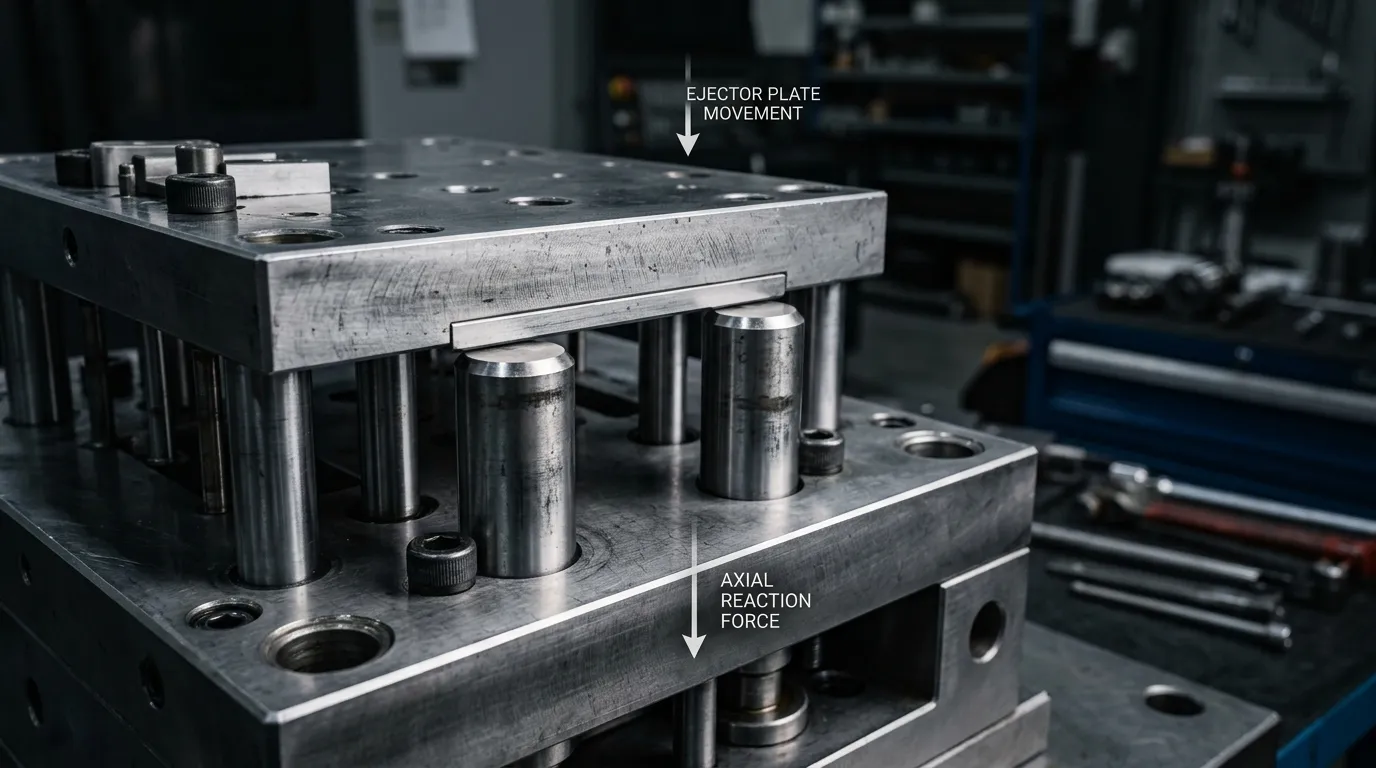
A mold limit pin is a fixed mechanical stop. When the moving mold component reaches the designed endpoint, it contacts the pin or a surface supported by the pin. The stop reaction then passes into the mounting plate and surrounding mold structure.
“Limit pin” and “stop pin” are often used for similar components, but supplier terminology is not always consistent. The drawing should therefore state the actual function:
- which component moves;
- the direction of movement;
- the required endpoint;
- which surfaces make contact;
- whether the stop sees gradual loading or repeated impact.
A limit pin should also be separated from other cylindrical mold components.
| Componente | Función principal | Interacción típica | Principal preocupación de selección |
|---|---|---|---|
| Pasador límite o pasador de tope | Restringe el viaje en un extremo definido | La placa o mecanismo móvil contacta el tope | Carga de contacto, Apoyo, Desgaste, and effective stop length |
| Pasador guía y casquillo | Guía y alinea las secciones del molde durante el movimiento | El pasador guía acopla su casquillo correspondiente | Alineación, Compromiso, Autorización, Lubricación, y desgaste |
| Pasador eyector | Empuja el componente moldeado desde la cavidad o núcleo | La cara del pasador contacta con la pieza moldeada | Ejection force, Ubicación, surface marks, y retención |
| Pasador de retorno | Devuelve o reinicia el conjunto eyector | El cierre del molde o un mecanismo de retorno mueve el sistema eyector hacia atrás | Return stroke, Interferencia, and reliable reset |
| Bloque límite | Proporciona un tope mecánico más amplio | La placa o mecanismo contacta una cara de tope más grande | Área de contacto, space, Apoyo, and replacement access |
Guide pins and bushings are responsible for guided mold movement and mold-half alignment. Their design belongs to the separate subject of Pasadores y casquillos de molde. A limit pin may help maintain a repeatable mechanism endpoint, but that does not make it a substitute for a guide system.
Define el mecanismo del molde del automóvil antes de seleccionar el tope
The first design question is not “Which pin size should be used?” It is “What movement must be stopped?”
An automotive mold may contain several moving systems, each with different loading conditions:
- an ejector plate reaching the end of its stroke;
- a slider reaching its open or closed position;
- a side-action mechanism stopping after core withdrawal;
- a moving support or auxiliary plate reaching a controlled endpoint.
Before selecting a stop, Define:
- The moving component and its direction of travel.
- The total stroke and required final position.
- The moving mass.
- The expected velocity when contact occurs.
- Any hydraulic, Primavera, Máquina, or mechanical force still acting at the endpoint.
- The number and location of stop points.
- The available plate thickness and pin support depth.
- The mating-surface material and contact geometry.
- Access for installation, Inspección, Ajuste, y sustitución.
- Any OEM, Tier, or customer-specific tooling requirements.
Automotive customer specifications may set their own rules for mechanical stops, Placas de desgaste, Sistemas guía, movement controls, Materiales, or documentation. Those requirements should be checked before generic design guidance is applied.
Topes de placa eyector
An ejector plate is usually broad and relatively stiff, but it may still deflect under load. If several limit pins are used, their position and effective height affect how the plate reaches the endpoint.
A practical ejector-plate stop arrangement should consider:
- whether the stops are distributed around the loaded area;
- whether the plate can contact all stops at nearly the same time;
- whether one region of the plate bends before another;
- whether the stop reaction is transferred into adequately supported mold structure;
- whether the pins remain accessible after assembly.
If one pin is slightly taller or better supported than the others, it may contact first and carry a disproportionate part of the reaction.
Slider, Side-Action, and Moving-Plate Stops
Horizontal or angled mechanisms introduce additional concerns. A stop pin may receive side load if the slider is not guided correctly or if the contact faces are not square to the direction of travel.
For these mechanisms, verificar:
- whether the stop controls the open or closed position;
- whether the contact is axial or angled;
- whether a wear plate or replaceable insert is needed;
- whether an adjustable endpoint is required;
- whether dirt, lubricante, or molding residue can enter the contact area;
- whether the stop can be inspected without major disassembly.
The guide system should control the path of the slider. The stop should control its endpoint. Combining both functions in one unsupported pin increases the risk of bending and uneven wear.
Cómo viaja la carga a través del sistema de pasadores límite
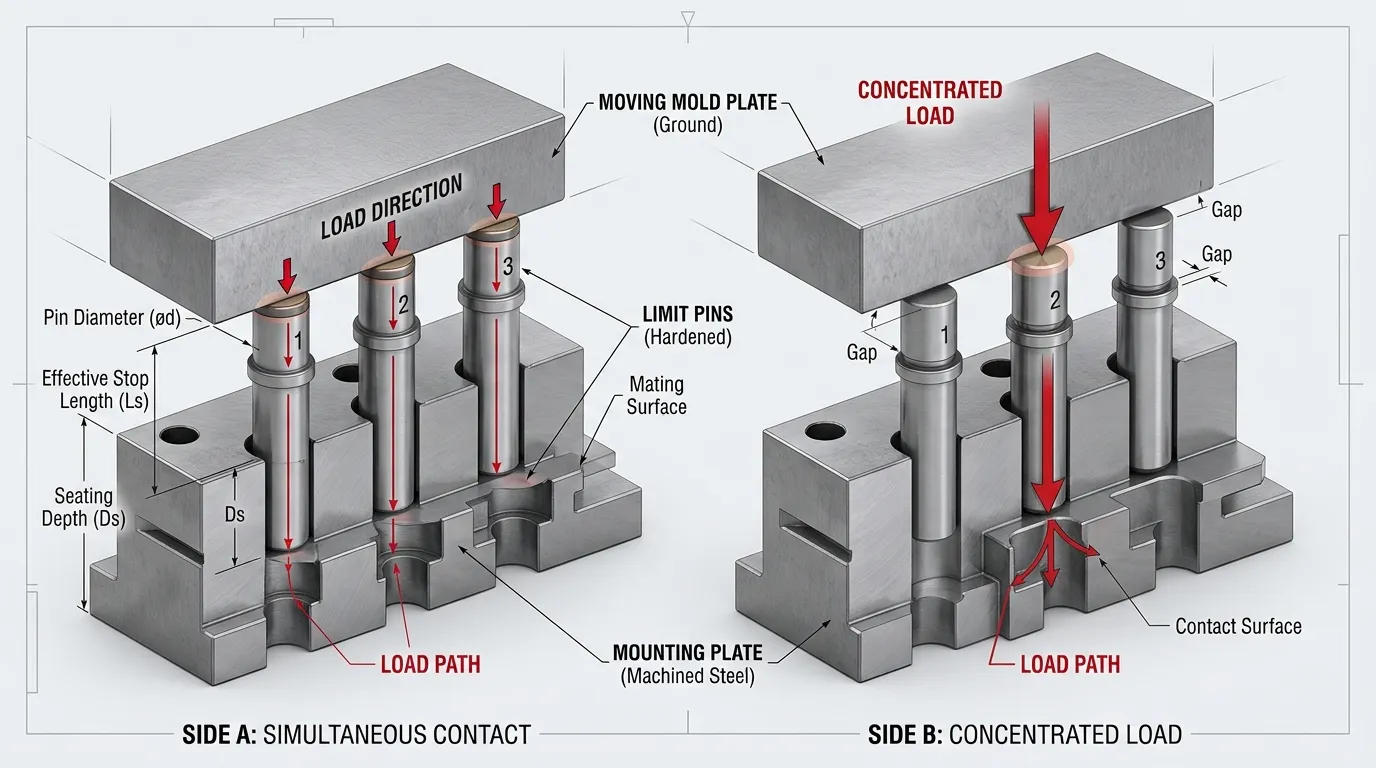
A limit pin does not carry load independently. It is one part of a load path:
mecanismo móvil → cara de contacto → pasador de límite o tope → asiento del pasador → placa de montaje → estructura de molde
Every part of that path must support the reaction.
A pin loaded directly along its axis mainly sees compression. A pin contacted off-center or at an angle may also see bending. Bending becomes more significant when the exposed length is large, the mounting support is shallow, or the contact force is not aligned with the pin axis.
The mating surface matters as much as the pin. A small pin end creates a concentrated contact area. Even when the pin itself remains intact, the opposing plate may indent or wear. That indentation changes the effective stopping position.
The surrounding plate must also be stiff enough to support the stop. A strong pin mounted in a thin or flexible plate may still produce inconsistent contact because the plate deflects.
Contacto estático frente a impacto al final de la carrera
A mechanism that settles gradually against a stop creates a different condition from one that strikes the stop at speed.
| Condición de contacto | Características principales | Preocupación de selección |
| Contacto gradual o estático | La carga aumenta lentamente y puede permanecer en el extremo | Compresión, Soporte de placas, long-term indentation, y estabilidad |
| Contacto de impacto repetido | La masa en movimiento alcanza el tope con velocidad medible | Impact severity, dureza, Aflojamiento, Deformación, and mating-surface damage |
| Contacto controlado o amortiguado | El movimiento se ralentiza antes de alcanzar la parada mecánica | Residual force, control reliability, and emergency stop capacity |
Moving mass and contact velocity influence the energy reaching the stop. Deceleration distance, Amortiguación, machine control, and structural flexibility also affect the contact condition. A final pin design should not be approved from static force alone when repeated impact is possible.
Por qué varios pines de límite pueden no compartir la carga por igual
Using four stops does not guarantee that each carries one quarter of the load.
Unequal sharing can result from:
- small differences in effective pin height;
- uneven seating;
- Desviación de placas;
- non-parallel contact surfaces;
- asymmetric stop placement;
- different support stiffness beneath each pin;
- wear or indentation at one contact point.
The tallest or stiffest-supported pin may contact first. It then begins carrying load before the other stops engage. Con el tiempo, this can create a repeating pattern: one pin wears or indents faster, the endpoint shifts, and the remaining pins begin contacting under different conditions.
Effective stop height, Asientos, Rigidez de la placa, and contact pattern should therefore be evaluated together.
Geometría, Material, and Fit Determine Wear and Endpoint Stability
Catalog dimensions describe the part, but they do not fully describe its performance. Diámetro, Longitud efectiva, exposed length, Ajuste de montaje, Geometría de contacto, Condición del material, and the opposing surface all influence the stop.
Diámetro, Effective Length, and Unsupported Length
Several dimensions have different functional roles:
| Dimensión o característica | Efecto funcional |
| Diámetro del pin | Influences stiffness, bearing area in the mounting hole, and resistance to bending |
| Longitud total | Define el tamaño total del componente pero puede no ser igual a la dimensión de parada funcional |
| Longitud efectiva de registro | Controla el extremo final del mecanismo |
| Longitud sin soporte | Influye en la sensibilidad y rigidez de la flexión |
| Profundidad de asientos | Afecta al soporte y a la estabilidad posicional |
| Geometría de extremos | Controla el área de contacto y la presión local |
| Característica de hombro o retención | Affects seating, Montaje, Eliminación, and repeat positioning |
A long pin with a small exposed diameter is more sensitive to lateral force than a short, well-supported pin of the same material. Increasing hardness alone does not correct an unfavorable load direction or excessive unsupported length.
The mounting-hole fit also needs to match the intended service method. A permanently retained pin, a replaceable maintenance item, and an adjustable stop do not require the same mounting arrangement.
Dureza, Dureza, and the Mating Surface
Hardness can improve resistance to indentation and abrasive wear, but it is not the only material property that matters. Repeated impact also requires adequate toughness. A harder component is not automatically a safer component if it becomes more sensitive to cracking or transfers damage into a softer plate.
The pin and mating surface should be treated as a contact pair. Comprobado:
- pin material and heat-treated condition;
- pin hardness;
- mating-surface material and hardness;
- end-face contact area;
- contact angle;
- expected impact severity;
- whether the mating surface is replaceable.
A hardened wear plate or replaceable insert may be more practical than allowing the stop to contact an expensive mold plate directly. It can localize wear in a serviceable component, provided the insert is adequately supported and secured.
Heat treatment should be defined by the required material condition, not by a generic claim that heat-treated parts are always better. The target hardness, treatment method, distortion control, and verification requirements should be stated where they are functionally important.
Ajuste, Asientos, and Functional Precision
For a limit pin, useful precision means the mechanism reaches a stable, repeatable endpoint. That result depends on more than a tight diameter tolerance.
Important factors include:
- the pin’s effective stop length;
- Ajuste de montaje;
- full seating against the reference surface;
- perpendicularity of the pin to the contact direction;
- flatness and condition of the opposing surface;
- height consistency between multiple stops;
- resistance to loosening;
- repeatability after replacement.
El Sistema ISO 286 para tolerancias y ajustes provides standardized terminology for linear-size tolerances and hole-and-shaft relationships. It does not identify one universal fit for every limit pin. The required fit depends on retention, Sustituto, Carga, Temperatura, Material de la placa, y necesidades de mantenimiento.
Surface texture should also be specified only where it affects fit, Contacto, Medición, or wear. Broader information about tolerance, Acero, and inspection planning belongs with Piezas de molde de precisión.
Los patrones de desgaste muestran dónde falla el sistema de tope
A worn pin is often a symptom of a wider stop-system problem. Visual damage should be treated as evidence to investigate, not as a complete diagnosis.
| Observación | Posibles colaboradores | Riesgo funcional | Qué verificar |
| Hendidura en la cara final | High local contact pressure, soft material condition, Impacto, small contact area | Reducción de la altura efectiva de tope | Área de contacto, Dureza, impact condition, Superficie de apareamiento |
| Extremo de alfileres con setas | Deformación plástica por carga concentrada o repetida | Cambio de endpoint y eliminación difícil | Material condition, impact severity, Geometría de extremos |
| Pasador doblado | Carga lateral, off-axis contact, longitud excesiva sin soporte, poor guidance | Desalineación del contacto y punto final inestable | Dirección de carga, support depth, Estado de la guía |
| Desgaste unilateral | Tilted contact, Carga lateral, Desviación de placas, Asientos pobres | Transferencia desigual de carga | Patrón de contacto, Perpendicularidad, Rigidez de la placa |
| Puntuación | Contacto deslizante, Contaminación, Desalineación, superficie rugosa de acoplamiento | Desgaste acelerado y posible convulsión | Contact direction, Escombros, Lubricación, Condición de la superficie |
| Pasador suelto | Incorrect fit, Impacto repetido, damaged mounting hole, poor retention | Movimiento del extremo y daño adicional a la placa | Mounting fit, hole condition, retention method |
| Placa de acoplamiento hundida | Pin harder than the opposing surface, small contact area, insufficient support | Deriva de punto final incluso si el pin parece aceptable | Dureza de la placa, insert condition, Apoyo, Geometría de contacto |
| Desgaste desigual entre varios alfileres | Height mismatch, unequal support, Desviación de placas | Una parada transporta la carga primero | Effective heights, Asientos, spacing, contact sequence |
Wear changes the geometry of the stop system. Material loss from the pin, indentation in the mating surface, or movement inside the mounting hole can all alter the final position without producing a complete fracture.
Replacement should therefore be based on functional condition, Cambio dimensional, Patrón de contacto, and application requirements—not a universal number of molding cycles.
Choose the Right Stop Architecture: Pin, Block, or Adjustable Stop
A cylindrical limit pin is useful when space is limited, the contact direction is controlled, and the required endpoint can be established with a fixed component. It is not automatically the best stop for every mechanism.
| Opción de parada | Mejor adaptado para | Principales ventajas | Principales limitaciones |
| Pasador de límite fijo | Compacto, defined stop points with controlled axial contact | Geometría simple, replaceable, available in standard or custom forms | Limited contact area; sensitive to side load and support conditions |
| Bloque límite | Mayor contacto o mayor necesidad de distribución de carga | Larger contact area, robust support, easier use of replaceable wear faces | Requiere más espacio y superficies de montaje precisas |
| Tope ajustable | Endpoint que requiere configuración o corrección controlada | Permite ajustar la posición durante el montaje o mantenimiento de la herramienta | Needs secure locking, Acceso, and verification after adjustment |
| Usa el inserto con tope | Placa cara que requiere una superficie de contacto en condiciones | Protege la placa principal y simplifica el mantenimiento | Adds components, attachment requirements, and tolerance interfaces |
Sensors or switches may confirm that a mechanism reached a position, but position detection does not automatically replace a correctly designed mechanical stop. The control and mechanical systems should have clearly defined roles.
Cuando un pin estándar es suficiente, y cuando la personalización está justificada
A standard pin may be suitable when its geometry, Condición del material, Ajuste, Longitud efectiva, Cara de contacto, and replacement method match the mold requirement.
Customization may be justified when the application needs:
- a non-standard effective length;
- a special shoulder or mounting feature;
- a larger or shaped contact end;
- a specified material or heat-treated condition;
- tighter control of a functional dimension;
- replacement compatibility with an existing mold;
- customer-specific documentation;
- improved installation or removal access.
Custom does not automatically mean better. It is justified when the standard component cannot satisfy the defined function without compromise.
Qué poner en el dibujo o en la RFQ
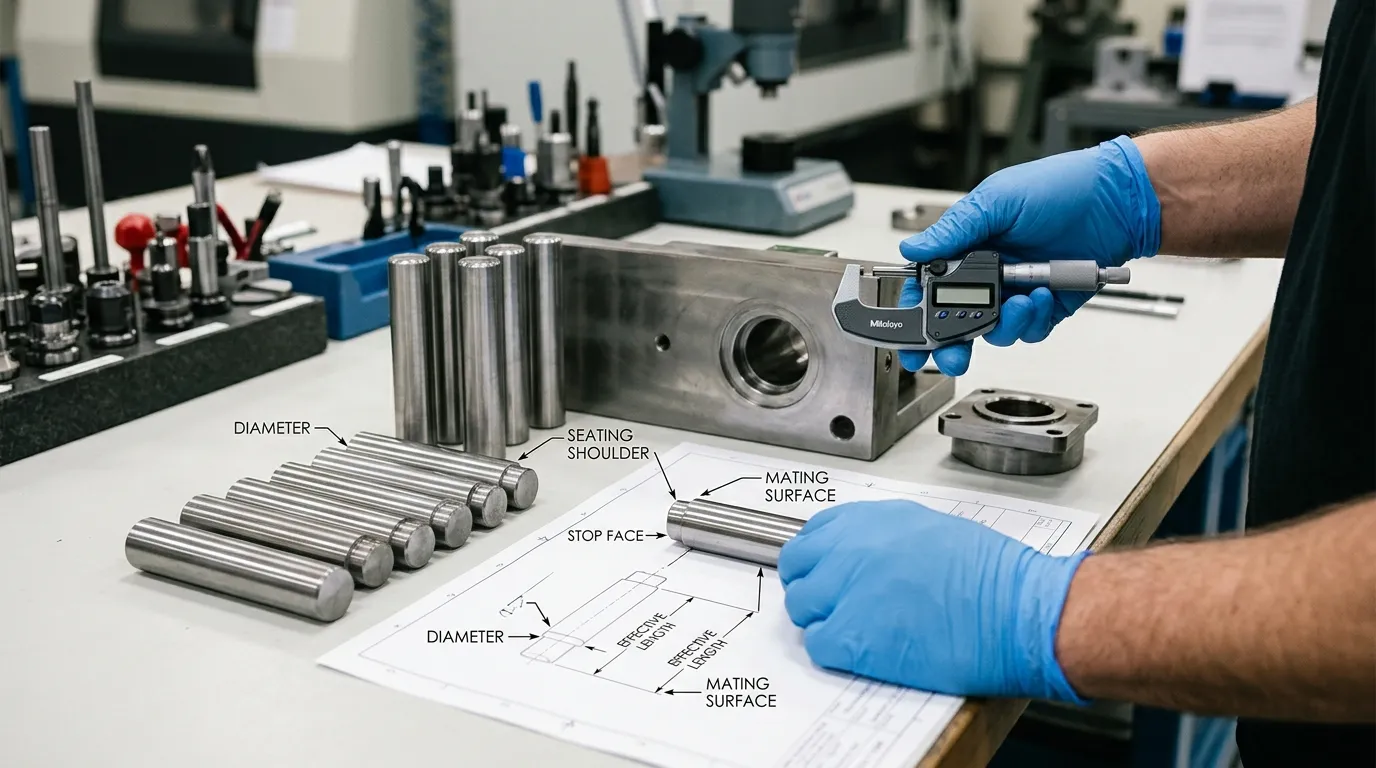
A useful RFQ should describe both the part and the mechanism in which it will operate. Sending only a nominal diameter and length leaves important engineering decisions undefined.
Información de la aplicación
Incluye:
- type of moving mechanism;
- stopped component;
- direction of travel;
- total stroke;
- required final position;
- Masa en movimiento;
- expected contact velocity or impact condition;
- external hydraulic, Primavera, Máquina, or mechanical force;
- number and spacing of stops;
- operating temperature and contamination conditions where relevant;
- applicable automotive customer or tooling specification.
Definición de componentes
Especificar:
- Diámetro del pin;
- total length;
- effective stop length;
- unsupported or exposed length;
- Geometría de extremos;
- shoulder and seating dimensions;
- mounting-hole relationship;
- fit or retention requirement;
- removal feature if replacement is expected;
- geometric controls needed for seating or contact.
Requisitos de materiales y procesos
State:
- material grade and condition;
- heat-treatment requirement;
- target hardness where justified;
- functional surface requirements;
- mating-surface material and hardness;
- need for a wear plate or replaceable insert.
Inspección y documentación
Depending on the project, request:
- dimensional inspection results;
- Verificación de dureza;
- Documentación material;
- drawing revision control;
- part or batch identification;
- first-article or sample approval;
- confirmation of replacement interchangeability;
- customer-specific automotive records.
IATF 16949 concerns automotive quality-management systems. Certification may support process control, but it does not prove that a particular limit-pin geometry, Material, or load rating is correct for the mold.
SunshinePro states that it supports custom mold parts based on customer drawings and lists standard and non-standard mold limit pin options. Its published Mold Limit Pin configuration uses S45C, with stated diameter and length tolerances, 15–17 HRC hardness, Rectificado de precisión, y tratamiento térmico al vacío. These are product-page specifications, not universal design criteria for every automotive application.
The listed configuration should be checked against the actual mechanism load, Apoyo, Superficie de apareamiento, Ajuste, endpoint requirement, and customer specification. Readers who have completed these checks can review SunshinePro’s Opciones de pasadores límite de molde o Presentar un dibujo y requisitos de solicitud for quotation.
Compartir:



Escrito por Sunshine
Al sol, Somos un fabricante y proveedor profesional de componentes de moldes de precisión, ofreciendo una amplia gama de productos para aplicaciones de estampado y moldes de inyección. Nuestro enfoque principal es el punzonamiento de troqueles, Pasadores y fundas eyector, y postes guía y casquillos. Con mecanizado CNC avanzado, Control de calidad estricto, y una fuerte capacidad de producción, Garantizamos la fiabilidad, Piezas de alta precisión, junto con componentes estándar en stock para un suministro global rápido y eficiente.
NOTICIAS
CONSIGUE EL SERVICIO
Con piezas de calidad para todos los presupuestos y personal amable formado para que tu visita sea informativa y sin complicaciones.
