



Proceso de fabricación de moldes: Revisión de diseño, Mecanizado, Asamblea, y QC
Mold manufacturing starts with design review and DFM analysis, followed by CNC machining, EDM processing, mold assembly, testing, and quality control. A reliable mold manufacturing process reduces production defects, prevents expensive rework, shortens lead times, and helps manufacturers verify that a mold can run consistently before shipment approval.
A mold project can fail long before production starts. Poor DFM planning, loose tolerances, or rushed machining often create delays that show up during mold trials. That’s why experienced tooling suppliers focus heavily on process control from the first design review through final inspection. Understanding each stage helps buyers evaluate suppliers, reduce tooling risk, and avoid costly production issues later.
What are the main stages of mold manufacturing?
Mold manufacturing typically moves through design review, Mecanizado CNC, EDM processing, Montaje, Ensayos de molde, and final quality inspection. Each stage affects lead time, Precisión dimensional, production stability, and long-term mold performance.
Most production molds follow a structured workflow. Manufacturers review the product design first, then confirm tolerances, Comportamiento material, and molding feasibility before steel cutting begins. This early planning stage helps reduce expensive machining changes later.
After approval, the project moves into machining and component production. Shops use CNC milling, EDM, molienda, Tratamiento térmico, and polishing to produce precision mold parts. Once components are complete, technicians assemble and fit the mold before testing it in production conditions.
A standard mold production workflow usually includes:
- Revisión de diseño y análisis de DFM
- Aprobación del diseño de moldes
- Mecanizado CNC y EDM
- Tratamiento térmico y acabado
- Montaje y ajuste del molde
- Ensayo y muestreo de moho
- Inspección final y aprobación de envío
If you need a broader overview of tooling structure and terminology, esto Flujo de trabajo de moldes de inyección guide explains how different mold systems and production stages connect.
Why does design review happen before machining?
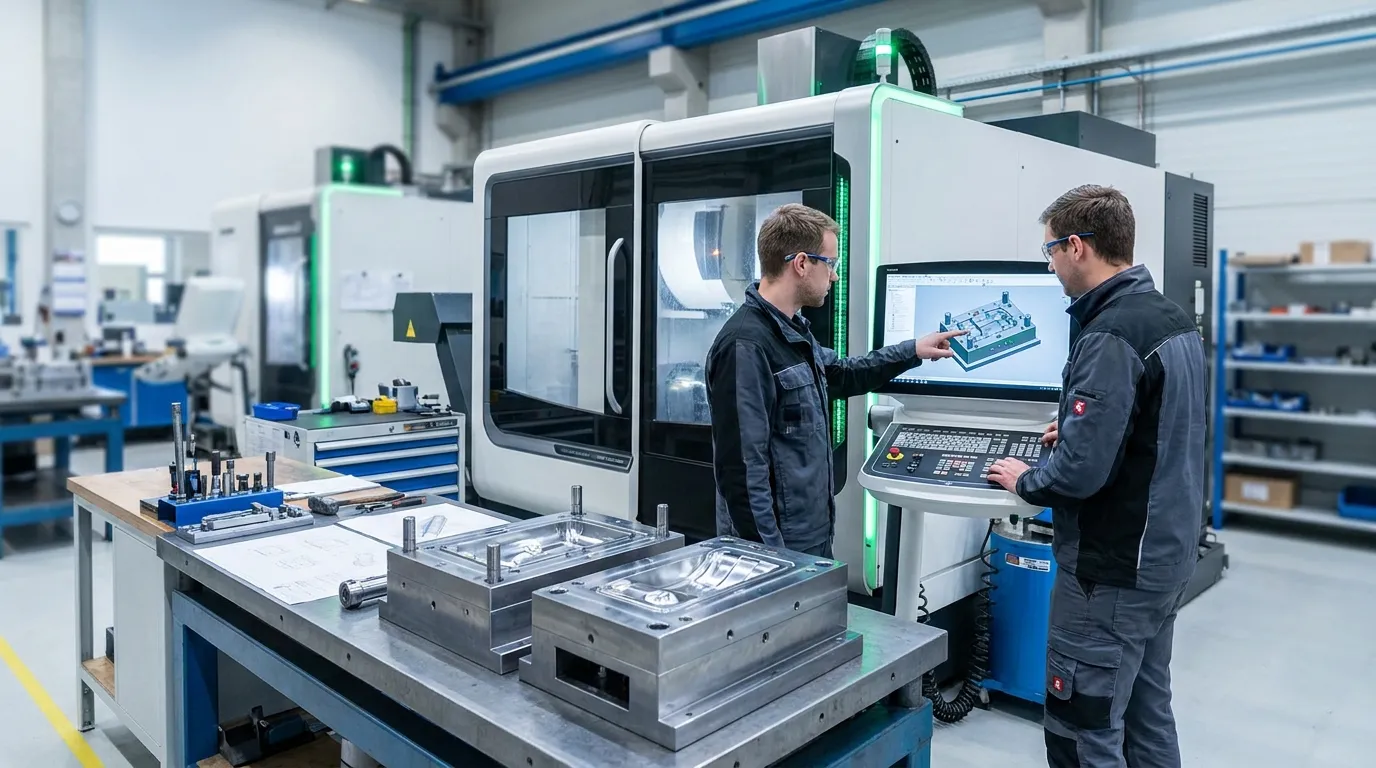
Design review happens before machining because tooling errors become expensive after steel cutting starts. Manufacturers use DFM analysis to verify part geometry, Contracción, Colocación de puertas, Distribución de refrigeración, and production feasibility before committing to machining.
DFM, Abreviatura de Design for Manufacturability, helps mold manufacturers identify production risks early. Los ingenieros revisan el grosor de la pared, Socavos, Ángulos de tiro, cooling paths, and material shrinkage before finalizing the tooling layout. A small geometry issue at this stage can create major rework after machining begins.
Fast tooling delivery is not always a sign of a better mold manufacturer. Some suppliers shorten lead time by reducing DFM review or trial validation. That approach can create larger production problems later, especially for high-volume molds with tight tolerances.
Problemas comunes de DFM detectados antes del mecanizado
Common problems discovered during DFM review include:
- Grosor desigual de la pared que causa deformación
- Mala ubicación de la puerta que afecta al balance de llenado
- Disposiciones de refrigeración que aumentan el tiempo de ciclo
- Zonas finas de cierre propensas al desgaste
- Colocación difícil del pasador del eyector
A consumer electronics housing mold is a good example. During DFM review, engineers may discover that the original gate location creates visible weld lines near cosmetic surfaces. Adjusting the gate before machining is far cheaper than redesigning hardened steel later.
For a broader explanation of tooling structure and part design, see this Diseño de moldes de inyección de plástico o explorar el Guía completa de componentes de molde for component-level details.
How are mold components machined and finished?
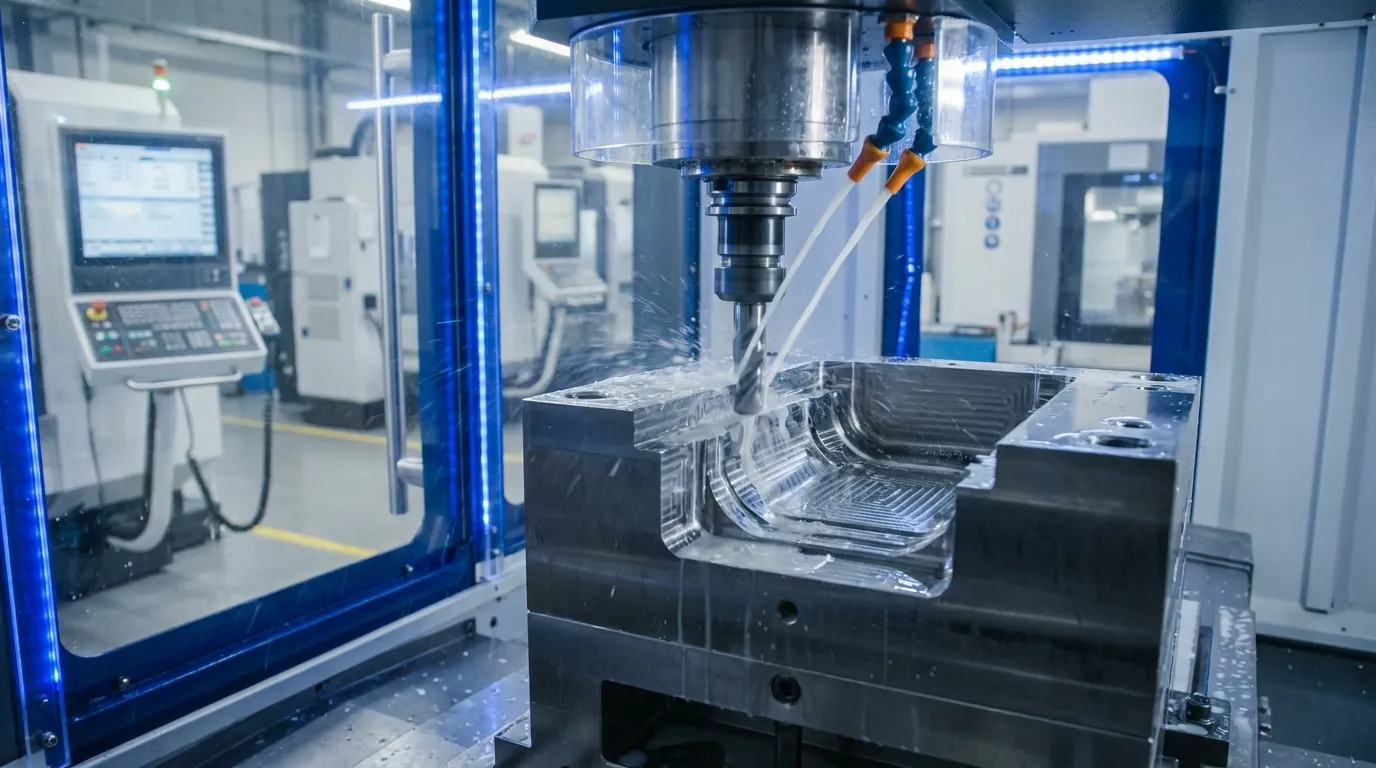
Mold manufacturers use CNC machining, EDM, molienda, and polishing to create precise mold components. The machining sequence depends on geometry complexity, Requisitos de tolerancia, surface finish targets, and production volume expectations.
Machining starts with raw tool steel blocks. CNC milling machines remove material to create mold bases, Cavidades, Colores, Canales de refrigeración, and ejector layouts. Shops often rough-machine components first, then leave extra stock for finishing operations after heat treatment.
Operaciones de mecanizado CNC
CNC equipment handles most standard mold geometry. High-speed milling improves surface finish and dimensional consistency, especially for hardened steel molds used in automotive or medical production.
Typical CNC operations include:
| Funcionamiento | Propósito |
|---|---|
| Fresado en bruto | Elimina grandes cantidades de acero |
| Fresado de acabado | Alcanza dimensiones finales |
| Perforación | Crea canales de refrigeración |
| Tapping | Añade funciones con hilos |
| Fresado a alta velocidad | Mejora el acabado superficial |
EDM, molienda, y pulido
EDM, o mecanizado por descarga eléctrica, is used for deep ribs, Esquinas afiladas, and complex geometries that standard cutters cannot reach. Grinding improves flatness and tolerance accuracy, while polishing prepares cosmetic surfaces.
An automotive dashboard mold may require additional EDM work after trial sampling reveals minor warpage near thin rib sections. This type of adjustment is common during mold refinement.
A mold that passes dimensional inspection once is not automatically production-ready. Stable repeatability during mold trials matters more than a single successful sample.
Precision alignment parts also affect long-term performance. Estos Componentes de molde de precisión help maintain cavity alignment, Reducir el desgaste, and improve consistency during repeated production cycles.
How does mold assembly and fitting work?
Mold assembly combines machined components into a functioning tooling system with aligned cores, Cavidades, Eyectores, Canales de refrigeración, and guide elements. Proper fitting reduces flash, Desgaste, dimensional variation, and premature maintenance issues.
After machining is complete, technicians begin fitting all mold components together. This stage includes cavity alignment, ejector system installation, cooling connection setup, slide fitting, and movement testing. Small alignment errors can affect part quality, Tiempo de ciclo, y vida útil del molde.
Assembly teams also check shutoff surfaces and moving components for smooth operation. Flash problems often begin with poor fitting or inconsistent parting line contact. Shops usually perform manual spotting and adjustment work before trial molding starts.
Key assembly checks include:
- Alineación de pasadores guía
- Movimiento de eyección
- Sellado del canal de refrigeración
- Verificación de desplazamiento del deslizamiento
- Inspección de contacto de línea de separación
Low tooling cost can increase long-term production cost if the mold requires constant maintenance or unstable cycle performance. Proper fitting work often separates reliable production molds from short-life tooling.
Estos Postes guía y casquillos play a major role in maintaining alignment during repeated mold opening and closing cycles.
What quality control checks happen before shipment?
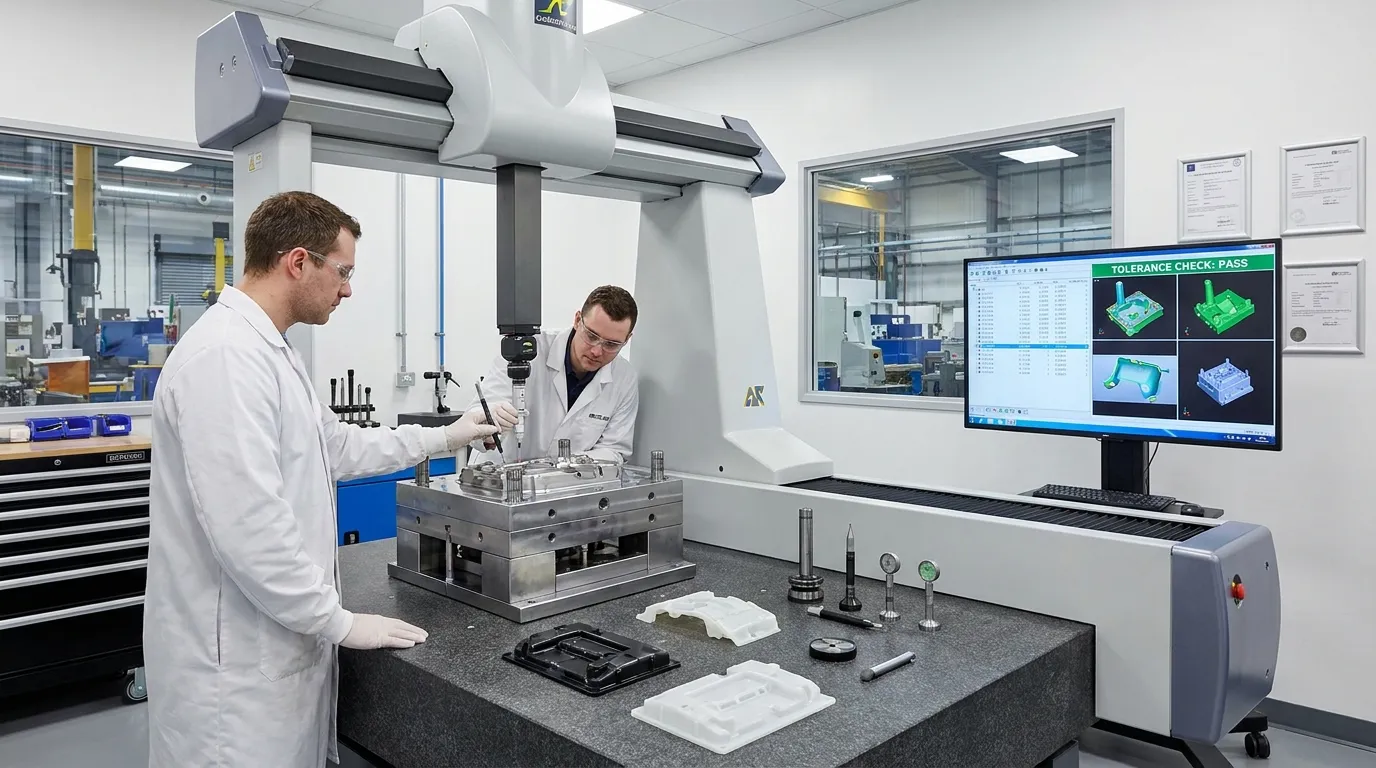
Quality control in mold manufacturing includes dimensional inspection, mold trial validation, fit verification, and sample-part testing. Manufacturers typically confirm tolerances, Acabado superficial, Rendimiento de refrigeración, and stable molding conditions before shipment.
QC starts long before final shipment. Shops inspect components during machining, after heat treatment, during assembly, and again after trial production. Coordinate measuring machines, often called CMM systems, are commonly used for dimensional verification.
Primera inspección del artículo
First article inspection confirms that the mold produces parts within specification. Manufacturers usually compare molded samples against approved drawings, cosmetic standards, and assembly requirements before customer approval.
A medical device enclosure mold may require additional documentation and repeatability testing before acceptance. Tight tolerance projects often include multiple sample runs to verify stable dimensions across repeated cycles.
Lista de verificación de control de calidad para la fabricación de moldes
| Comprobación de control de calidad | Propósito |
|---|---|
| Inspección dimensional | Confirma la precisión de la cavidad |
| Comprobación de acabado superficial | Previene defectos estéticos |
| Verificación de enfriamiento | Estabiliza el tiempo de ciclo |
| Prueba de eyección | Confirma un lanzamiento fiable |
| Muestreo de ensayo de moho | Verifica la preparación para la producción |
| Inspección de ajuste | Previene el destello y el desgaste |
| Pruebas de repetibilidad | Confirma dimensiones estables |
Lead time can increase when trial samples fail dimensional inspection or cooling performance checks. Según Evok Poly y Aprios, production molds often require additional validation and refinement before final approval.
If you're comparing tooling categories across industries, Esta guía para Aplicaciones en moldes industriales explains how mold requirements change by production environment.
What usually delays mold manufacturing projects?
Mold manufacturing delays usually come from late design changes, machining rework, trial failures, material shortages, or unresolved dimensional problems. Small DFM mistakes early in the project can create multi-week delays later during testing and validation.
Most tooling delays begin before the mold reaches production trials. Poor communication during design review, unclear tolerance expectations, or incomplete product drawings can create rework after machining starts.
A consumer electronics housing project might require a gate redesign during mold testing after weld lines appear on visible surfaces. Even small geometry changes can delay delivery by several weeks because machining, Pulido, and validation all need revision.
Tabla de riesgo de retraso por moho
| Delay Cause | Impacto típico | Método de prevención | Acción de recuperación |
|---|---|---|---|
| Cambios de diseño tardíos | Remecanizado | Diseño de congelación anterior | Revisar el calendario de herramientas |
| Fallo de moldeo de prueba | Muestreo adicional | Mejor análisis de DFM | Ajustar los parámetros de procesamiento |
| Escasez de materiales | Retrasos en la programación | Primeros pedidos de acero | Material aprobado como sustituto |
| Desequilibrio en el enfriamiento | Tiempo de ciclo más largo | Revisión de simulación | Modificar los canales de refrigeración |
| Desajuste dimensional | Rechazo de control de calidad | Planificación de tolerancias | Retrabajo de superficies de cavidades |
Según PoderosoCielo, trial parameter mismatch and gate redesign are common reasons for mold schedule overruns. Moldes HH also emphasizes that stronger DFM and QC planning reduces production launch problems.
For a broader look at scheduling and process flow, esto Cronología de producción de moldes guide explains how tooling stages affect delivery expectations.
How do manufacturers validate a mold before production?
Manufacturers validate a mold by running trial production cycles, checking repeatability, verifying dimensions, and confirming stable process conditions. The goal is to prove that the mold can produce consistent parts before shipment approval.
Muestreo y aprobación de ensayos
Trial molding usually starts with short production runs. Engineers adjust injection pressure, cooling time, holding pressure, and cycle parameters while monitoring part quality. This stage helps identify flash, Curvatura, Marcas de hundimiento, o deriva dimensional.
A high-cavity packaging mold may require cooling-channel adjustments after trial runs reveal unstable cycle times between cavities. These refinements improve consistency before full-scale production begins.
Manufacturers also evaluate repeatability across multiple cycles. Stable production matters more than a single acceptable sample. Buyers should ask for dimensional reports, sample approvals, and trial documentation before approving final shipment.
For additional information about production-ready tooling systems, esto Validación de moldes de producción resource explains how molds transition from testing into full manufacturing use.
Acertando en el siguiente paso
A successful mold manufacturing project depends on more than fast machining or low tooling cost. Design review, QC planning, assembly accuracy, and production validation all affect long-term performance. Buyers who understand the workflow can identify risk earlier and ask better questions before approving a supplier.
If you're evaluating a new tooling project, focus on how the manufacturer handles DFM review, trial validation, and inspection control. Those stages usually determine whether a mold performs reliably in production or creates expensive problems later.
Preguntas frecuentes
How long does mold manufacturing take?
Most production molds take several weeks to several months depending on complexity, Recuento de cavidades, machining requirements, and validation testing. Mold trials and design revisions often add extra time before production approval.
Why is DFM important in mold manufacturing?
DFM helps manufacturers identify production risks before steel cutting begins. Early review reduces rework and prevents delays caused by shrinkage issues, poor cooling layout, or incorrect gate placement.
What machines are used in mold manufacturing?
Manufacturers commonly use CNC milling machines, EDM equipment, Máquinas de rectificar, polishing systems, and coordinate measuring equipment. Each process supports dimensional accuracy and surface finish control.
What causes mold delivery delays?
Design changes, machining errors, failed mold trials, and material sourcing problems are common causes of delay. Poor communication during DFM review can also create expensive rework later in the project.
How is mold quality checked?
Manufacturers use dimensional inspection, mold trial sampling, fit verification, and sample-part validation to confirm mold quality. Inspection usually happens throughout machining, Montaje, and final testing stages.
Should tooling be aluminum or steel?
Steel molds usually provide better durability and longer production life for high-volume manufacturing. Aluminum molds can reduce tooling time and cost for prototypes or lower-volume production runs.
Compartir:



Escrito por Sunshine
Al sol, Somos un fabricante y proveedor profesional de componentes de moldes de precisión, ofreciendo una amplia gama de productos para aplicaciones de estampado y moldes de inyección. Nuestro enfoque principal es el punzonamiento de troqueles, Pasadores y fundas eyector, y postes guía y casquillos. Con mecanizado CNC avanzado, Control de calidad estricto, y una fuerte capacidad de producción, Garantizamos la fiabilidad, Piezas de alta precisión, junto con componentes estándar en stock para un suministro global rápido y eficiente.
NOTICIAS
CONSIGUE EL SERVICIO
Con piezas de calidad para todos los presupuestos y personal amable formado para que tu visita sea informativa y sin complicaciones.
