



D2 vs acero M2 para pasadores de punzón: Desgaste, Dureza, y Velocidad
For punch pins, D2 and M2 solve different combinations of wear, Impacto, and thermal stress. D2 is often a practical choice when gradual abrasive wear is the main concern and the die operates under controlled cold-work conditions. M2 may be the stronger candidate when the punch faces repeated edge chipping, difficult stock, long production runs, slender geometry, or sustained heat at the cutting edge.
Neither material is automatically better. Press speed alone does not determine the answer, and a harder punch is not always a more durable punch. Autorización, Tratamiento térmico, Geometría, Alineación, Lubricación, and the actual failure pattern can matter as much as the steel grade.
Material selection is also only one part of a complete die system. The broader relationship between punches, esto, Autorización, and tooling requirements is covered in SunshinePro’s Guía de troqueles de punzonados (Inferido).
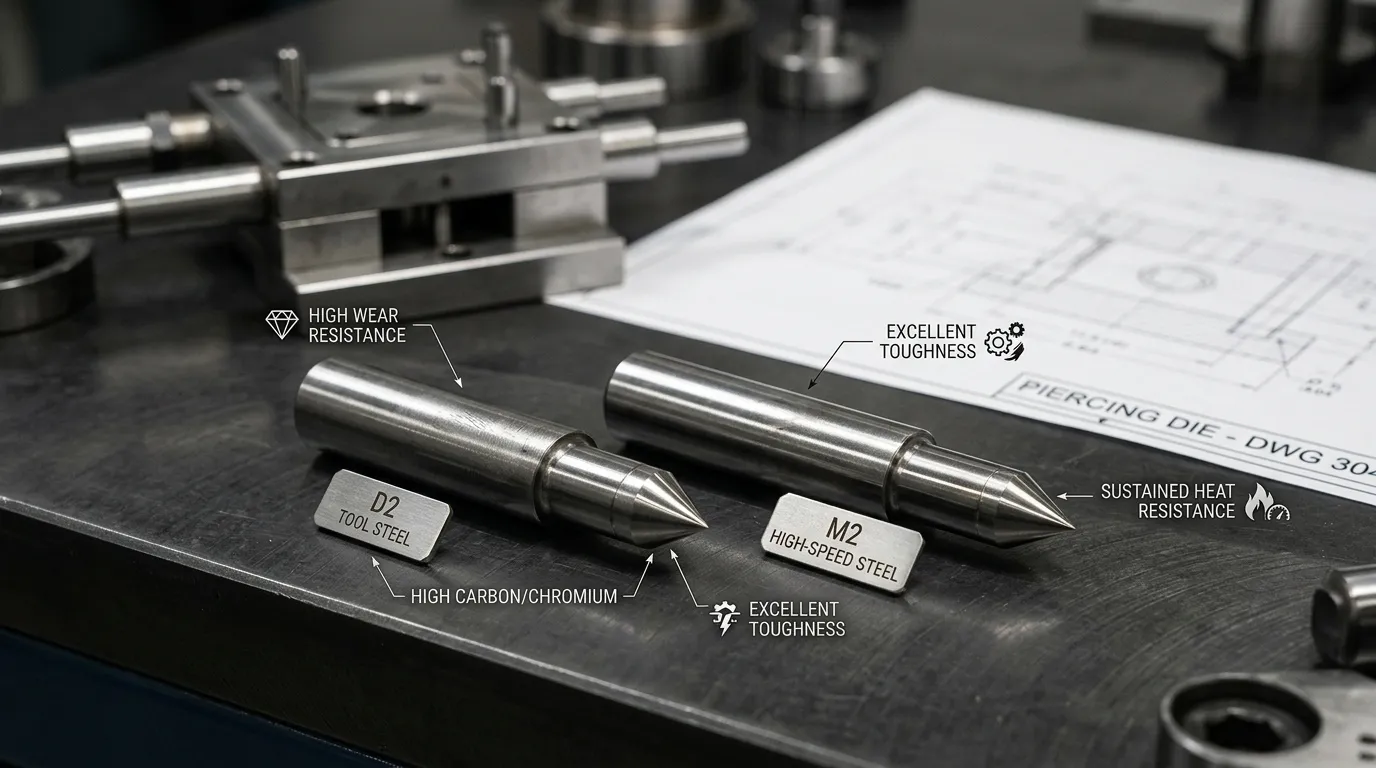
Comparación de pins de punzón D2 vs M2 de un vistazo
| Factor de comparación | Acero para herramientas D2 | Acero de alta velocidad M2 |
|---|---|---|
| Familia del acero | Acero para herramientas de trabajo en frío | Acero de alta velocidad |
| Fuerza típica de selección | Fuerte resistencia al desgaste bajo condiciones controladas de trabajo en frío | Balanced wear resistance, edge stability, dureza, and hot hardness |
| Limitación principal | Can become vulnerable to chipping or fatigue when the hardness, Geometría, or loading is too aggressive | Un mayor coste de materiales y procesamiento puede no justificarse en aplicaciones leves |
| Desgaste abrasivo | A menudo es un candidato fuerte donde predomina el desgaste abrasivo gradual | Also wear resistant, especially where wear occurs with heat or repeated impact |
| Dureza y astillado | Dependiente de la aplicación; geometry and heat treatment must be controlled | A menudo se considera cuando D2 experimenta un desgaste recurrente en el borde bajo condiciones estables |
| Calor sostenido | Menos adecuado para aplicaciones donde el filo de corte permanece caliente durante largos periodos | Más conocido por mantener la dureza bajo temperaturas elevadas de servicio |
| Condiciones de mejor ajuste | Stable alignment, suitable clearance, controlled impact, moderate thermal demand | Long runs, difficult stock, higher thermal demand, slender punches, or expensive downtime |
| Dirección de costes | Comúnmente considerada el punto de partida más económico | Normalmente se evalúa cuando una mayor fiabilidad puede compensar el coste añadido |
| Required verification | Calificación exacta, Tratamiento térmico, Dureza, Geometría, y condiciones de producción | Calificación exacta, Tratamiento térmico, Condición de temple, Dureza, y condiciones de producción |
These are selection tendencies, not guaranteed performance rankings. A poorly supported M2 punch can fail before a correctly designed D2 punch, while an over-hardened or misaligned D2 punch can chip before its wear resistance becomes useful.
Por qué D2 y M2 se comportan de forma diferente en un puñetazo
D2 is a high-carbon, high-chromium cold-work tool steel. It is commonly associated with wear resistance, compressive-load capability, and dimensional stability in tools operating without sustained high-temperature exposure. El Hoja técnica del BÖHLER K110, which covers a D2-family grade, lists punching and stamping tools among its applications.
M2 belongs to the molybdenum high-speed-steel family. Its alloy system is designed to retain hardness and cutting performance under greater thermal demand. El Hoja técnica del BÖHLER S600, covering an M2-family grade, emphasizes wear resistance, dureza, edge stability, Resistencia a la compresión, and red hardness.
The difference cannot be reduced to a single Rockwell hardness value. Two punch pins at a similar HRC may still behave differently because of:
- Composición de aleaciones y distribución de carburos
- Austenitización, Apagado, and tempering conditions
- Microestructura conservada
- Rectificado y condición superficial de EDM
- Geometría del punzón y soporte
- Temperatura durante la producción
- El tipo de desgaste o fractura que ocurre
The agreed material standard therefore matters. ASTM A681 covers alloy tool steels such as D2, mientras ASTM A600 covers high-speed tool steels such as M2.
Nombres de grado que los compradores no deberían considerar como equivalentes automáticos
Worldwide sourcing often involves several designation systems. D2 may be discussed alongside SKD11 or 1.2379, while M2 may be cross-referenced with SKH51, SKH9, or 1.3343.
These names should not be accepted as interchangeable without checking the applicable standard, Química, production route, and final heat-treated condition. The drawing or purchase specification should identify the agreed grade rather than relying on a general trade name.
DC53 also should not be described as another name for standard D2. It is a separate modified cold-work steel with its own processing and performance characteristics.
Resistencia al desgaste: Identify the Wear Mechanism Before Choosing
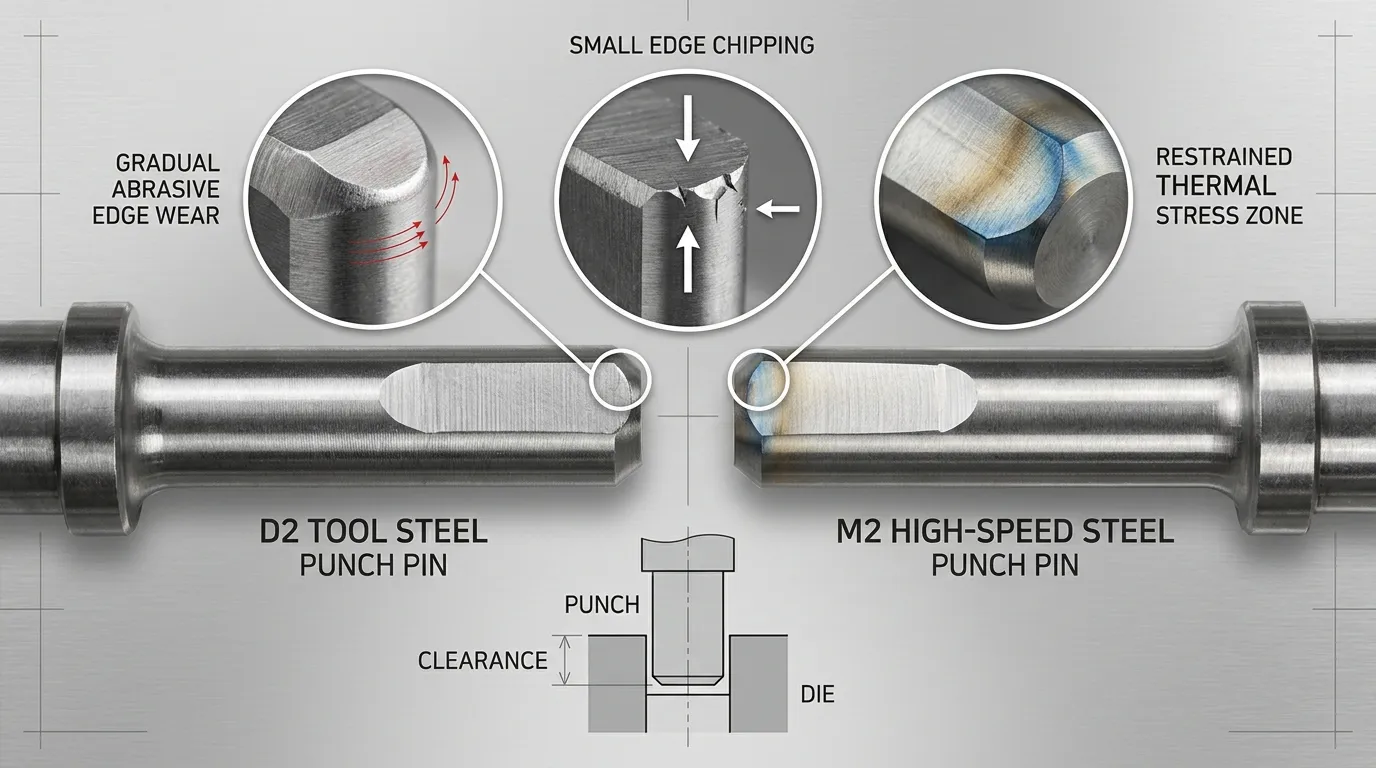
Asking which steel has “better wear resistance” is incomplete until the wear mechanism is known.
Desgaste abrasivo gradually removes material from the punch edge or flank. It may be driven by hard particles, escama, an abrasive workpiece, or repeated sliding contact. D2 is often considered when this predictable, gradual wear is the primary problem and shock loading remains controlled.
Desgaste adhesivo y agallado involve material transfer, Pastilla, or local seizure between the punch and workpiece. These problems are influenced heavily by workpiece material, Acabado superficial, Lubricación, Autorización, y recubrimiento. Changing from D2 to M2 may not correct galling if friction and material adhesion remain the real causes.
El desgaste combinado con desconchados o calor creates a different selection problem. M2 may provide a more useful performance balance where the edge must resist abrasion while also tolerating repeated stress and sustained temperature.
Before changing steel, inspect how the existing punch is deteriorating:
| Condición observada | Probablemente un tema a investigar | Implicación material |
| Suave, gradual edge recession | Desgaste abrasivo | D2 may remain suitable; compare maintenance interval and total cost |
| Recogida de material o depósitos rugosos | Galling, Fin, Lubricación, revestimiento | Corregir las condiciones superficiales antes de culpar al acero a granel |
| Pequeños trozos rompiéndose del borde | Astillado, Dureza excesiva, Geometría, Autorización, Carga lateral | M2 puede considerarse después de controlar las causas del sistema |
| Desgaste rápido durante largas carreras ininterrumpidas | Abrasión combinada y calor | La capacidad de resistencia a caliente del M2 podría volverse más relevante |
SunshinePro’s die punch pin page lists precision grinding and TiN and TiCN coating options. These processes can support surface condition and wear control, but a coating cannot compensate for unsuitable steel, Mala alineación, Autorización incorrecta, or weak punch support.
Dureza, Astillado, and Punch Geometry
Punch toughness is not determined by the steel name alone. The final hardness, Tratamiento térmico, edge shape, Longitud sin soporte, and loading direction all affect whether the punch bends, chips, or develops fatigue cracks.
A large, well-supported round punch and a long, narrow punch do not place the same demands on the material. Small-diameter punches, sharp internal features, narrow points, and long unsupported sections create greater stress concentration and bending risk.
Repeated chipping can result from:
- Dureza excesiva para la geometría
- Juego incorrecto entre el punzón y el dado
- Mal guiado o alineación
- Carga lateral
- Apoyo insuficiente de cabeza o cuerpo
- Daño por desgaste
- Una capa de refundición EDM incontrolada
- Defectos en el tratamiento térmico
- Sobrecarga local por variación de stock
A published failure analysis of an AISI D2 punch found that punch damage could involve fatigue, carbide cracking, excessive loading, heat-treatment issues, backup-plate wear, Autorización, and guiding conditions. The study reinforces a basic rule: changing the material without correcting the mechanical cause may only move the failure to another location. Consulta el estudio en fatiga y desgaste en un puñetazo AISI D2.
M2 may deserve evaluation when a D2 punch repeatedly chips despite correct alignment, suitable clearance, stable heat treatment, and adequate support. It should not be treated as a substitute for investigating the die system. A more complete diagnosis of side loading, Autorización, Guiado, and fracture causes belongs in the guide to Rotura de punzones en troqueles de estampado.
Cuando la velocidad de presión hace relevante la dureza caliente del M2
The term “high-speed steel” often leads to an oversimplified rule: fast press equals M2. Actual punch conditions are more complicated.
Strokes per minute affect the number of loading events, but they do not directly state the cutting-edge temperature. Thermal demand also depends on:
- Duración continua
- Resistencia y grosor de la pieza
- Tamaño del agujero y geometría del punzón
- Espacio de contacto para el puñón a matriz
- Fricción y agallado
- Lubricación
- Disipación de calor entre carreras
- La duración y frecuencia de las paradas de producción
A fast press running short batches of thin, manageable stock may produce less sustained edge heat than a slower press running thick, high-strength material continuously.
M2’s hot hardness becomes more valuable when the cutting edge remains hot enough for ordinary cold-work performance to deteriorate. That condition may appear during long progressive-die runs, difficult stock punching, Alta fricción, or inadequate cooling between cycles.
D2 can still be suitable at a high numerical press speed when thermal load, Impacto, and chipping risk remain controlled. M2 should therefore be selected because of the complete duty cycle, not because the press specification contains a high strokes-per-minute number.
D2 or M2? Choose by Failure Mode and Application
The following table provides a starting direction. It is not a substitute for examining the die, Pieza de trabajo, Tratamiento térmico, and failed punch.
| Condición de aplicación | Candidato probable titular | Motivo | Comprueba antes de decidir |
| Stable, gradual abrasive wear | D2 | Una fuerte capacidad de desgaste en frío puede ser suficiente | Dureza, Intervalo de afilado, stock abrasiveness |
| El borde D2 se desmarca repetidamente | Se puede evaluar M2 | Un equilibrio más amplio entre tenacidad y estabilidad de filo puede ayudar | Autorización, Alineación, Geometría, Tratamiento térmico |
| Producción larga e ininterrumpida con calor sostenido en el borde | M2 | La dureza en caliente se vuelve más relevante | Actual temperature drivers, Fricción, Lubricación |
| Punzón de diámetro pequeño o delgado | Se puede evaluar M2 | La geometría puede requerir mayor resistencia al desconchado y la fatiga | Longitud sin soporte, Guiado, head support |
| Punzonado de volumen moderado en acero dulce o al carbono | D2 puede ser suficiente | La demanda térmica y de impacto puede no justificar M2 | Stock thickness, Autorización, desired maintenance interval |
| Material inoxidable o propenso a las galisas | Dependiente de la aplicación | Fricción, Adhesión, and heat may dominate | Lubricación, Acabado superficial, revestimiento, Autorización |
| Lámina gruesa o de mayor resistencia | M2 puede ofrecer una ventaja | Cargas más altas pueden aumentar la tensión en el borde y el calor | Punch diameter, press force, Apoyo, hole geometry |
| El tiempo de inactividad es considerablemente más caro que el coste de la herramienta | M2 puede estar justificado económicamente | El coste inicial adicional puede ser aceptable si mejora la fiabilidad | Registros de producción y resultados de ensayos controlados |
Condiciones típicas donde D2 puede ser suficiente
D2 remains a reasonable candidate when the punch experiences predictable wear under stable cold-working conditions. Suitable clearance, strong guidance, adequate support, and controlled hardness allow its wear resistance to be used without excessive chipping.
It can be a practical choice for moderate production duties where current sharpening intervals are acceptable and the application does not create sustained heat or severe impact.
Condiciones en las que M2 puede justificar su mayor coste
M2 becomes more attractive when a punch must maintain its edge under combined wear, repeated stress, and thermal demand. Examples include long production runs, difficult or higher-strength stock, slender punch geometry, and applications where recurring D2 chipping continues after system problems have been corrected.
The economic case is strongest when unplanned breakage or press downtime costs much more than the difference in punch material and processing.
Steel Grade Alone Will Not Fix Clearance, Alineación, or Heat-Treatment Problems
Before replacing D2 with M2, confirm that the current punch is being tested fairly. Como mínimo, Reseña:
- Espacio de contacto para el puñón a matriz
- Concentricidad y alineación del punzón
- Estado del poste guía y del casquillo
- Soporte de punzón y longitud sin soporte
- Variación en el grosor y dureza de la pieza
- Consistencia de lubricación
- Quemaduras por rechinar o daños en el filo
- Condición superficial de EDM
- Dureza final y condición de temple
- Coating condition
- Patrón de desgaste en la apertura del punzón y troquel
Incorrect clearance can increase cutting load, Formación de Burr, edge stress, y el desconchado. Misalignment can place bending loads on a punch designed mainly for compression. Grinding or EDM damage can also provide a starting point for fatigue cracks.
A punch works as part of a larger assembly. The relationship between the punch, Retenedor, Guías, Bujes, die insert, and support components is covered more broadly in the Guía de componentes del chip.
Compare Cost by Downtime and Maintenance, Not Steel Price Alone
D2 may have a lower initial cost in many sourcing situations, but purchase price does not show the complete economic result. M2 may cost more to purchase, Máquina, heat-treat, or grind, yet still be worthwhile if it reduces expensive production interruptions.
A useful comparison should include:
| Factor de coste | Pregunta para evaluar |
| Coste inicial del punzón | What is the delivered cost in the specified grade and condition? |
| Afilado | How many hits occur between scheduled sharpening events? |
| Rotura no planificada | Does the punch wear predictably or fail without warning? |
| Tiempo de inactividad | How much production is lost during replacement and die adjustment? |
| Desguace | Does edge deterioration affect burrs, Dimensiones, or part quality? |
| Inventario | How many spare punches are required to protect production? |
| Mano de obra de mantenimiento | How much toolroom time is spent inspecting, sharpening, and replacing punches? |
M2 is not automatically the lower-cost choice. It becomes economically attractive only when its performance under the actual application reduces enough maintenance, failure, chatarra, or downtime to offset the added cost.
Qué especificar antes de solicitar un pasador perforador D2 o M2
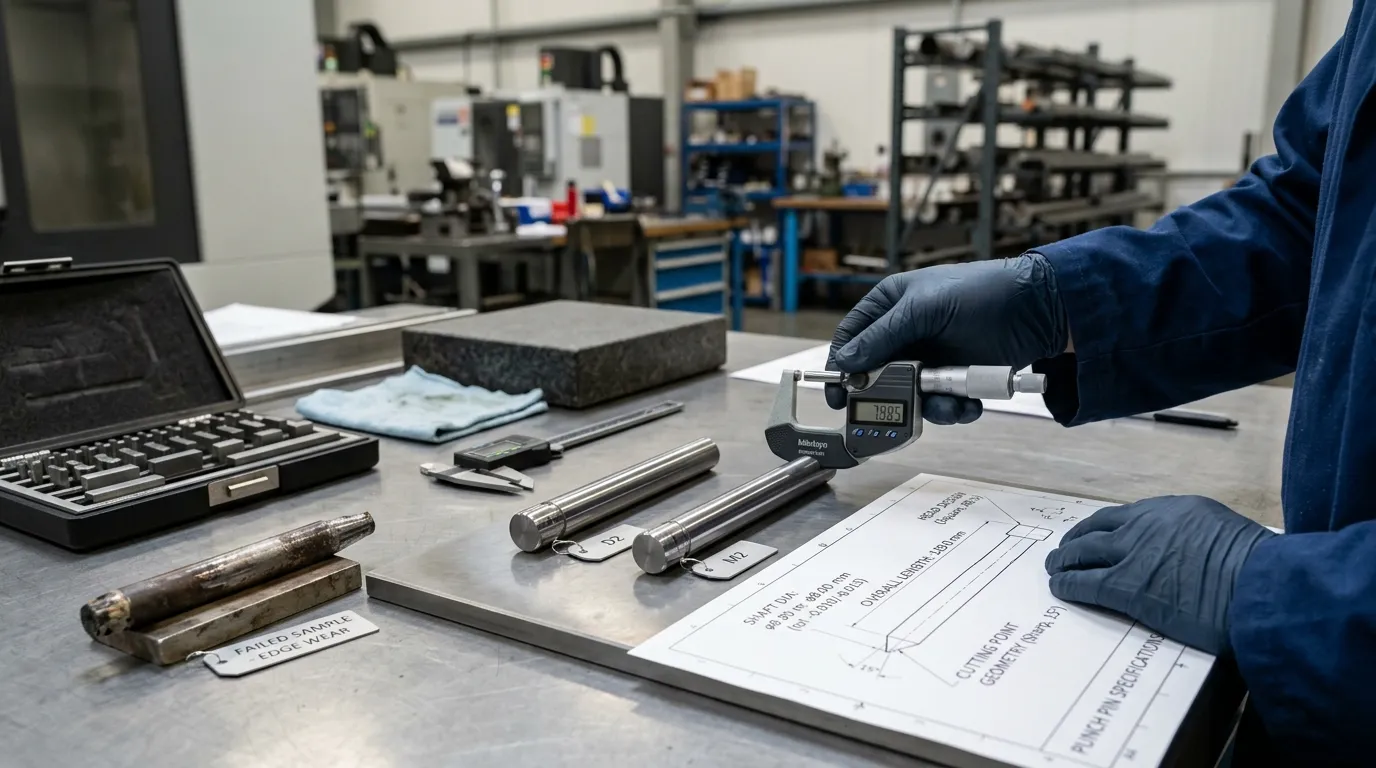
A supplier cannot make a reliable material recommendation from the punch diameter alone. The RFQ should describe both the component and its operating conditions.
Proporcionar:
- Un dibujo en dimensiones
- Punch diameter, Longitud, and unsupported length
- Diseño y disposición de la cabeza
- Point shape, corner radii, and special cutting features
- Material y calidad de la pieza
- Espesor de la lámina
- Dimensiones y forma del agujero
- Espacio de contacto para el puñón a matriz
- Tipo de prensa y velocidad de funcionamiento
- Duración continua
- Recuento anual esperado de visitas
- Lubricante y método de aplicación
- Material existente del punzón y dureza medida
- Current failure symptom: Desgaste, Irritante, Chips, Flexión, o fatiga
- Fotografías o muestras fallidas cuando estén disponibles
- Recubrimiento necesario
- Designación y estándar acordados del material
- Certificado de material requerido
- Documentación de tratamientos térmicos
- Requisito de inspección de dureza
- Criterios de aceptación para una prueba de producción
SunshinePro states that non-standard components can be produced from customer drawings. Es Página del producto del pasador de troquelada lists custom diameter, Longitud, Diseño de la cabeza, Material, y opciones de recubrimiento, together with SKH51, SKH9, DC53, Calificaciones ASP, y carburo. The page also mentions CNC machining, Rectificado de precisión, EDM, y tratamiento térmico al vacío.
That information does not confirm AISI D2 availability. Buyers requiring D2 should ask the supplier to confirm the exact material designation, applicable standard, Condición de tratamiento térmico, and documentation before ordering.
A controlled trial remains the most reliable final check. Compare D2 and M2 using the same drawing, Autorización, Prensa, workpiece batch, lubricante, Estado del recubrimiento, y método de inspección. Record the hit count and actual failure mechanism rather than judging only by whether the punch still appears usable.
Cuando ni D2 ni M2 convencionales son la respuesta correcta
If both materials fail after clearance, Apoyo, Alineación, Lubricación, Geometría, and heat treatment have been corrected, the application may require a different solution.
Possible next steps include reviewing:
- Acero de alta velocidad para metalurgia en polvo
- Carburo
- Un sistema de recubrimiento diferente
- Geometría revisada del punzón
- Mejoría del guiado o soporte
- Cambios en la holgura o lubricación
SunshinePro lists ASP grades and carbide among its punch-pin material categories, but these alternatives should be evaluated against the same application data rather than treated as automatic upgrades.
For a material review or quotation, submit the punch drawing, Detalles de la pieza, Condiciones de producción, and current failure evidence through the Página de contacto de SunshinePro. The strongest recommendation will come from matching the steel, Tratamiento térmico, Geometría, and die conditions to the failure mode the punch must actually survive.
Compartir:



Escrito por Sunshine
Al sol, Somos un fabricante y proveedor profesional de componentes de moldes de precisión, ofreciendo una amplia gama de productos para aplicaciones de estampado y moldes de inyección. Nuestro enfoque principal es el punzonamiento de troqueles, Pasadores y fundas eyector, y postes guía y casquillos. Con mecanizado CNC avanzado, Control de calidad estricto, y una fuerte capacidad de producción, Garantizamos la fiabilidad, Piezas de alta precisión, junto con componentes estándar en stock para un suministro global rápido y eficiente.
NOTICIAS
CONSIGUE EL SERVICIO
Con piezas de calidad para todos los presupuestos y personal amable formado para que tu visita sea informativa y sin complicaciones.
