



Pasadores de posicionamiento rectos vs cónicos: Lo cual encaja con el molde?
Straight and tapered mold positioning pins solve the same broad problem—bringing mating mold plates into a controlled final position—but they do it differently.
A straight positioning set works best when the mold’s main guide system already controls the approach accurately and the designer needs close, repeatable pre-positioning. A tapered positioning set adds progressive lead-in, allowing the mating components to capture limited offset as the mold closes.
Neither design is automatically more accurate or durable. The correct choice depends on engagement sequence, approach alignment, pin-to-bushing fit, parting-line conditions, taper seating, sensitive mold features, y acceso de mantenimiento. These positioning components also operate inside a wider system of Pasadores y casquillos de molde (Inferido), rather than replacing the mold’s primary guidance by themselves.
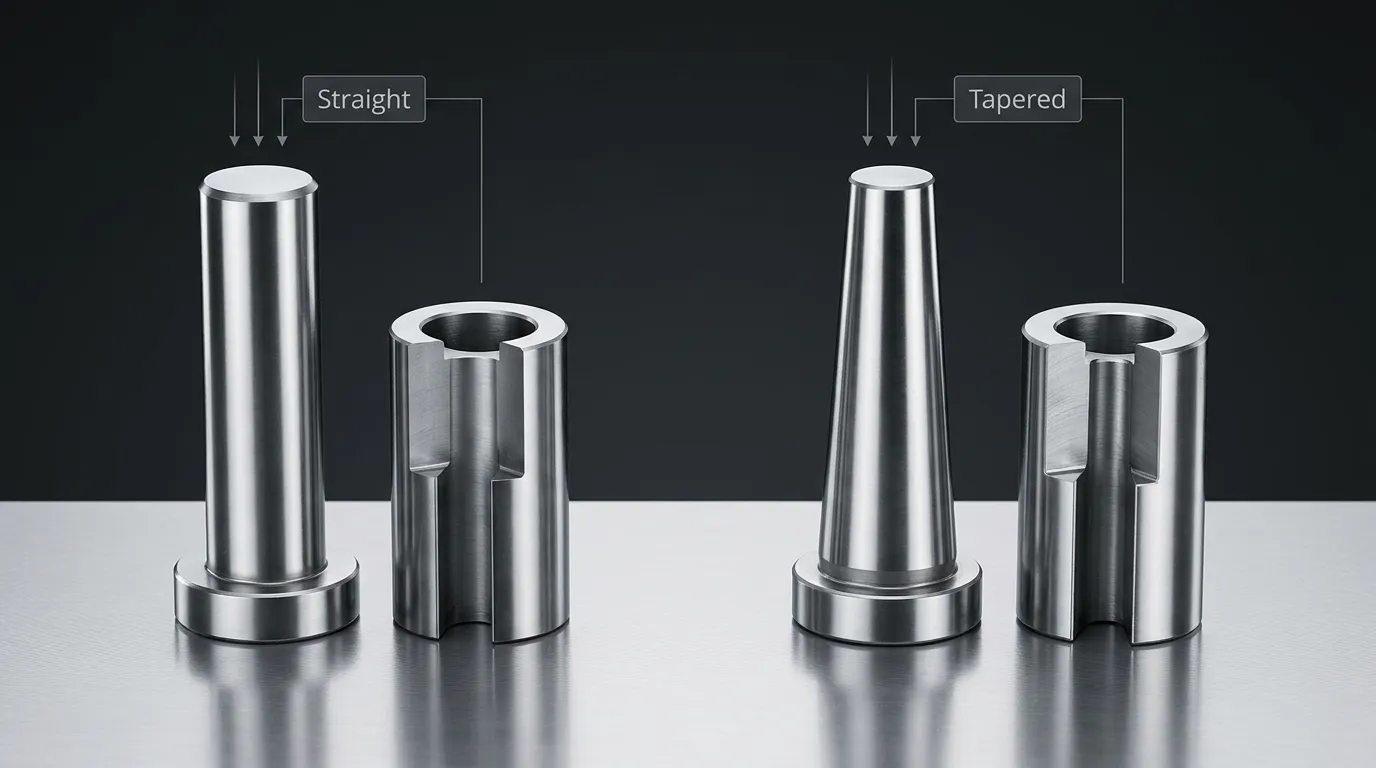
Posicionamientos rectos y afilados a simple vista
The comparison should cover the complete pin-and-bushing pair, not only the visible pin shape.
| Factor de comparación | Conjunto de posicionamiento recto | Conjunto de posicionamiento cónico |
|---|---|---|
| Geometría de localización | Superficie de localización paralela o cilíndrica | Superficie de localización cónica o cónica |
| Comportamiento de entrada | Entra con un espacio libre casi constante | El espacio libre se reduce progresivamente durante la entrada |
| Requisito de aproximación | Normalmente requiere una alineación previa bien controlada | Puede captar una cantidad limitada de desplazamiento de aproximación |
| Posicionamiento final | Determinado principalmente por el ajuste y alineación entre pasadores y casquillos | Determined by taper geometry, seating position, and mating accuracy |
| Condición de cierre | Algunos diseños requieren espacio para la línea de separación al cierre total | Algunos diseños pueden configurarse para contacto de estrechamiento total al cierre |
| Principal ventaja | Controlled, repeatable pre-positioning | Introducción progresiva y captura geométrica |
| Limitación principal | Puede enlazarse si las piezas ajustadas se desplazan fuera del eje | Puede hacer cuña o desarrollar contacto desigual si el asiento no es correcto |
| Mejor condición de ajuste | Sistema de guía estable y enfoque predecible de molde | Necesidad de corrección controlada durante el enfrentamiento final |
| Dificultad de retrofit | El reemplazo debe preservar el ajuste y la ubicación del eje | Conversion requires review of taper, Asientos, Montaje, and mating geometry |
A straight system is not merely a tapered system without an angle. The geometry changes how the components enter, where contact develops, and how positional error is transferred into the mold plates.
Cómo se acopla cada geometría al cerrarse el molde
The mold’s leader pins and guide bushings normally control the initial movement of the two mold halves. Positioning pins act later in the closing sequence, refining plate location before sensitive features make full contact.
Una secuencia típica es:
- The leader pins enter their guide bushings and establish the general closing path.
- The positioning pin begins entering its mating bushing.
- The positioning set reduces the remaining lateral movement between the plates.
- Pines del núcleo, Insertos, shutoffs, or other close-clearance features reach their final engagement.
- The mold reaches its designed closed condition.
This sequence matters because positioning components should normally control plate location before delicate features are forced to absorb misalignment. MISUMI’s mold-component documentation, por ejemplo, describes positioning sets intended to engage before core pins and also notes the need for an appropriate precision leader-pin system. Exact timing still depends on the specific mold design and selected component set.
La función principal de guía pertenece a Pasadores guía de molde. Positioning pins supplement that guidance near final closure; they should not be expected to correct a damaged guide system, severe platen movement, or major mold-base error.
Cómo se activa un conjunto de posicionamiento recto
A straight positioning pin enters a cylindrical mating bore. Because the locating surfaces remain parallel, the available entry clearance does not progressively increase toward the tip in the same way as a full tapered locating interface.
This makes prior alignment important. When the leader-pin system has already brought the mold plates close to their intended axes, a straight positioning set can provide controlled and repeatable pre-positioning. The final movement between the pin and bushing depends heavily on their specified fit.
The same close fit that improves positional control can also increase sensitivity to:
- Entrada fuera del eje
- Contaminación en el casquillo
- Bordes dañados o elevados
- Concentricidad incorrecta
- Movimiento térmico o estructural
- Puntos de localización redundantes que sobreconstreñen las placas
Some catalog straight positioning systems require a small parting-line clearance when the mold is fully closed. That requirement prevents the positioning components from unintentionally carrying closure load or interfering with full plate contact. It is product-specific and must be taken from the selected supplier’s drawing rather than treated as a universal value.
Cómo se activa un conjunto de posicionamiento cónico
A tapered pin enters a matching tapered bushing or seat. At the beginning of engagement, the smaller leading section provides more room for entry. As the mold continues to close, the available radial clearance decreases and the taper progressively guides the mating components toward a common axis.
This progressive capture is the main reason to consider a tapered system. It can tolerate a limited amount of initial offset that might cause edge contact in a close straight interface.
Final performance, sin embargo, depends on more than the presence of a taper. The designer must control:
- Ángulo de estrecha o relación de estrecha
- Posición axial de asientos
- Concentricidad entre las características de localización y montaje
- Engagement length
- Distribución de contactos
- Condición de línea de separación
- Método de retención y eliminación
Some supplier systems can be arranged to reach full taper contact or zero clearance at mold closure. That behavior applies only to the documented design. It should not be generalized to every tapered positioning pin.
If the taper seats too deeply, uses incompatible mating angles, or enters under excessive offset, it may create wedging, Contacto desigual, difficult release, or unwanted load on the mold plates.
Los criterios de selección que realmente deciden el mejor ajuste
The pin shape should not be selected in isolation. The mold’s approach behavior and final positioning requirement are more important than a general preference for straight or tapered components.
| Criterio de selección | El heterosexual suele ser preferido cuando... | Normalmente se prefiere la reducción cuando... |
| Alineación de aproximación inicial | El sistema de pasador líder ya controla los ejes de cerca | El desplazamiento de aproximación limitado debe capturarse progresivamente |
| Requisito posicional final | Un ajuste cilíndrico específico puede proporcionar el control requerido | La ubicación final se establece mediante asientos de taper controlados |
| Características sensibles del moho | Se necesita preposicionamiento antes de que los núcleos o insertos encaje | Se necesita una corrección gradual antes de los cortes o el contacto cercano con las características |
| Sensibilidad a la entrada | La entrada fuera del eje es mínima y predecible | Se necesita algo de entrada para reducir el contacto abrupto con los bordes |
| Condición de cierre | Se puede mantener la separación necesaria para la línea de operación o de separación | Se puede definir y controlar el comportamiento de asiento completo |
| Riesgo a gestionar | Encuadernación y marcado | Aplastamiento y contacto desregular en estrechamiento |
| Control de montaje | Los ejes de pasador y casquillo pueden sujetarse con precisión | El eje cónico y el asiento axial pueden mantenerse con precisión |
| Estrategia de reemplazo | El reemplazo cilíndrico directo es práctico | Se pueden reproducir geometrías de estrecho y asientos igualados |
| Disponibilidad de componentes | Existe un conjunto recto estándar adecuado | Existe un conjunto de conos estándar adecuado o se justifica un diseño personalizado |
The decision also depends on whether the required component exists as a standard catalog item. Where diameter, Taper, Montaje, Retención, or engagement conditions fall outside standard ranges, a drawing-based part may be necessary. SunshinePro states that it supplies both standard components and non-standard mold parts processed from customer drawings. Its broader guidance on Piezas estándar de molde can help separate catalog selection from customization.
Cuando una serie de posicionamiento en recta es la mejor opción
A straight positioning system is generally the stronger candidate when the mold’s initial guidance is already stable.
Typical conditions include:
- The leader pins and guide bushings keep plate approach error low.
- The positioning set needs to establish a close, repeatable location before core pins engage.
- The designer can specify and inspect the cylindrical pin-to-bushing fit.
- Parting-line clearance requirements are known.
- Mounting bores and locating axes can be held concentric.
- Contamination and off-axis impact can be controlled.
- Replacement components can reproduce the original fit.
Consider a mold containing several delicate core pins that enter close-clearance holes near the end of closure. If the main guide system already brings the two mold halves into reliable alignment, a straight positioning set can refine their location before those core pins enter.
The design becomes less suitable when significant lateral error remains at the start of positioning engagement. A close straight fit should not be used as a substitute for correcting damaged leader pins, worn guide bushings, or mislocated mounting bores.
Cuando un conjunto de posicionamiento cónico es la mejor opción
A tapered positioning system is generally more appropriate when the mold needs a controlled lead-in before reaching its final position.
Typical conditions include:
- Limited approach variation remains after the main guide system engages.
- The mold needs progressive rather than abrupt correction.
- The taper can engage before sensitive shutoffs, Insertos, or cores reach contact.
- Taper angle, axial seating, and contact position can be defined accurately.
- The design can prevent excessive seating force.
- Removal access is available if the taper becomes tightly seated.
- The selected supplier can reproduce the complete mating geometry.
A tapered system may be useful when two plates approach with a small lateral offset that is acceptable at the start of engagement but must be reduced before a close shutoff meets its mating surface. The taper introduces correction gradually as engagement increases.
That does not mean a tapered pin can repair a poorly guided mold. Its capture range is limited by the actual geometry. Forcing a taper to correct excessive offset can concentrate load on one side of the pin and bushing, damage the contact surfaces, or shift stress into the surrounding mold plate.
Riesgos, Failure Modes, and Retrofit Mistakes
Straight and tapered systems fail in different ways, although both are sensitive to poor mounting, Contaminación, Desgaste, and incorrect engagement order.
| Riesgo | Causa probable | Posible resultado | Respuesta de diseño |
| Encuadernación recta | Ajuste ajustado combinado con entrada fuera del eje | Jamming, Puntuación, plate damage | Mejorar las recomendaciones previas y verificar la autorización de operación |
| Carga en los bordes | El pasador desalineado contacta el borde del casquillo | Vestimenta local, Chips, Deformación | Revisa el momento de la interrupción y la ubicación del eje |
| Aplastamiento en estrechamiento | Asientos axiales excesivos o geometría de estrechamiento inadecuada | Difficult opening, unwanted preload | Define con precisión el registro axial y la estrechatura de acoplamiento |
| Contacto desregular en reducción | Ángulo, Concentricidad, or mounting error | Desgaste localizado y mala ubicación final | Inspeccionar la geometría del cónico y los datums de montaje |
| Agallado o marcado | Poor finish, material pairing, Lubricación, o contaminación | Movimiento brusco y desgaste acelerado | Especificar superficies de contacto y condiciones de mantenimiento |
| Espacio libre inducido por el desgaste | Contacto repetido y apoyo insuficiente | Aumento del movimiento posicional | Definir criterios de inspección y sustitución |
| Contacto prematuro de características | El conjunto de posicionamiento se activa demasiado tarde | Damage to cores, Insertos, or shutoffs | Corregir la secuencia de enfrentamiento |
| Eliminación de componentes difíciles | No hay función de extracción ni acceso trasero | Mantenimiento más prolongado y riesgo de daños en las placas | Incluye grifos de desmontaje o acceso de servicio planificado |
One of the most common design mistakes is treating straight and tapered positioning sets as interchangeable.
Changing a straight pin to a tapered pin affects the mating bushing, installation depth, axial seating, Patrón de contacto, parting-line condition, and removal method. The surrounding mold plate may also need different machining. A retrofit should therefore be reviewed as a system change, not a simple pin substitution.
También ocurre lo contrario. Replacing a tapered system with a straight fit may remove the original lead-in and make the mold more sensitive to approach error.
Lo que deben especificar el dibujo y la RFQ
A supplier cannot evaluate a positioning system accurately from pin diameter alone. The drawing or request for quotation should define the complete mating arrangement.
Incluye:
- Geometría de posicionamiento recta o cónica
- Dimensiones del pasador y del casquillo
- Engagement length
- Taper angle or ratio, Cuando sea aplicable
- Ajuste previsto o condición final del asiento
- Espacio libre requerido para la línea de separación
- Laterales de montaje de pasadores y casquillos
- Método de retención
- Asiento axial o ubicación de tope
- Desmontar el grifo o acceso de extracción
- Requisitos de materiales
- Tratamientos térmicos y requisitos de dureza
- Requisitos de acabado superficial
- Concentricidad crítica y tolerancias dimensionales
- Cantidad
- Requisito de reemplazo por conjunto combinado o intercambiable
- Dimensiones de inspección
- Requisitos de informe de inspección
- Relevant operating temperature, Contaminación, Carga, or maintenance conditions
The pin and bushing should be treated as a mating system. Ask whether replacement components are individually interchangeable or whether the supplier expects them to remain a matched pair.
Detailed tolerance selection belongs in the component drawing and supplier review. Generic fit assumptions are risky because a straight sliding fit, a close positioning fit, and a fully seated taper behave differently during mold closure.
SunshinePro states that it can process non-standard mold parts from customer drawings. The company also describes raw-material inspection, Monitorización en proceso, Pruebas finales, and inspection reporting on its quality page. Those statements support asking about drawing review and critical inspection dimensions, but the exact process, Tolerancia, Material, and report for a specific positioning set still need written confirmation.
Regla de Selección Final
Choose a straight positioning set when the mold already has controlled approach guidance and needs close, repeatable pre-positioning.
Choose a tapered positioning set when limited approach offset must be captured progressively and the taper’s seating condition can be controlled.
Review another alignment solution when the mold has severe lateral movement, damaged guide components, major platen problems, or loads beyond what a positioning set should correct.
The better design is the one that matches the complete closing sequence, not the pin shape that appears more precise in isolation.
Preparación de un dibujo de componentes de posicionamiento para revisión del proveedor
Before requesting a quotation, prepare a drawing that shows both sides of the mating system and identifies the functional datums. Include the mold-closing direction, engagement position, final closure condition, and any sensitive features that must be protected before contact.
A useful supplier submission should contain:
- Los dibujos del pasador y del casquillo
- Los detalles relevantes de montaje de la placa de molde
- Required fit, Autorización, or taper seating
- Material, Dureza, Fin, y requisitos de inspección
- Condiciones esperadas de reemplazo e intercambiabilidad
SunshinePro offers standard and tailored mold-component solutions and accepts drawing-based non-standard part inquiries. For a straight or tapered positioning system, use the Página de contacto to submit the complete mating design and request confirmation of manufacturability, critical inspection points, y estrategia de reemplazo.
Compartir:



Escrito por Sunshine
Al sol, Somos un fabricante y proveedor profesional de componentes de moldes de precisión, ofreciendo una amplia gama de productos para aplicaciones de estampado y moldes de inyección. Nuestro enfoque principal es el punzonamiento de troqueles, Pasadores y fundas eyector, y postes guía y casquillos. Con mecanizado CNC avanzado, Control de calidad estricto, y una fuerte capacidad de producción, Garantizamos la fiabilidad, Piezas de alta precisión, junto con componentes estándar en stock para un suministro global rápido y eficiente.
NOTICIAS
CONSIGUE EL SERVICIO
Con piezas de calidad para todos los presupuestos y personal amable formado para que tu visita sea informativa y sin complicaciones.
