



Ejector Sleeves: When to Use Them Instead of Ejector Pins
Ejector sleeves are used in injection molds when parts eject around a core pin, deep boss, or cylindrical feature where standard ejector pins cannot distribute force evenly. They improve concentric ejection, reduce cosmetic defects, and protect hollow or thin-wall features. Correct sleeve fit, Autorización, and concentricity are critical because poor alignment increases wear, pegado, and part damage during ejection.
Parts with deep bosses or tall cylindrical cores often fail when standard ejector pins apply uneven force during ejection. That problem gets worse in cosmetic molds where stress marks or cracking can ruin the finished part. Ejector sleeves solve this by distributing force around the feature instead of pushing from one small point. The challenge is knowing when sleeves are necessary, how tight the fit should be, and what specifications matter before production starts.
What does an ejector sleeve do in injection molding?
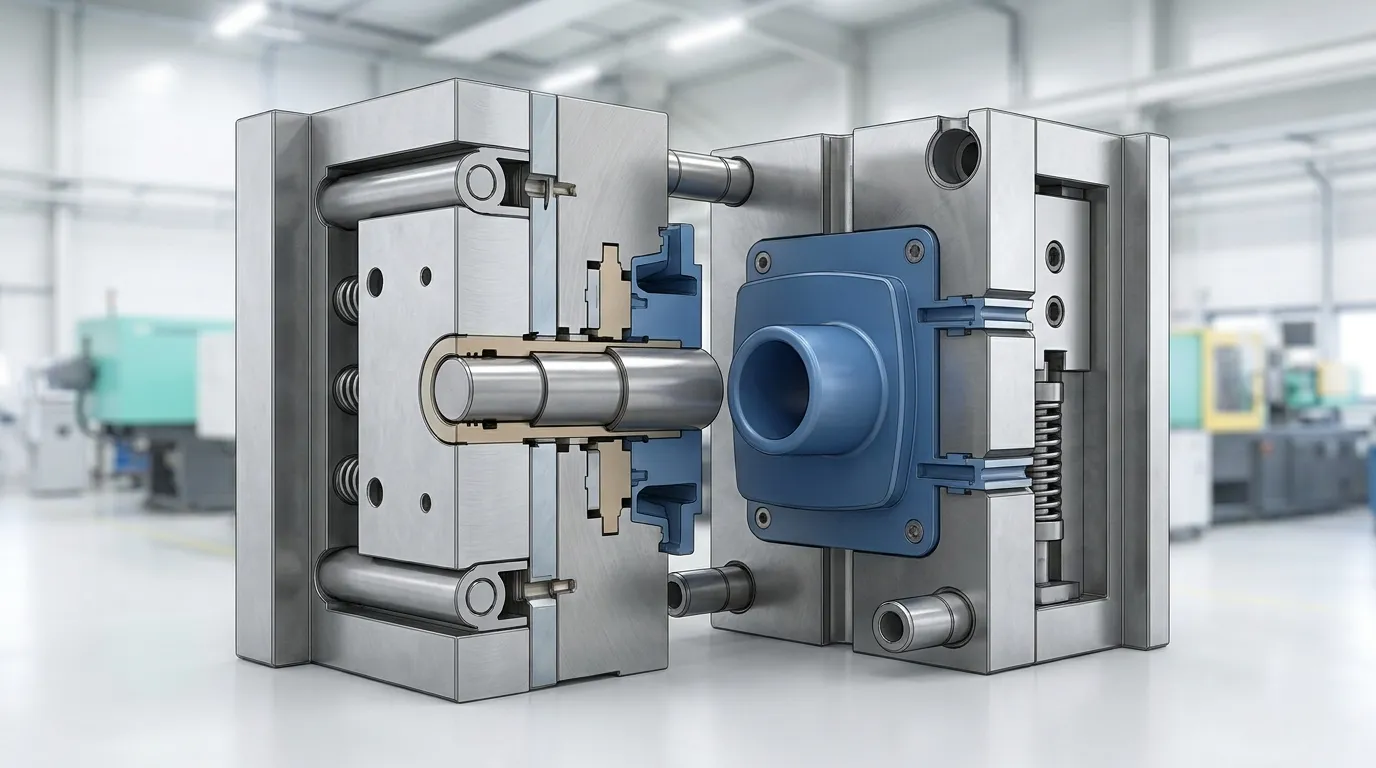
Ejector sleeves are tubular ejectors designed to push molded parts off core pins or cylindrical features evenly. They reduce stress concentration compared to standard ejector pins and help prevent deformation around bosses or hollow sections.
An ejector sleeve works like a hollow ejector pin. Instead of pushing from a single contact point, the sleeve surrounds the core pin and applies force evenly around the molded feature. This helps the part release without tilting, Grietas, or sticking during ejection.
Sleeves are commonly used for cylindrical geometries such as bosses, hubs, y secciones huecas. These shapes often trap tightly around the core pin after cooling. A standard pin can create localized stress in one area, especially on thin-wall plastic parts.
Según el US5730812A patente de fabricación, ejector sleeves are produced with strict concentricity control so the sleeve moves smoothly around the core pin during repeated molding cycles.
For readers who want a broader overview of mold components, Sunshine Pro Guía completa de componentes de molde explains how ejector systems fit into the full mold assembly.
También puedes revisar estos Conceptos básicos del perno eyector to compare solid pins with sleeve-style ejectors.
When should you use an ejector sleeve instead of an ejector pin?
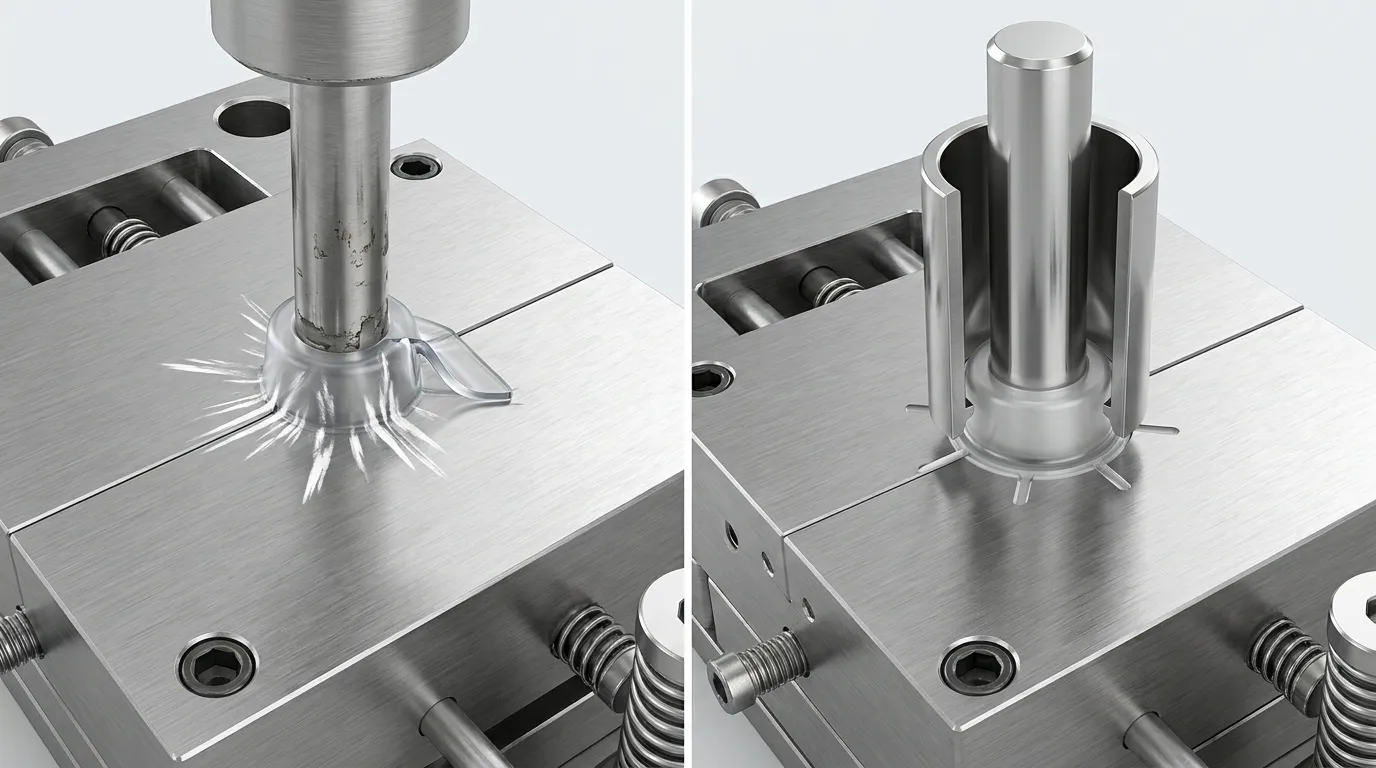
Use ejector sleeves when parts eject around a core pin, deep boss, or cylindrical feature where a standard ejector pin would create uneven force or visible stress marks. Sleeves distribute pressure more evenly and improve concentric ejection.
Ejector sleeves are usually the safer choice when the molded feature surrounds a core pin. The sleeve keeps the ejection force centered, which reduces side loading and lowers the risk of deformation. This matters most in cosmetic parts, thin-wall parts, and deep cylindrical geometries.
Standard ejector pins are not automatically the simpler or safer option. Around deep bosses or cylindrical cores, they often create uneven force that increases cosmetic defects and sticking risk. A sleeve may cost more upfront, but it can prevent expensive mold adjustments later.
Tabla de Decisión de Funda vs Clavo
| Geometría de las piezas | Opción recomendada | Riesgo si se elige mal | Sensibilidad cosmética |
|---|---|---|---|
| Jefe profundo | Manga eyector | Cracking de jefe | Alto |
| Cilindro hueco | Manga eyector | Lanzamiento desigual | Alto |
| Área estructural plana | Pasador eyector | Riesgo mínimo | Bajo |
| Función soportada por núcleos altos | Manga eyector | Carga lateral | Medio |
| Pared gruesa no estética | Pasador eyector | Marcas menores de testigos | Bajo |
A cosmetic electronics housing is a common example. Deep screw bosses inside the housing often show stress whitening when standard pins eject too aggressively from one side. A sleeve spreads the force around the boss and reduces visible defects.
For a broader look at mold ejection layouts, Guía de Sunshine Pro para Diseño del sistema de eyección explains how different ejector components work together inside the mold.
Which molded part geometries typically require ejector sleeves?
Ejector sleeves are commonly used for deep bosses, cylindrical hubs, and hollow molded sections where centered ejection is critical. These geometries often fail with standard pins because force concentrates on a small contact area.
Most sleeve applications involve parts that wrap tightly around a cylindrical core. During cooling, the plastic shrinks around the core pin, which increases friction during ejection. A centered sleeve helps release the part evenly instead of pushing from one edge.
Common examples include bottle caps, medical housings, electronic screw bosses, and precision cylindrical parts. High-cycle cap molds often rely on sleeves because the parts are thin, flexible, and sensitive to deformation during release.
Aplicaciones comunes de la geometría
| Tipo de geometría | Por qué ayudan las fundas |
|---|---|
| Jefes profundos | Evita que se agrieten alrededor de la pared del jefe |
| Tapas de pared delgada | Reduce la deformación durante la liberación |
| Bujes cilíndricos | Mantiene la eyección concéntrica |
| Carcasas cosméticas | Reduce las marcas visibles de tensión |
| Partes altas soportadas por núcleo | Previene la carga lateral |
Por qué las fundas se usan comúnmente alrededor de los pines del núcleo
Core pins support internal molded features such as holes, Jefes, and tubes. When the plastic cools, those features grip the core tightly. An ejector sleeve moves around the core pin and applies balanced pressure to the entire feature.
Según ZJ Mold Tech, sleeve ejectors are widely used for cylindrical molding applications because they improve ejection stability around core-supported geometries.
También puedes revisar estos Componentes de eyección de molde to understand where sleeves fit inside larger ejection assemblies.
Why do fit and concentricity matter for ejector sleeves?
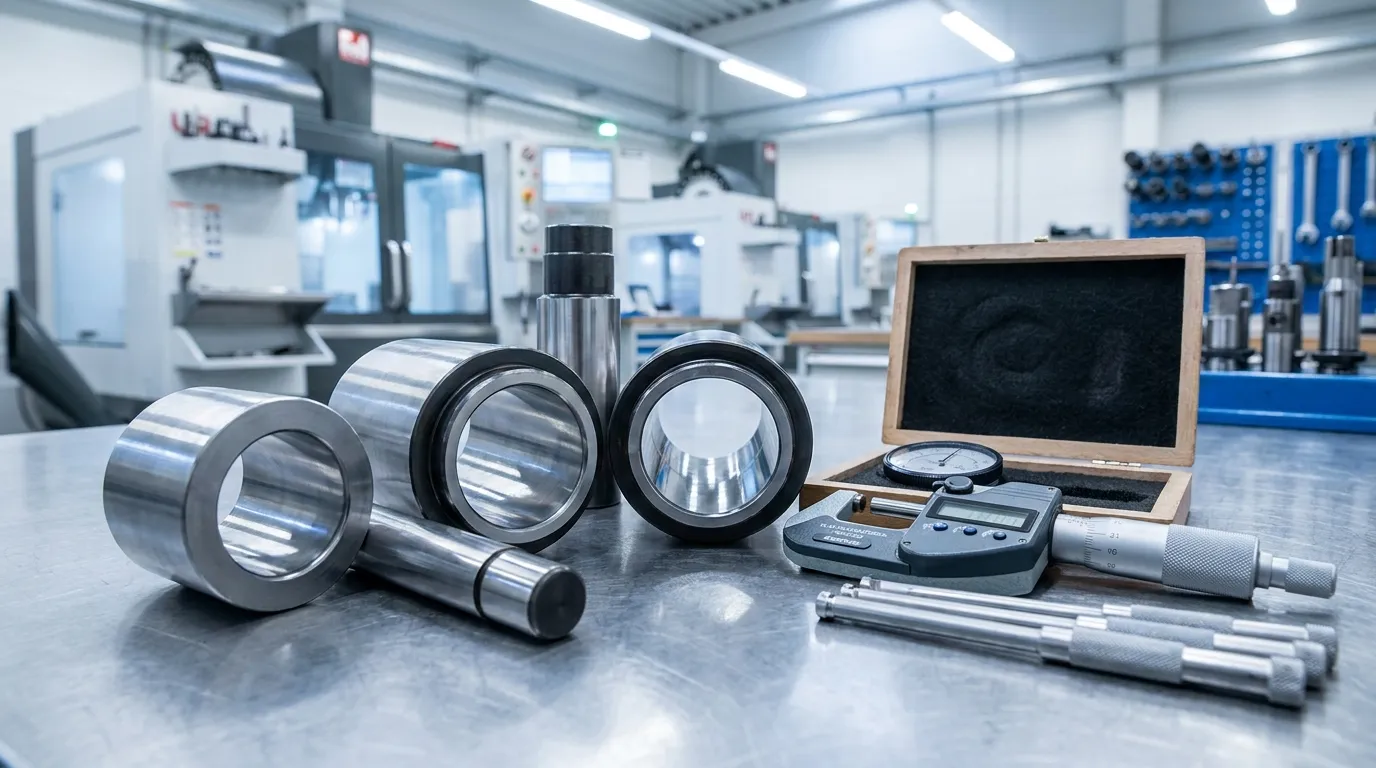
Ejector sleeves require tight concentricity and controlled clearance because misalignment increases friction, Desgaste, and sticking during ejection. Poor fit can damage both the molded part and the mold core.
Unlike standard ejector pins, sleeves move around another component. That means both the inside diameter and outside diameter must stay aligned during repeated molding cycles. Even small concentricity errors can create uneven contact and friction.
El Especificaciones de la manga eyectora de molde Choice reference tight TIR values and nitrided surfaces to improve alignment stability and wear resistance. Those tolerances become more important in high-cycle molds.
Overly tight sleeve clearance is not always better. Tight fits improve stability, but aggressive clearance reduction can increase galling and friction if lubrication or alignment is poor. In many production molds, controlled movement is safer than forcing near-zero clearance.
Problemas comunes causados por una baja concentración
| Problema | Causa probable |
|---|---|
| Encuadernación de mangas | Pasador del núcleo desalineado |
| Galling | Fricción excesiva |
| Desgaste desigual | Pobre concentración |
| Pegado de piezas | Espacio libre ajustado |
| Daño al núcleo | Carga lateral durante la eyección |
A medical molding application is a good example. Medical molds often run high volumes with strict dimensional requirements. Many manufacturers use nitrided sleeves because the harder surface helps reduce wear while maintaining stable movement around the core pin.
What materials and surface treatments are commonly used for ejector sleeves?
Most ejector sleeves use H13 or SKD61 hot-work tool steel because these materials resist wear, thermal fatigue, and repeated ejection stress. Nitrided surfaces further improve hardness and reduce galling.
Injection molds run through repeated heating and cooling cycles, so sleeve materials must resist thermal fatigue and surface wear. H13 and SKD61 are common choices because they hold hardness well under high-temperature production conditions.
Según Resumen del material de ZGCGMJ, SKD61 provides strong wear resistance and thermal stability for repeated molding cycles. Many suppliers also add nitriding treatments to increase surface hardness without making the sleeve brittle.
Materiales comunes de las mangas eyector
| Material | Beneficio principal | Uso típico |
|---|---|---|
| Acero H13 | Resistencia al calor | Moldes de alto ciclo |
| SKD61 | Resistencia al desgaste | Moldes de precisión |
| Acero nitrurado | Dureza superficial | Piezas cosméticas |
| Acero de herramienta endurecido | Durabilidad | Producción general |
A thin-wall cap mold running continuously at high speed puts heavy wear on sleeve surfaces. En esa situación, nitrided sleeves often last longer because the hardened surface reduces friction during repeated ejection cycles.
What failures happen when the wrong ejector method is used?
Using ejector pins where sleeves are required can create uneven ejection force, leading to boss cracking, Marcas de tensión, pegado, or deformation. Incorrect sleeve fit can also accelerate mold wear and cause galling.
Most ejection failures start with uneven force distribution. When a pin pushes against one side of a deep boss, the plastic can flex or crack during release. Cosmetic surfaces are especially vulnerable because stress whitening often appears before the part fully ejects.
A mold with poor sleeve concentricity can create another problem. Repeated friction between the sleeve and core pin causes galling, which is surface damage created by metal-to-metal contact. Once galling starts, the sleeve movement becomes rough and sticking gets worse.
Fallos comunes de eyección
| Fracaso | Typical Cause | Mejor solución |
|---|---|---|
| Blanqueamiento por estrés | Fuerza desigual de los pasadores | Uso de eyección de mangas |
| Cracking de jefe | Carga lateral | Fuerza de la manga centrada |
| Galling | Mala limpieza | Ajuste y lubricación correctos |
| Pegado de piezas | Desalineación | Mejorar la concentricidad |
| Desgaste desigual | Control de tolerancia flexible | Ajuste de manga de precisión |
El MoldMakingAnálisis de tecnología highlights how wear conditions and improper operating alignment contribute to ejector sleeve failure over time.
También puedes revisar estos Problemas comunes con los pasadores de eyección to understand how poor ejection choices affect overall mold performance.
How do you specify ejector sleeves correctly for a mold build?
Correct ejector sleeve specification depends on core-pin diameter, required clearance, stroke length, Dureza, and concentricity tolerance. Inaccurate sizing increases wear risk and can create unstable ejection.
The first step is matching the sleeve ID to the core pin diameter with the correct running clearance. The sleeve must move freely without excessive looseness. Stroke length also matters because the sleeve needs enough travel to release the molded feature completely.
Standard catalog sleeves work for many molds, but complex cosmetic parts often require custom dimensions or tighter concentricity controls than off-the-shelf components provide. Buyers sometimes underestimate how much part geometry affects sleeve specification.
Lista de verificación de especificaciones de la manga eyector
| Elemento de especificación | Por qué importa |
|---|---|
| Diámetro del pasador del núcleo | Determina el ID de la funda |
| Diámetro exterior de la manga | Encaja en la disposición de las placas eyectables |
| Ajuste de espacio | Controla la estabilidad del movimiento |
| Longitud del recorrido | Garantiza la expulsión total |
| Grado de material | Afecta a la vida útil |
| Dureza | Mejora la durabilidad |
| Tratamiento superficial | Reduce la agallación |
| Tolerancia a la concentricidad | Previene el atascamiento |
Cuando es necesaria una manga eyector personalizada
Custom sleeves are often required for unusual boss geometries, cosmetic molds, or precision medical parts. A standard sleeve may fit dimensionally but still fail if the tolerance stack creates unstable movement around the core.
A procurement comparison shows this clearly. A standard MISUMI sleeve may work for a common bottle-cap mold, but a custom-machined sleeve is often safer for a nonstandard electronics housing with tight cosmetic requirements.
For more detail on precision component sizing, Guía de Sunshine Pro para Tolerancias de herramientas de precisión explains how tolerance control affects tooling performance.
Are standard ejector sleeves enough for most molds?
Standard ejector sleeves handle many production molds successfully, especially for common cylindrical geometries with moderate cosmetic requirements. They are easier to source, less expensive, and available in common dimensions from major suppliers.
Custom sleeves become more important when molds require unusual diameters, tighter concentricity, or higher cosmetic standards. Medical molds, thin-wall packaging, and precision electronics often need tighter control than standard catalog parts provide.
Fundas estándar vs personalizadas
| Factor | Funda estándar | Funda personalizada |
|---|---|---|
| Tiempo de espera | Corto | Más largo |
| Coste | Inferior | Más alto |
| Tamaños disponibles | Limitada | Flexible |
| Control de la concentricidad | Grado estándar | Aplicación específica |
| Rendimiento estético | Moderado | Mayor precisión |
If the mold uses basic cylindrical features and standard production speeds, catalog sleeves are usually enough. For high-cycle or cosmetic molds, tighter engineering control often pays for itself through lower defect rates and reduced maintenance.
Cómo elegir la opción correcta
Choosing between ejector sleeves and standard pins comes down to geometry, force distribution, and tolerance control. Jefes profundos, cylindrical cores, and cosmetic surfaces usually benefit from sleeve ejection because the force stays centered during release.
Before finalizing a mold design, review the core-pin diameter, clearance fit, expected production volume, y requisitos cosméticos. Those details affect wear life more than the component price alone. When ejector sleeves are specified correctly, they reduce sticking, improve part quality, and help stabilize long production runs.
Preguntas frecuentes
What is the primary function of an ejector sleeve?
An ejector sleeve pushes molded parts evenly around a core pin or cylindrical feature during mold ejection. It spreads force over a larger contact area than a standard ejector pin, which helps reduce stress marks and deformation.
When should ejector sleeves be used instead of ejector pins?
Ejector sleeves should be used for deep bosses, hollow cylinders, and core-pin-supported features that require centered ejection. Standard ejector pins can apply uneven pressure and increase the risk of cracking or visible stress marks.
Why are ejector sleeves used around core pins?
Ejector sleeves surround the core pin so the ejection force stays balanced around the molded feature. This reduces side loading, improves release stability, and helps prevent sticking during production.
What materials are commonly used for ejector sleeves?
H13 and SKD61 hot-work tool steels are common ejector sleeve materials because they resist wear and thermal fatigue. Many manufacturers also use nitrided surfaces to improve hardness and reduce galling.
What causes ejector sleeve failure?
Pobre concentración, incorrect clearance, lubricación insuficiente, and side loading are common causes of ejector sleeve failure. These conditions increase friction and wear, which can lead to binding and unstable ejection.
Do ejector sleeves require tight tolerances?
Sí, ejector sleeves require controlled clearance and tight concentricity so they move smoothly around the core pin. Loose or misaligned sleeves increase wear and can damage both the mold and molded part.
Compartir:



Escrito por Sunshine
Al sol, Somos un fabricante y proveedor profesional de componentes de moldes de precisión, ofreciendo una amplia gama de productos para aplicaciones de estampado y moldes de inyección. Nuestro enfoque principal es el punzonamiento de troqueles, Pasadores y fundas eyector, y postes guía y casquillos. Con mecanizado CNC avanzado, Control de calidad estricto, y una fuerte capacidad de producción, Garantizamos la fiabilidad, Piezas de alta precisión, junto con componentes estándar en stock para un suministro global rápido y eficiente.
NOTICIAS
CONSIGUE EL SERVICIO
Con piezas de calidad para todos los presupuestos y personal amable formado para que tu visita sea informativa y sin complicaciones.
