



Prevención de tirones de slug en troqueles de estampado: Causas y soluciones
Slug pulling occurs when a pierced slug remains attached to the punch and travels upward during the return stroke. The slug may stay on the punch face, drop back onto the strip, become trapped near the stripper, or return to the working area where it can be struck again.
Effective slug pulling prevention in stamping dies starts with identifying what is holding the slug to the punch. Common mechanisms include vacuum, lubricant adhesion, residual magnetism, Sujeción de rebabas, unsuitable punch-to-die clearance, worn cutting edges, and insufficient die-wall retention.
Autorización, Alineación, die construction, and cutting-edge maintenance are broader tooling fundamentals covered in the Guía de troqueles de punzonados (Inferido). This guide focuses specifically on diagnosing slug pulling and matching the correction to its actual cause.
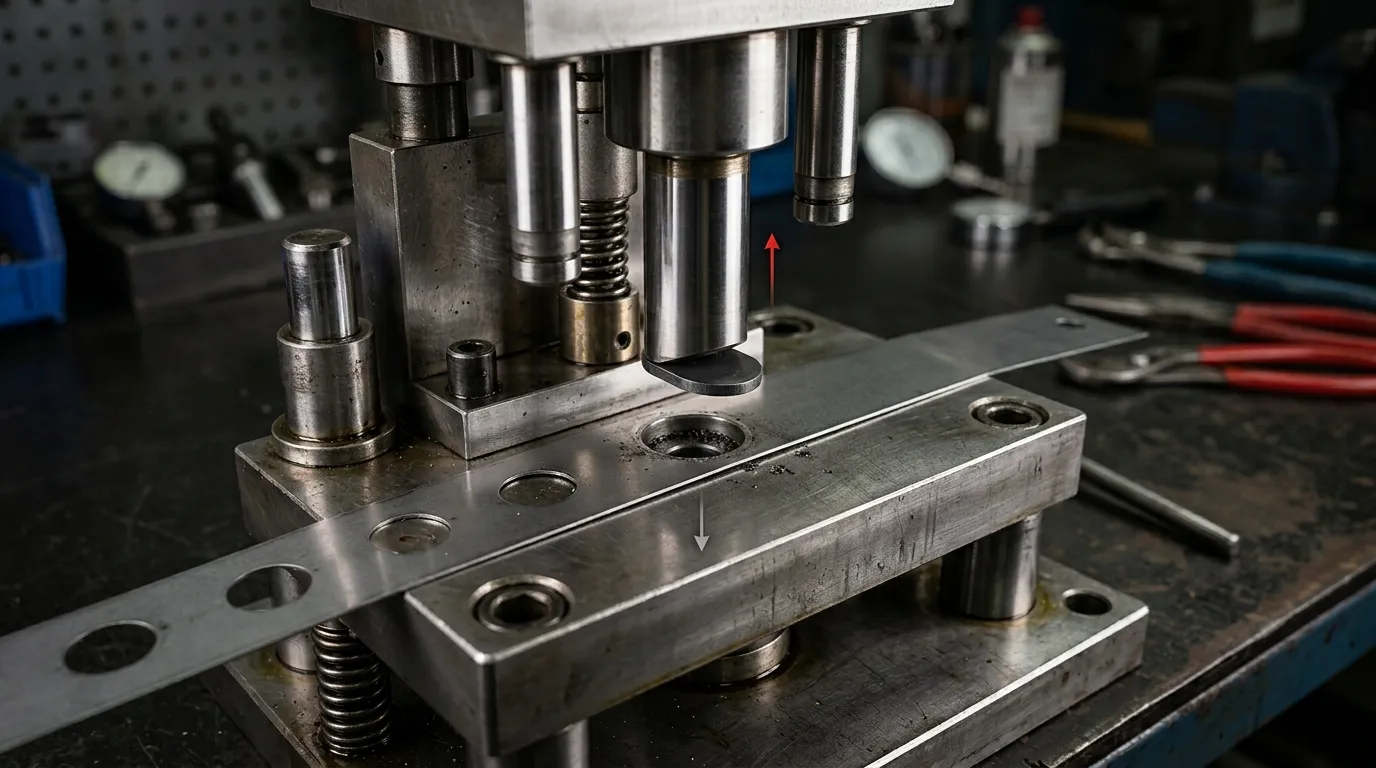
Cómo es el tirón de la bala y por qué puede dañar el troquel
During a normal piercing cycle, the punch enters the sheet, separates the slug, and pushes it into the die opening. As the punch retracts, the stripper holds the sheet down while the slug remains in the die channel or continues through the relief area.
With slug pulling, the separated slug follows the punch during retraction. It may remain attached for the full upstroke or release unexpectedly above the die surface.
Typical signs include:
- A slug stuck to the punch face.
- Loose slugs appearing on top of the strip.
- Circular or shaped dents near pierced holes.
- Repeated slugs around the stripper or die surface.
- Feed interruption after a piercing station.
- Unusual impact noise during a subsequent stroke.
- Cutting-edge marks that appear after a double hit.
- Intermittent defects that occur only at normal press speed.
A returned slug can be struck between the punch and strip during the next cycle. This may mark the part, chip a cutting edge, overload a small punch, or interrupt strip movement in a progressive die. If repeated impact is contributing to tool failure, the related Rotura de punzones en troqueles de estampado guide covers the broader fracture and overload mechanisms.
Confirma que el problema es un tirón real de slug
Not every slug found near the die surface was carried upward by the punch. Identifying where the scrap becomes uncontrolled prevents the wrong corrective action.
| Estado | ¿Qué pasa? | Observación típica | Área principal a investigar |
|---|---|---|---|
| Verdadera tirada de babosas | El proyectil permanece unido al punzón durante la retracción | Bala visible en la cara del punzón o liberada por encima de la tira | Fuerzas de pegado entre el puñón y la retención del troquel |
| Apilamiento de slugs | Múltiples slugs se acumulan dentro del canal del chip | Increasing discharge resistance, blocked relief, compressed slug column | El país, Relevo, outlet, and scrap path |
| Caída de babosas o rebote | La bala se separa pero se mueve de forma impredecible tras el lanzamiento | Bala suelta encontrada cerca del troquel sin indicios de la fijación del punzón | Geometría de salida del troquel y control de chatarra |
| Chatarra flotante | Detached light scrap returns to the working area through airflow, Vibración, or poor evacuation | Las piezas sueltas se mueven de forma independiente al puñetazo | Chutes, outlets, airflow, and scrap handling |
Slow-cycle observation may reveal where the slug releases, but some failures only occur at production speed. High-speed video, Cuando esté disponible, can show whether the slug follows the punch, pauses in the die opening, or becomes loose after discharge.
Other useful clues include:
- Oil patterns on the slug or punch face.
- Metallic debris or deposits around the cutting edge.
- A noticeable magnetic attraction between the punch and slug.
- Changes that began immediately after sharpening.
- A failure that appears only after increasing press speed.
- A slug that is already detached before it reaches the die surface.
Scrap suction can help remove detached light scrap, but it does not directly release a slug that is still attached to the punch. Component roles such as the punch, El botón, stripper, Elementos guía, and wear parts are covered more broadly in the Guía de componentes del chip.
Por qué una bala sigue al puñetazo durante la retracción
Slug pulling is best understood as a force-balance problem. Forces holding the slug against the punch act against forces that retain the slug in the die or push it away from the punch.
Según Investigación revisada por pares sobre mecanismos de tirón de babosas, the dominant mechanism can change with punch diameter, Autorización, penetration depth, cutting speed, lubricant viscosity, Condición de arista, and material behavior. Several mechanisms may also act at the same time.
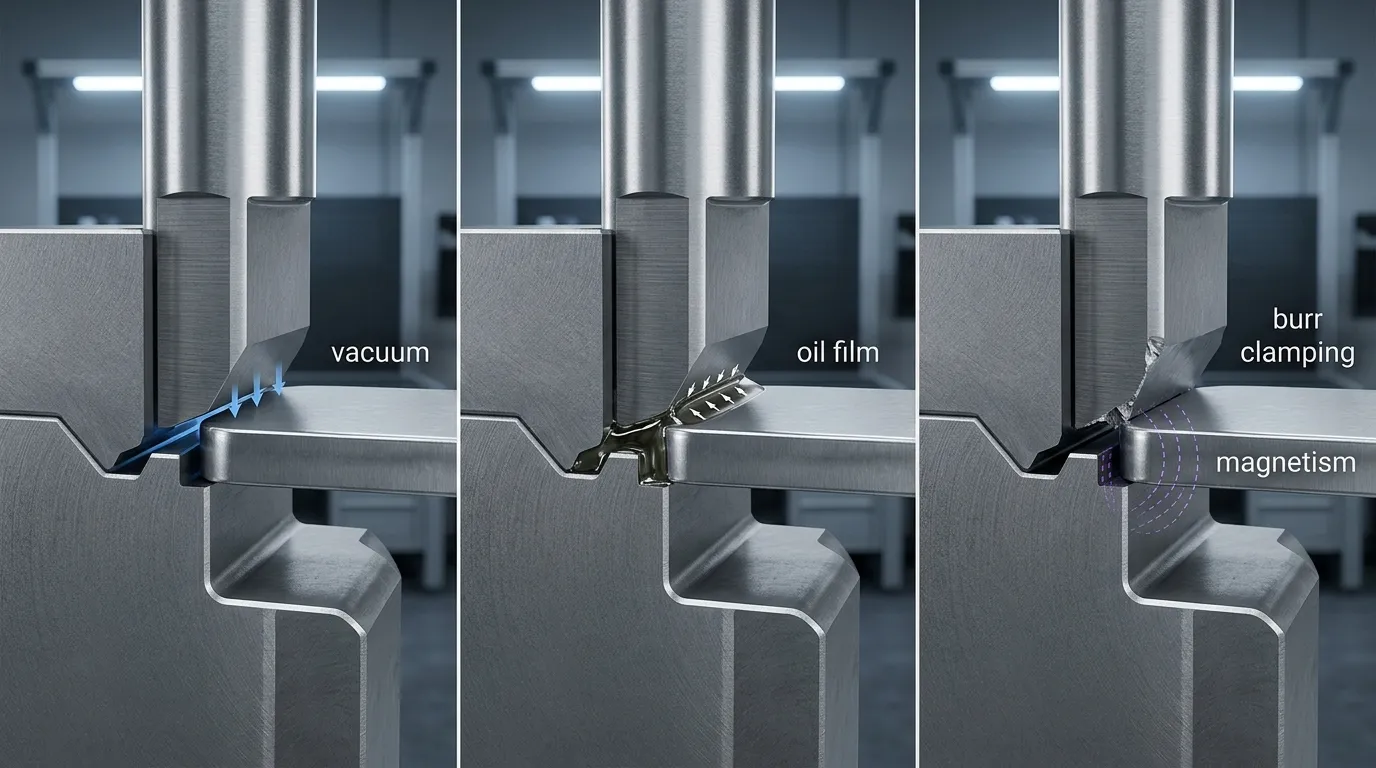
Vacío y adhesión a la película de aceite
After the slug separates, a small sealed space may form between the punch face and the slug. As the punch retracts, pressure in that space can fall below the surrounding pressure. The resulting vacuum force helps keep the slug against the punch face.
Vacuum-related pulling may become more influential when:
- The slug has broad, flat contact with the punch face.
- The punch retracts quickly.
- Air cannot enter the space easily.
- The punch travels deeply into the die.
- The punch diameter creates a relatively large sealed area.
- Lubricant helps maintain the seal.
Lubricant can also create its own adhesive force. A thick oil film between the punch face and slug may resist separation, especially when the lubricant has high viscosity or is applied excessively.
That does not mean lubrication should simply be removed. Lubricant may be necessary for tool wear control, strip movement, and part quality. The correct response is to review the lubricant type, Cantidad, Temperatura, and application consistency through controlled trials.
Magnetismo residual y sujeción de muelas
A steel punch can retain magnetism after grinding, Afilado, or contact with magnetic workholding equipment. If the slug material is ferromagnetic, magnetic attraction may be enough to carry a small or light slug upward.
Residual magnetism is especially suspect when slug pulling begins immediately after:
- Punch sharpening.
- Surface grinding.
- Magnetic chuck use.
- Punch replacement.
- Maintenance involving magnetic tools.
Burr clamping is a different mechanism. During fracture, the slug edge may develop a burr that mechanically grips the punch cutting edge. Worn edges, Chips, Espacio inadecuado, and changes in fracture geometry can increase this gripping action.
The distinction matters. Demagnetizing will not correct mechanical clamping, while sharpening alone will not remove residual magnetism.
Retención insuficiente del chip o liberación incorrecta del slug
The die channel must perform two tasks that can conflict with each other. It must resist the slug’s upward return, but it must also allow the slug to travel downward without stacking or excessive compression.
Punch-to-die clearance affects:
- Fracture behavior.
- Slug size and deformation.
- Burr direction and size.
- Contact between the slug and die wall.
- Cutting and stripping forces.
- The slug’s ability to move through the die.
Excessively open clearance may reduce useful die-wall retention or create unstable slug behavior. Excessively tight clearance may increase cutting force, Desgaste, burr-related clamping, or slug compression.
Die land length, relief geometry, internal wear, Depósitos, and damaged transitions also affect the holding and release forces. Research on Tensiones de contacto entre troquelada y slug shows that die geometry and radial contact influence slug-retaining friction. More compression is not automatically better; excessive plastic deformation may reduce the effective retaining stress or contribute to stacking.
There is therefore no universal clearance percentage that prevents slug pulling in every material, Grosor, and punch geometry.
Diagnostica la causa antes de modificar la herramienta
A structured investigation is usually more effective than immediately adding an ejector, changing clearance, or modifying the die.
- Confirm that the slug follows the punch.
Observe the slug during retraction and determine whether it remains attached, releases near the stripper, or becomes loose only after leaving the die. - Identify what changed before the failure appeared.
Check for recent sharpening, a new material coil, a lubricant change, higher press speed, Sustitución de componentes, die regrinding, or clearance adjustment. - Record where the slug releases.
A slug that stays attached throughout the upstroke may indicate a strong vacuum, oil adhesion, Magnetismo, or burr clamping. A slug that releases near the die entrance may indicate marginal retention. - Inspect the punch face and cutting edge.
Look for wear, Chips, built-up material, Residuos de aceite, burr marks, or circular witness marks from repeated contact. - Inspect the die channel.
Check the land, Relevo, wall condition, Depósitos, Daños, and evidence of slug stacking. - Check for residual magnetism.
Compare the punch’s attraction before and after demagnetizing when magnetic sticking is suspected. - Verify the actual clearance.
Do not rely only on the nominal drawing. Confirm punch size, La apertura, Desgaste, and clearance per side in the current tool condition. - Review punch penetration.
Too little penetration may fail to advance the slug into a retaining or relief region. More penetration, sin embargo, may increase the volume change beneath the punch and strengthen vacuum during withdrawal. - Compare slow and production-speed behavior.
A setup that works during slow cycling may fail when withdrawal speed, Lubricación, Vibración, and thermal conditions reach normal production levels. - Change one variable at a time.
If clearance, Lubricación, Velocidad, and penetration are changed together, the team cannot reliably identify which adjustment corrected or worsened the problem.
All inspection and testing should follow the plant’s approved press-safety and toolroom procedures.
Compara la solución con la causa confirmada
Start with reversible maintenance and setup corrections. Move to process changes next. Punch-side or die-side modifications should follow only when the observed mechanism justifies them.
Mantenimiento y correcciones de configuración
| Condición observada | Comprobado | Posible corrección |
| El problema empezó después de grindar | Atracción magnética residual | Desmagnetizar el punzón y verificar el resultado |
| Película de aceite visible entre el punzón y el slug | Cantidad de lubricante y viscosidad | Corregir la aplicación excesiva o inconsistente |
| Las marcas de muelas o filos sujetan el punzón | Cutting-edge wear, Chips, Autorización | Restaura el borde y vuelve a comprobar el espacio real |
| Depósitos en la pared de punzón o matriz | Recogida o contaminación de materiales | Limpia las superficies afectadas e investiga la fuente |
| Marcas de testigos desiguales | Alineación de punzonador y matriz | Corrige la alineación antes de cambiar la geometría |
| El problema comenzó tras el reemplazo | Dimensiones instaladas y penetración | Confirma que el nuevo componente coincide con el dibujo y la configuración |
These checks are relatively low cost and can reveal whether the failure was introduced by maintenance or setup rather than the original die design.
Ajustes de proceso y geometría
Clearance should be reviewed as part of the whole cutting condition, not changed in one direction by default. The correct value depends on the material, Grosor, Tamaño del agujero, part-quality requirement, Estado de la herramienta, and die geometry.
Punch penetration also requires careful evaluation. Increasing entry may help place the slug deeper into a retaining section, but it may also increase vacuum effects. Reducing entry may decrease vacuum volume while leaving the slug insufficiently controlled by the die.
Other controlled adjustments may include:
- Reviewing lubricant quantity and delivery position.
- Comparing lower and normal production speeds.
- Correcting inconsistent material feeding or strip support.
- Restoring the intended die land and relief condition.
- Confirming that the slug can move downward without obstruction.
After each change, check hole quality, burr condition, stripping behavior, tool marks, and scrap movement. A correction that stops slug pulling but creates excessive burrs or die-channel stacking is not a complete solution.
Modificaciones de herramientas en el lado del punzón y del lado del troquel
Punch-side modifications act directly on the slug or the pressure beneath the punch:
- Punzón ventilado: Provides a path for pressure equalization and is most relevant when vacuum is the dominant mechanism.
- Mechanical slug ejector: Uses a spring-loaded or resilient element to push the slug away from the punch face.
- Compressed-air blow-off: Applies a timed downward force through or near the punch.
- Geometría de cizalladura: Reduces full-face contact or deforms the slug so it separates more easily from the punch.
Die-side modifications increase resistance to upward movement or improve controlled discharge:
- Slug-retention grooves or catcher features: Create local interference below the cutting edge.
- Controlled die-wall contact: Uses the die channel to generate sufficient retaining friction.
- Corrected land and relief geometry: Holds the slug where needed, then permits downward release.
- Repair or replacement: Restores worn or damaged internal geometry.
Each option has limitations. Small punches may not have enough internal space for a vent or ejector. Air passages can clog, consume compressed air, or weaken a slender punch. Ejector elements can fatigue. Shear geometry may create side loading or unacceptable slug deformation. Retention features must remain effective after sharpening and must not create slug stacking.
Investigación en Aire a alta presión para la eliminación de slug also shows why pneumatic approaches should be treated as application-specific tooling solutions rather than universal retrofits.
Comparar métodos de prevención de tirones de babosas por mecanismo y compensación
| Método | Mecanismo de mejor ajuste | Principal ventaja | Limitación principal | Qué verificar |
| Desmagnetización | Magnetismo residual | Rápido y mínimamente invasivo | No corrige el vacío ni la sujeción de rebabas | La atracción magnética se reduce y la tracción se detiene |
| Reseña de lubricantes | Adhesión de aceite y película | Puede corregir el problema sin modificar la herramienta | Muy poco lubricante puede aumentar el desgaste | Desgaste de la herramienta, strip movement, and part quality remain acceptable |
| Restauración de bordes | Sujeción de rebabas o filo de corte desgastado | Restaura la condición prevista de fractura | El afilado puede alterar la entrada o la salida del magnetismo | Condición de arista, penetration, and magnetism |
| Corrección de espacio libre | Mala fractura o retención del troquel | Aborda una variable de corte fundamental | Wrong adjustment can increase burrs, Fuerza, o desgaste | Hole quality, muelas, Desmontaje, y movimiento de babosas |
| Ajuste de penetración | Proyectil que no entra en la región correcta del dado | Puede mejorar la posición de la bala | Una mayor entrada puede reforzar el vacío | Posición del slug y comportamiento a velocidad de producción |
| Punzón ventilado | Vacío | Iguala directamente la presión | El paso puede obstruir o reducir la fuerza del golpe | El camino del aire permanece abierto y el punzón sigue siendo estructuralmente adecuado |
| Eyector mecánico | Fuerte adhesión facial | Añade fuerza de separación positiva | Requiere espacio y mantenimiento continuo | Ejector force, Fatiga, and timing |
| Aire comprimido | Vacío o adhesión persistente | Fuerte, controllable separation | Needs air supply, timing, and clean passages | Air consumption, clogging, and reliable ejection |
| Geometría de cizalladura | Contacto facial amplio o adhesión | Interrumpe el contacto sin un mecanismo interno | Puede provocar carga lateral o deformación en slug | Carga de punzones y requisitos de piezas |
| Función de retención de troqueles | Resistencia insuficiente a la inversión de slug | Sujeta el slug por debajo del filo cortante | Puede afectar el afilado y el flujo de chatarra | La retención sigue siendo efectiva sin apilamiento |
| Sensor de protección de matriz | Ciclos anormales intermitentes | Puede detener la prensa antes de que se dañe repetidamente | Detecta el problema pero no elimina su causa | Reliable detection under oil, Vibración, and normal speed |
The best option is determined by the confirmed mechanism, available tool space, punch strength, material conditions, Requisitos de mantenimiento, and whether the method prevents, removes, or only detects the abnormal slug.
Verifica que la solución funcione a velocidad de producción
A few successful slow strokes do not prove that the problem is resolved. Vacío, lubricant behavior, Vibración, and scrap movement can change as the press reaches normal operating speed.
Use a controlled verification sequence:
- Confirm consistent slug release during reduced-speed observation.
- Increase to normal production speed according to approved procedures.
- Check that slugs travel through the intended die and scrap path.
- Inspect pierced holes and surrounding surfaces for new marks.
- Check that burr condition has not worsened.
- Confirm that stripping remains stable.
- Inspect the punch and die edges for unusual witness marks.
- Make sure slugs are not accumulating in the die channel.
- Observe the tool after it reaches normal operating temperature.
- Record any recurrence rather than judging the result from a few cycles.
The test record should include the material lot, Condición del lubricante, Velocidad de presión, changed variable, run duration, observations, and inspection results. This makes later recurrence easier to trace.
Información a recopilar antes de solicitar una modificación con puñón o matriz
When maintenance and controlled process adjustments do not resolve slug pulling, a tooling supplier will need more than a damaged punch sample.
Prepárate:
- Part or strip drawing.
- Punch and die dimensions.
- Material grade and thickness.
- Hole or slug shape and size.
- Actual clearance per side.
- Punch penetration depth.
- Die land and relief dimensions.
- Press type and production speed.
- Lubricant type and application method.
- Sharpening and maintenance history.
- Photos of the punch face, cutting edge, die channel, slug, y rebala.
- Video showing when and where the slug releases.
- Frecuencia de fallos.
- Recent process or tooling changes.
- Corrections already tested and their results.
- Required hole, Burr, and surface-quality criteria.
Complete application data helps distinguish between a replacement component, a geometry correction, or a process problem that would not be solved by a new punch.
SunshinePro Pasador de perforación personalizado page confirms drawing-based customization of punch dimensions, Perfiles, materiales, y tratamientos superficiales. It also lists CNC machining, EDM, molienda, and heat treatment. These verified capabilities support component review, but they do not by themselves confirm availability of vented punches, Sistemas eyectores, pneumatic passages, or slug-retention features.
Cuando se justifica la revisión de reemplazo o de herramientas personalizadas
Replacement or custom tooling review becomes reasonable when:
- The punch or die is too worn or damaged for practical restoration.
- Actual geometry no longer matches the intended clearance or penetration.
- The die channel cannot provide reliable retention and discharge.
- Slug pulling returns after confirmed maintenance and process corrections.
- A different punch profile or component dimension is required.
- A proposed vent, eyector, shear, or retention feature needs structural review.
Listas de SunshinePro Troqueles y pasadores de punzonamiento among its product categories and offers drawing-based custom punch components. For a technical review, provide the drawings, Información material, tool dimensions, Velocidad de presión, lubricant conditions, and observed slug behavior through the Página de contacto de SunshinePro. The goal should be to review the component against the confirmed failure mechanism rather than requesting a generic anti-slug modification.
Compartir:



Escrito por Sunshine
Al sol, Somos un fabricante y proveedor profesional de componentes de moldes de precisión, ofreciendo una amplia gama de productos para aplicaciones de estampado y moldes de inyección. Nuestro enfoque principal es el punzonamiento de troqueles, Pasadores y fundas eyector, y postes guía y casquillos. Con mecanizado CNC avanzado, Control de calidad estricto, y una fuerte capacidad de producción, Garantizamos la fiabilidad, Piezas de alta precisión, junto con componentes estándar en stock para un suministro global rápido y eficiente.
NOTICIAS
CONSIGUE EL SERVICIO
Con piezas de calidad para todos los presupuestos y personal amable formado para que tu visita sea informativa y sin complicaciones.
