



Pasadores de perforación para troqueles progresivos: Precisión para herramientas de alto ciclo
Punch pins for progressive dies must be selected as part of a complete station system, not as isolated hardened components. The operation performed at the station, strip material, feature geometry, Espacio de corte, punch support, Alineación, Condiciones de desmontaje, and maintenance plan all affect punch reliability.
A harder material or premium coating cannot compensate for excessive unsupported length, Mala alineación, Autorización incorrecta, or unstable strip feeding. Para información más amplia sobre tipos de troqueles, Materiales, Tolerancias, y la obtención, véase el Guía de troqueles de punzonados (Inferido). This guide focuses specifically on selecting, diagnosing, and specifying working punches for progressive tooling.
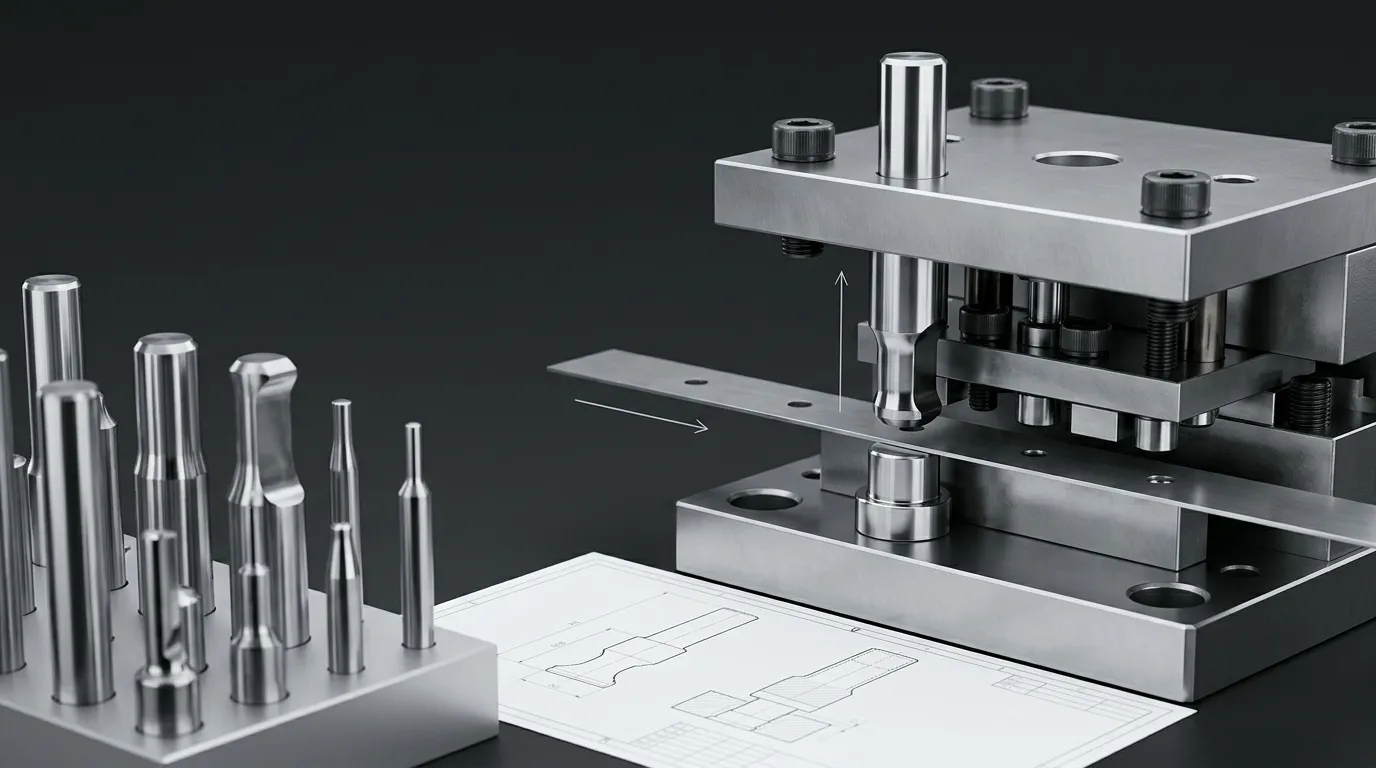
Por qué los troqueles progresivos necesitan especificaciones específicas de punzonadores para la estación
A progressive die moves strip material through a sequence of stations. Each press stroke may pierce, notch, trim, Forma, or separate a feature while the feeder and pilots maintain the strip’s position.
This creates several demands that are less significant in a simple single-operation die:
- Errors at one station can affect every station that follows.
- Repeated side loading can gradually deflect a punch even before visible failure occurs.
- Feed or pilot errors can move the strip relative to the punch.
- Stripping force loads the punch during withdrawal from the stock.
- Slugs or loose material can interfere with later operations.
- Regrinding one punch can alter penetration or timing relative to other stations.
“High-cycle” therefore describes an operating condition, not a guaranteed number of strokes. Actual punch life depends on the complete combination of material, Geometría, Autorización, Condiciones de prensa, Lubricación, Apoyo, y mantenimiento.
Adapta el punzón a la operación en cada estación
The first selection question should be: What does this punch do at its station?
Different operations create different loading patterns.
| Funcionamiento de la estación | Demanda principal de punzones | Riesgos comunes a evaluar |
|---|---|---|
| Piercing | Cizalladura repetida a través de un perfil cerrado | Desgaste de los filos, small-section breakage, slug pulling, Crecimiento de la muela |
| Entallamiento o recorte | Cizallamiento a lo largo de un borde de tira o contorno parcial | Asymmetric load, side deflection, desgaste desigual |
| Corte | Separación final de la pieza o portador | High separation load, timing sensitivity, Shock |
| Formación | Deformación plástica en lugar de simple cizalladura | Side thrust, Flujo de materiales, Irritante, profile wear |
| Pilotaje | Registro de tiras en lugar de corte de características | Position error, pilot entry damage, feed mismatch |
A small round piercing punch, por ejemplo, may be limited by slenderness and slug behavior. A long trimming profile may be more sensitive to uneven loading across its edge. A forming punch may need greater resistance to lateral force and material pickup.
Los punzones de trabajo y los pasadores piloto desempeñan diferentes funciones
A working punch cuts or forms the strip. A pilot pin enters a previously produced hole or locating feature to refine strip position before critical operations occur.
The terms are sometimes mixed in supplier catalogues, so the drawing and RFQ should state the function clearly. El Norma de terminología de perforadores ISO 8695 can help distinguish recognized punch types, while pilot design still needs to reflect strip thickness, feed conditions, and the actual locating method.
A pilot should not be selected using the same assumptions as a piercing punch. Its entry shape, Ubicación, Autorización, and relationship with the feeder are central to its function.
Specify Geometry, Apoyo, and Alignment as One System
Punch geometry cannot be evaluated only by nominal diameter or overall length. The designer must consider the smallest working section, profile transitions, Shank, cabeza, Longitud sin soporte, Método de retención, and mating die opening.
For a reliable specification, Reseña:
- working-tip diameter or profile;
- smallest cross-section;
- unsupported length below the guide or holder;
- shank and head dimensions;
- transition radii where the part design allows them;
- straightness and relevant runout;
- concentricity between the working end and shank;
- profile tolerance for non-round punches;
- edge condition and regrind allowance;
- functional datums for replacement inspection.
A punch that is strong in compression can still fail if it is long, Esbelto, poorly guided, or exposed to lateral load.
Perfil y longitud sin soporte Rigidez del puñón
As unsupported punch length increases, resistance to deflection decreases. Narrow slots, small diameters, sharp profile changes, and asymmetric cutting edges further increase stress concentration.
Side loading is especially damaging because it can move the punch tip away from the intended axis. This changes the effective clearance around the profile. One side may then carry more cutting load, causing uneven wear or local chipping.
Orientación técnica sobre Mejorando la vida útil del puñetazo also connects lateral loading with punch-tip deflection and altered cutting clearance. This is why repeated breakage should not automatically lead to a harder punch material. The underlying problem may be geometry, Apoyo, feed position, or station loading.
The Holder, Backing Plate, Stripper, and Die Button Must Agree
The punch operates through a stack of supporting components:
| Componente | Relación con el ponche | Problemas si la relación es mala |
| Portapunzones o retenedor | Localiza y asegura el vástago | Position error, Flexibilidad, repeated misalignment |
| Placa de respaldo | Soporta la cabeza del punzón bajo carga axial | Head indentation, Asientos pobres, local overload |
| Placa de decapante | Elimina el material y puede guiar la parte de trabajo | High withdrawal load, tip movement, Puntuación |
| Botón o matriz de troqueles | Recibe el punzón y establece la abertura de corte | Uneven clearance, Daño en el filo, Variación de muelas |
| Postes guía y casquillos | Mantener la alineación del dado superior a inferior | Off-center entry, Desgaste unilateral, Chips |
A guided stripper can help maintain the punch tip’s relationship with the die opening. Explicación técnica de MISUMI sobre las estructuras de los chips notes the use of movable strippers for precision and progressive punching, including punch-tip guidance.
The wider roles of holders, backing plates, strippers, Los botones, and guide systems are covered in the Guía de componentes del chip. For this application, the important point is that changing only the punch may not solve a support or alignment problem.
Control Clearance, Strip Registration, and Slug Movement
The punch and die opening form a working pair. Their relationship affects cutting load, fracture behavior, Formación de Burr, edge wear, and slug movement.
Clearance should be based on the actual:
- Material de la pieza;
- strip thickness;
- hardness or strength;
- feature geometry;
- condición de borde requerida;
- punch and die material;
- alignment capability;
- expected wear behavior.
A nominal clearance value is not enough if the punch deflects or the die set is misaligned. The effective clearance may become larger on one side and smaller on the other.
La autorización debe seguir el material y la característica
There is no single clearance percentage suitable for every progressive-die station.
Research on blanking has shown that clearance can influence punch wear, burr size, and the geometry of the cut feature. Uno Estudio revisado por pares sobre chapa de acero endurecida found measurable relationships among blanking clearance, Desgaste por punzón, and burr development under its tested conditions.
The practical lesson is not to copy the study’s values into an unrelated die. Instead, use the material grade, Grosor, Fuerza, Geometría, and quality requirement to establish a starting condition, then verify it through controlled inspection.
Uneven wear around the punch should trigger checks for:
- off-center punch entry;
- worn guide components;
- punch deflection;
- die-button movement;
- feeder or pilot error;
- uneven cutting load;
- local edge damage.
Registro y control de slug protegen las estaciones aguas abajo
Progressive tooling depends on repeatable strip positioning.
A typical sequence is:
- The feeder advances the strip by the intended pitch.
- Pilots refine or confirm strip position.
- The stripper controls the stock near the working area.
- The punch enters the strip and die opening.
- The slug or trimmed material clears the station.
- The stripper removes the stock from the punch during return.
A feed or pilot problem can cause the punch to engage the strip off-center. Excessive stripping force can bend a slender punch or loosen its retention. A returned slug can remain on the punch face, re-enter the strip, or interfere with a later station.
Slug pulling therefore should not be treated only as a waste-removal issue. It can become a punch-damage and strip-progression problem.
Elige el material y el recubrimiento según el riesgo dominante de fallo
Punch material should be selected after identifying the expected loading and failure mode. Maximum hardness alone is not a reliable selection method.
The main properties to balance are:
- Resistencia al desgaste;
- dureza;
- Resistencia a la compresión;
- resistance to plastic deformation;
- dimensional stability after heat treatment;
- resistance to chipping under shock or side load;
- suitability for the intended coating and finish.
Selecciona el sustrato antes del recubrimiento
| Condición de aplicación | Dirección de los materiales a evaluar | Principal limitación a comprobar |
| Desgaste moderado con carga de impacto o variable | Categoría de acero para herramientas o acero de alta velocidad | Puede desgastarse más rápido que una opción más resistente al desgaste |
| Desgaste abrasivo severo con alineación estable | Higher-wear tool steel, powder-metallurgy steel, o carburo | Coste, molienda, Chips, and support requirements |
| Punzón pequeño con carga lateral repetida | Acero más resistente y mejor guiado | El desgaste puede aumentar si el sustrato es demasiado blando |
| Stable, high-wear piercing condition | Se puede considerar el carburo | Sensitive to shock, Desalineación, and inadequate support |
| Desgaste por adhesivo o pastilla | Suitable substrate plus finish, Lubricación, or coating review | El recubrimiento no puede corregir errores de geometría ni de juego |
Carbide can provide high wear resistance and compressive strength, but it is not automatically the best choice for every station. A carbide punch exposed to misalignment, Shock, or side loading may chip where a tougher steel would tolerate the same disturbance.
SunshinePro lista SKH51, SKH9, DC53, ASP grades, and carbide among its punch-pin material categories. These are available directions, not proof that one grade is suitable for a specific die. The final choice requires the work material, Geometría, Apoyo, Condiciones de producción, y historial de fallos.
Utilizar recubrimientos para un problema de superficie definido
A coating should target a known surface issue such as abrasive wear, Desgaste por adhesivo, Irritante, o pastilla de material.
Before selecting one, confirmar:
- punch substrate and heat treatment;
- surface finish before coating;
- coating adhesion requirements;
- workpiece material and surface condition;
- Lubricación;
- Temperatura de funcionamiento;
- whether the punch will be reground;
- whether the coated surface includes the cutting edge, sidewall, o ambas.
SunshinePro lists TiN, TiCN, and DLC as custom punch-pin coating options. The appropriate choice depends on the substrate and contact conditions. No coating can correct an off-center punch, Apoyo insuficiente, weak profile, or incorrect punch-to-die relationship.
Diagnostica el desgaste y la rotura antes de reemplazar el punzón
The visible damage is not always the root cause. A symptom-based inspection reduces the risk of replacing the punch while leaving the system problem unchanged.
| Síntoma | Variables posibles | Primeras comprobaciones |
| La mueva aumenta gradualmente | Desgaste de los filos, die wear, clearance change | Inspect punch edge, La apertura, feature quality trend |
| El desgaste se nota principalmente en un lado | Deflection, Desalineación, feed error, Espacio desigual | Check guides, pilots, holder position, die-button alignment |
| Chips de borde localmente | Shock, Carga excesiva, Apoyo pobre, low toughness, tight local clearance | Inspect fracture location, punch support, La apertura, Dirección de carga |
| Curvas o hebillas de punzón | Longitud excesiva sin soporte, small section, Carga lateral, sobrecarga | Check profile, Orientación, station operation, strip position |
| El material se adhiere al punzón | Galling, mala lubricación, finish issue, Recubrimiento inadecuado | Inspect pickup pattern, stock surface, Lubricación, sidewall finish |
| Falla la cabeza del punzón | Poor seating, weak backing support, Concentración de esfuerzos, sobrecarga | Check holder, Placa de respaldo, Geometría de la cabeza, Patrón de contacto |
| Slug sigue el puñetazo | Adhesión, vacuum effect, poor slug relief, Condición de la cara de puñetazo | Inspect slug path, die relief, Punch Face, Lubricación |
| Desplazamientos de posición de las características | Feed, pilot, Guía, Titular, or punch movement | Check strip pitch, pilot condition, holder fit, die alignment |
Repeated fracture deserves a broader investigation. The dedicated guide to Rotura de punzones en troqueles de estampado covers fracture causes and preventive actions in more depth.
A practical rule is to inspect the mating and supporting components whenever the same punch fails again. Replacing a damaged punch with an identical one will not correct a worn die button, loose holder, unstable feeder, damaged stripper, or misaligned guide system.
Plan Regrinding, Inspección, and Interchangeable Replacement
Regrinding restores the cutting edge, but it also removes punch length. That change can affect penetration, stripper interaction, station timing, and the relationship with other punches.
A maintenance plan should define:
- the condition that triggers sharpening;
- allowable stock removal;
- original and remaining punch length;
- edge geometry after grinding;
- required straightness or runout;
- whether coating must be reapplied;
- inspection of the mating die button;
- timing or penetration adjustment after installation;
- the minimum remaining serviceable length.
Do not wait for severe chipping if the punch is intended to be reground. Grinding away extensive damage removes more material and may make it harder to preserve the original profile.
Replacement punches also need functional datums. A drawing should identify which surfaces control:
- position in the holder;
- working-tip location;
- head seating;
- overall operating length;
- profile orientation;
- relationship with the mating die opening.
SunshinePro states that its quality approach includes incoming inspection, Monitorización en proceso, Pruebas finales, y los informes de inspección. For an actual order, the buyer should still define which dimensions, Fecha, Tolerancias, and report fields must be verified.
Elige un pasador de perforación estándar o personalizado
A standard punch may be suitable when the required profile, Dimensiones, Estilo de cabeza, Método de retención, Material, and tolerances match an available design.
A custom punch is more likely to be required when the station uses:
- a non-round or proprietary profile;
- an unusual head or retention interface;
- a stepped or reduced working section;
- a special transition between shank and tip;
- an orientation feature;
- tight relationships between several datums;
- replacement dimensions tied to an existing die;
- a specific material, Tratamiento térmico, or coating combination.
| Pregunta de selección | Puede encajar un punzón estándar | Puede ser necesario un punzón personalizado |
| Is the working profile common? | Perfil de catálogo redondo o establecido | Special slot, contour, Paso, or asymmetric shape |
| Is the holder interface standard? | Configuración común de cabeza y vástago | Geometría propietaria de retención o asientos |
| Are replacement datums simple? | Control básico de diámetro y longitud | Multiple positional, Perfil, or orientation controls |
| Is the material readily available in the required form? | Grado estándar listado | Special grade, carbide form, or treatment requirement |
| Does the punch match an existing die? | Dimensiones estándar ya utilizadas | Se requiere compatibilidad exacta de reemplazo |
A worn sample can help identify the component, but it may not preserve the original dimensions. Desgaste, regrinding, Flexión, and edge damage can all distort the sample. A controlled drawing remains the preferred reference.
SunshinePro states that custom punch pins can be produced from drawings, Samples, or specifications, with custom dimensions, Formas, head profiles, Materiales, y recubrimientos. Its published processes include CNC machining, Rectificado de precisión, Tratamiento térmico, Tratamiento térmico al vacío, and EDM. Feasibility still needs to be confirmed for the specific geometry and tolerance combination.
Preparar el Paquete de Dibujo y RFQ
A complete inquiry helps the supplier evaluate material, Ruta de fabricación, Inspección, and replacement requirements without guessing.
Incluye:
- punch drawing and revision;
- station function: piercing, Recorte, Formación, cutoff, or piloting;
- strip material grade;
- strip thickness;
- workpiece hardness or strength where relevant;
- stock coating or surface condition;
- working profile and feature dimensions;
- mating die-button dimensions or intended clearance;
- Shank, cabeza, Retención, and orientation details;
- Datos funcionales;
- dimensional and geometric tolerances;
- required surface finish;
- Condición de arista;
- punch material and heat-treatment requirements;
- coating requirement, si ya está definido;
- unsupported length and guidance arrangement;
- press speed or production rate;
- expected production volume;
- Condición de lubricación;
- known failure symptoms;
- regrinding and spare-punch requirements;
- material certificate, Historial de tratamientos térmicos, coating record, or inspection-report requirements.
Published tolerance or hardness ranges should not be copied into the RFQ without checking whether they suit the drawing. SunshinePro’s punch pages publish capability ranges up to ±0.002 mm and HRC 58–68, but the achievable combination depends on punch size, Perfil, Material, Tratamiento térmico, Recubrimiento, y método de inspección.
The most useful supplier question is not “How many cycles will this punch last?” without operating data. Ask the supplier to review the station conditions, identify manufacturing or inspection risks, and confirm the proposed material, Geometría, and tolerance approach.
For a drawing-based feasibility review or quotation, submit the punch specification, strip information, station function, and known failure history through the Página de contacto de SunshinePro.
Compartir:



Escrito por Sunshine
Al sol, Somos un fabricante y proveedor profesional de componentes de moldes de precisión, ofreciendo una amplia gama de productos para aplicaciones de estampado y moldes de inyección. Nuestro enfoque principal es el punzonamiento de troqueles, Pasadores y fundas eyector, y postes guía y casquillos. Con mecanizado CNC avanzado, Control de calidad estricto, y una fuerte capacidad de producción, Garantizamos la fiabilidad, Piezas de alta precisión, junto con componentes estándar en stock para un suministro global rápido y eficiente.
NOTICIAS
CONSIGUE EL SERVICIO
Con piezas de calidad para todos los presupuestos y personal amable formado para que tu visita sea informativa y sin complicaciones.
